Every app on your phone was engineered by a team of PhDs whose only job was to make sure you can’t put it down.
That’s not a conspiracy theory. That’s a business model.
In 2026, your ability to focus deeply on income-producing work is one of the most valuable skills you can develop. More valuable than any course, any tool, or any trending side hustle. The attention economy has turned distraction into a trillion-dollar industry — and most people are the product, not the customer.
This article breaks down exactly how the attention economy works, why it’s one of the biggest threats to your financial future, and what you can do right now to protect your focus and build lasting wealth.
Here’s what you’ll learn:
- What the attention economy actually is (and why it targets you specifically)
- Why focus is now a genuine competitive advantage
- The real cost of digital distractions on your income
- 7 practical habits to reclaim your attention and protect your earnings
What Is the Attention Economy?
The attention economy is a system where human attention is treated as a scarce, valuable resource — and companies compete aggressively to capture as much of it as possible.
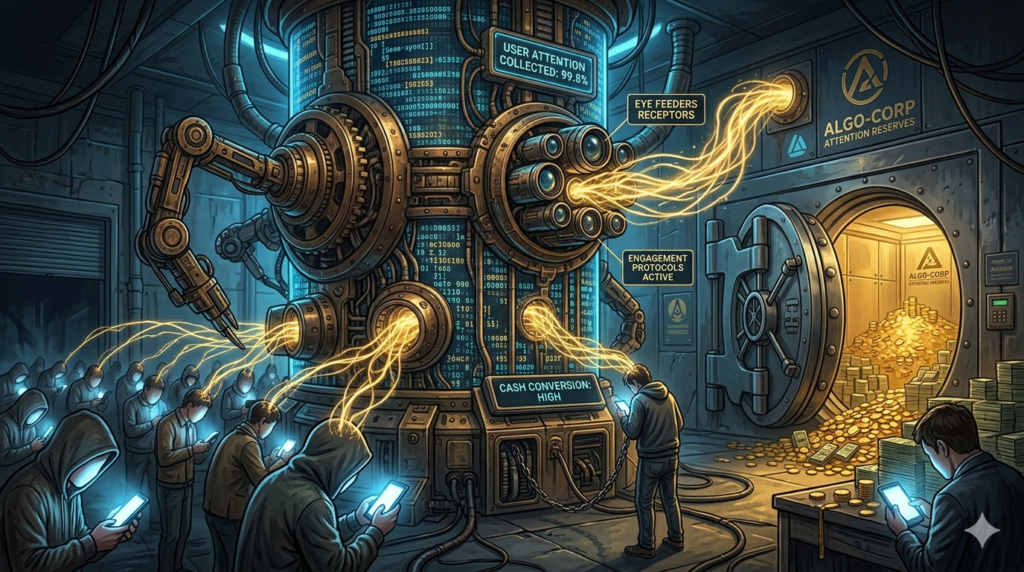
Here’s the simple version: platforms like TikTok, Instagram, YouTube, and X don’t sell you a product. They sell your attention to advertisers. The longer they keep you scrolling, watching, or clicking, the more money they make.
This isn’t a side effect of social media. It’s the core business model.
Nobel Prize-winning economist Herbert Simon laid the groundwork for this idea decades ago. He argued that information abundance creates attention scarcity. In other words: the more content there is, the harder it becomes to focus — and whoever controls your focus controls your behavior.
Fast-forward to 2026, and we’re living inside the most sophisticated attention-capture machine ever built. Every notification, every recommended video, every infinite scroll feature has been tested and optimized to keep you engaged — not informed, not productive, just engaged.
And while you’re engaged, you’re not building anything.
Why Focus Is Becoming More Valuable Than Money
Here’s something most financial advice won’t tell you: money is not the scarcest resource for most young entrepreneurs — focused time is.
Think about it. You can borrow money. You can earn more money. You can find investors, grants, or clients. But you cannot get back the three hours you spent doomscrolling last night when you were supposed to be building your email list. That is the real cost of living inside the attention economy without a plan.
In a world full of distraction, the person who can sit down and do deep, focused work for two to four hours a day has a massive advantage over everyone else. That’s not motivational fluff — it’s just economics. The attention economy has made deep focus so rare that supply and demand now heavily favors the person who can deliver it consistently.
Deep work is in short supply. Demand for it has never been higher. And the attention economy is the reason why.
A freelance copywriter who can block out the noise of the attention economy and focus for four hours to produce a high-converting sales page is more valuable than one who checks their phone every ten minutes and delivers mediocre work in twice the time. An affiliate marketer who spends ninety focused minutes creating content beats someone who “works” six distracted hours inside the attention economy and publishes nothing.
Focus is the multiplier on everything else you do. Without it, your skills don’t matter. Your strategy doesn’t matter. Your tools definitely don’t matter. The attention economy will always find a way to fill the gaps — unless you build walls around your most productive hours.
The Hidden Cost of Digital Distractions
Let’s talk about what distraction inside the attention economy is actually costing you — in real money.
Research from the University of California, Irvine, found that it takes an average of 23 minutes and 15 seconds to fully return to a task after being interrupted. So every time the attention economy pulls you away to check a notification, you’re not losing 30 seconds. You’re potentially losing half an hour of productive output.
Now multiply that by the number of times you check your phone per day. Studies put the average around 96 times for young adults. The attention economy is designed to make every one of those 96 checks feel urgent, necessary, and rewarding. Even if only half of those checks happen during work time, you’re hemorrhaging hours every single day.
For someone trying to grow an online income, those hours are everything.
Consider this: a beginner affiliate marketer needs to write content, build backlinks, analyze data, and learn new skills — all at once. Every hour the attention economy steals from you is an hour not spent doing any of those things. Over a year, that compounds into a serious gap between the person who protects their focus and the one who surrenders it to the attention economy without even realizing it.
The hidden cost of the attention economy goes far deeper than wasted time. It steals the compounding returns of consistent, focused work — and that is where real online income is built and lost.
How Social Media Algorithms Profit From Your Attention
Understanding how algorithms work is one of the most important things a digital entrepreneur can do — not just for content strategy, but for self-defense.
Social media algorithms are not neutral. They are optimized for engagement, and engagement is not the same as value. Content that triggers outrage, fear, or curiosity performs better than content that’s calm, nuanced, or constructive. That’s not an accident — it’s the result of billions of dollars in machine learning trained on human psychology.
Here’s what this means for you:
- The content you consume shapes your thinking — and a lot of what algorithms serve you is designed to keep you reactive, not strategic.
- The platforms want you comparing yourself to others — comparison drives engagement, and constant comparison kills the confidence you need to build something.
- Every minute you spend consuming is a minute you’re not creating — and in the creator economy, the gap between consumers and creators is the gap between broke and financially free.
This doesn’t mean you need to delete all your apps. It means you need to use them on your terms — as tools, not as environments you live inside.
Why Most Beginners Fail to Make Money Online
This is the part nobody wants to say out loud: most people who fail to build online income don’t fail because of strategy. They fail because of focus.
They jump between niches every few weeks because a new YouTube video told them there’s a better opportunity. They start three different businesses in one month and finish none of them. They spend hours watching tutorials about making money instead of actually making money.
This is called shiny object syndrome, and the attention economy is designed to feed it.
Every day, your feed will show you someone making $10,000 a month with dropshipping. Then someone else doing it with print-on-demand. Then crypto. Then faceless YouTube channels. Then AI automation. Every one of those videos is monetized — meaning someone profits every time you watch it, regardless of whether it helps you.
The business model of “make money online” content is to keep you learning, not earning.
The creators who actually build sustainable income are almost never the ones chasing the newest trend. They’re the ones who pick one model — whether that’s freelancing, affiliate marketing, digital products, or content creation — and stick with it long enough to see real results.
That takes focus. And focus requires protecting your attention.
7 Wealth-Building Habits That Protect Your Focus
These aren’t theory. These are practical habits that real digital entrepreneurs use to stay productive in a world designed to distract them.
1. Protect Your First 90 Minutes
Your brain is sharpest in the first 90 minutes after you wake up. Don’t give that window to your phone, your email, or social media. Use it for your most important revenue-generating task — writing, creating, building, or learning a high-value skill.
2. Work in Focused Blocks
The Pomodoro Technique is simple: 25 minutes of focused work, 5-minute break, repeat. Or use 90-minute deep work blocks if your task requires more sustained thinking. The key is structure. Unstructured work invites distraction.
3. Kill Notifications Entirely
Every notification is a context switch. Turn them all off — not on silent, off. Check your phone and email at scheduled times, not whenever the app decides to interrupt you. This single habit alone can add two to three productive hours to your day.
4. Use One Screen for Work
If you work on a laptop, keep your phone in another room. If you work on a desktop, use a second device for research only. The fewer tabs and apps open, the better. Multitasking is a myth — it’s just rapid task-switching, and it destroys the quality of every task you’re switching between.
5. Create a “Shutdown Ritual”
One of the biggest focus killers is carrying unfinished mental loops into your off time — and then carrying your off-time distractions back into your work time. End each work session by writing down exactly where you stopped and what you’ll do next. This closes the mental loop and makes it easier to start fresh tomorrow.
6. Audit Your Content Diet Weekly
Spend 10 minutes at the end of each week reviewing what you actually consumed — YouTube, podcasts, articles, social media. Ask yourself: did this content make me more productive, or did it just make me feel like I was being productive? Cut anything that’s consuming your time without producing results.
7. Schedule Social Media Like a Meeting
Instead of opening social media whenever you feel the impulse, schedule it like a business task. Two 20-minute windows per day is more than enough for most entrepreneurs. The rest of the time, it’s off.
How to Build an Attention Management System
Attention management is different from time management. Time management is about scheduling tasks. Attention management is about protecting the mental energy required to do those tasks well.
Here’s a simple system:
Step 1 — Identify your peak hours. Track your energy for one week. Note when you feel sharpest and when you tend to drift. Schedule your most important work in your peak hours, and save admin tasks, emails, and meetings for low-energy periods.
Step 2 — Design your environment. Your environment should make focus easy and distraction hard. This means:
- A dedicated workspace, even if it’s just a corner of a room
- Website blockers during work sessions (tools like Cold Turkey or Freedom)
- Headphones with background music or white noise to signal “work mode”
Step 3 — Set a single daily priority. Every morning, write down the ONE thing that, if completed, would make the day a success for your business. Not three things. One. Protect that task above everything else.
Step 4 — Track your focus, not just your output. Use a simple journal or app to log how many focused hours you actually worked each day. Most people are shocked to discover they’re getting one to two hours of real focused work despite “working” eight hours.
How AI Can Help You Reclaim Your Time
Here’s the irony: the same technology that powers algorithmic distraction can also help you fight it.
AI tools in 2026 are genuinely useful for digital entrepreneurs — not as shortcuts to skip learning, but as force multipliers for focused work.
For example:
Content creators working in the attention economy can use AI to outline articles, generate first drafts, and repurpose content across formats — cutting production time by 50% or more.
- Freelancers can automate repetitive admin tasks like proposal templates, invoice follow-ups, and client onboarding sequences — reclaiming hours lost to the attention economy grind.
- Affiliate marketers can use AI to research keywords, analyze competitor content, and generate meta descriptions — freeing up focus for higher-value strategy work in a distracted digital world.
The goal is not to let AI think for you. The goal is to use AI to fight back against the attention economy — eliminating low-value tasks that steal your focus so you can do the work only you can do.
Productivity in the attention economy isn’t about doing more. It’s about doing the right things, with full attention, every single day.
The Future Belongs to People Who Control Their Attention
Let’s be honest about where things are heading.
AI is automating more tasks. Content is becoming cheaper to produce. The barrier to entry for most online income models is dropping. That means competition is increasing — and in the attention economy, the differentiator will not be who has the best tools. It will be who can think most clearly, work most consistently, and stay most focused over time.
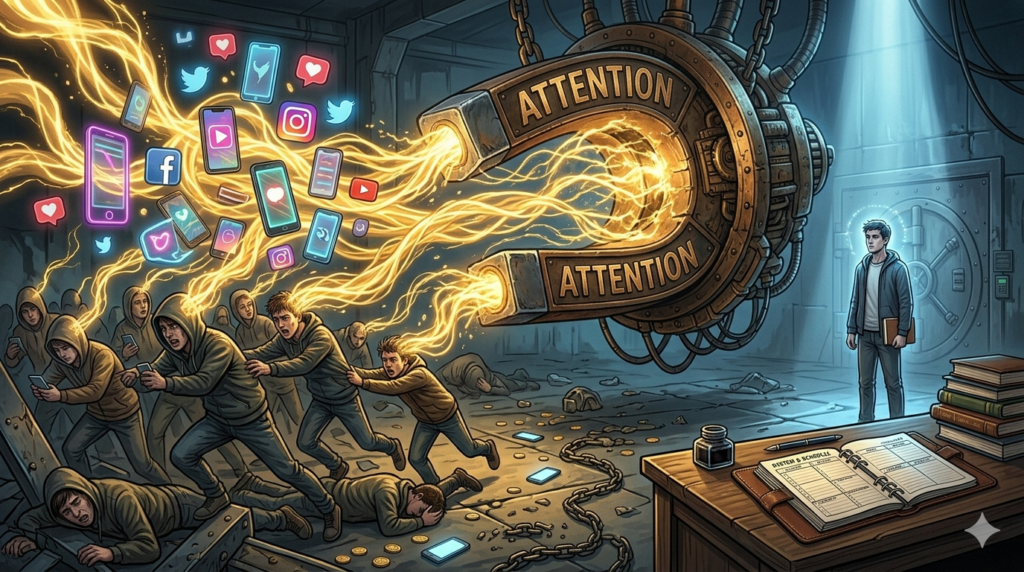
The attention economy will continue to evolve and grow more aggressive. Platforms will get better at capturing your focus. The content will get more immersive, more personalized, more addictive. The people who don’t build deliberate systems to protect their attention from the attention economy will find it increasingly difficult to build anything at all.
But here’s the good news: most people won’t do anything about it. They’ll keep losing to the attention economy — scrolling, jumping between ideas, watching other people build the life they want. That creates a real opportunity for anyone willing to be intentional.
In 2026, winning the attention economy battle is just as important as having the right business strategy. Financial freedom requires the mental discipline to execute consistently — and that discipline starts with protecting your focus every single day.
Conclusion
The attention economy is not going away. If anything, it will get more powerful, more personalized, and harder to resist with every passing year. Every platform, every app, and every algorithm is competing for the one thing you can never get back — your time and focus. And in 2026, that competition has never been more intense.
But now you know how the game works.
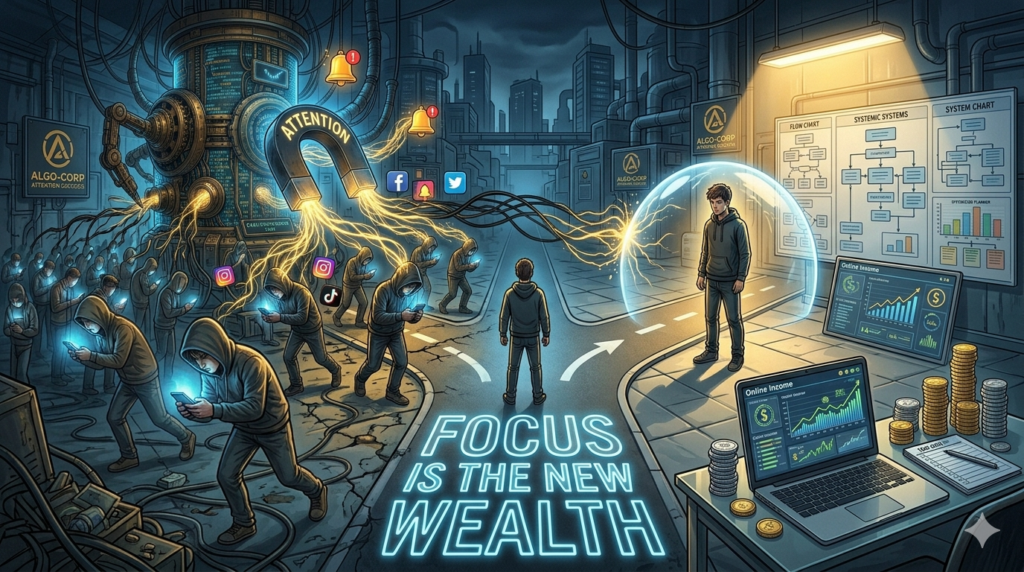
You know that the attention economy is not just a buzzword — it is a system designed to extract value from you while giving you nothing in return. You know that focus is the new wealth. You know that digital distractions are not harmless habits — they are expensive ones that quietly drain your income potential every single day.
The people building real online income are not the ones with the best ideas or the most followers. They are the ones who protect their attention long enough to execute consistently. A focused creator beats a distracted genius every single time. That is the core truth of surviving and winning in the modern attention economy.
The 7 habits in this article are not complicated. They don’t require expensive tools, a perfect morning routine, or quitting social media forever. They just require a decision — a decision to stop being a passive consumer inside the attention economy and start being an intentional builder who uses it on your own terms.
Start small. Protect your first 90 minutes tomorrow morning. Kill your notifications for one full day and see how much more you get done. Pick one online income model — affiliate marketing, freelancing, digital products, content creation — and commit to it for 90 days without jumping to something new. See what happens when you actually focus.
The attention economy profits from your confusion, your comparison, and your lack of direction. The moment you get clear, get focused, and get consistent — you stop being a consumer of someone else’s wealth and start building your own.
The gap between where you are and where you want to be financially is not a strategy gap. It is not a talent gap. It is an attention gap.
Close it — starting today.
🎯 Want weekly strategies to beat the attention economy and grow your online income? Subscribe to the LaunchWealthy newsletter and get actionable tips on digital business, wealth habits, and attention management delivered straight to your inbox. No fluff. No noise. Just what works.
Key Takeaways
- The attention economy is a system where your focus is bought and sold by tech platforms
- Focus has become a competitive advantage in a world optimized for distraction
- Every distraction costs you far more than the time it takes — interruptions destroy deep work
- Social media algorithms are engineered to maximize engagement, not to support your goals
- Most beginners fail online not because of bad strategy, but because of scattered focus
- 7 habits — protecting morning hours, focused work blocks, killing notifications, single-screen work, shutdown rituals, content audits, and scheduled social media — can transform your productivity
- Attention management is the skill of protecting your mental energy, not just scheduling your time
- AI tools can eliminate low-value tasks and free up time for focused, high-impact work
- The people who build wealth in the digital economy will be those who control their attention