Every few months, the headlines return like clockwork. “The Social Security Running Out of Money by 2033.” “The Social Security Benefits Could Be Cut by 20%.” “Congress Still Hasn’t Fixed The Social Security Problem.” The arguments get heated. Politicians point fingers. Retirees worry. Workers feel helpless.
But here’s what most people miss when they get caught up in The Social Security debate: the real crisis isn’t political—it’s personal.
The Social Security conversation dominates news cycles, but it’s missing the actual wake-up call that should matter to you. Whether The Social Security payments get adjusted, delayed, or reorganized, there’s a fundamental lesson buried beneath all The Social Security policy talk. And that lesson could change how you approach your financial future starting today.
The Real Problem Nobody’s Talking About
Let’s cut through the noise. Yes, The Social Security faces real challenges. The program’s trust fund is projected to deplete in about a decade. Yes, future benefit levels under The Social Security will likely look different than what today’s retirees receive. Yes, the politics around The Social Security and potential fixes is messy.
But if you’re under 50—or even if you’re not—here’s what should actually keep you up at night:
You’ve been taught to bet your entire retirement on a single income source you can’t control.
The Social Security system has been the foundation of retirement planning for generations. But think about it. For the last century, the cultural and financial narrative has been straightforward: work for 40 years, pay into The Social Security, retire at 65, and live off The Social Security plus maybe a pension. That was the deal. That was the promise under The Social Security.
The problem? That promise was built on very different economic conditions. Back then, there were many more workers per retiree. Healthcare costs were lower. People didn’t live as long after retirement. Families had more children. The system was designed for a specific era—and we don’t live in that era anymore.
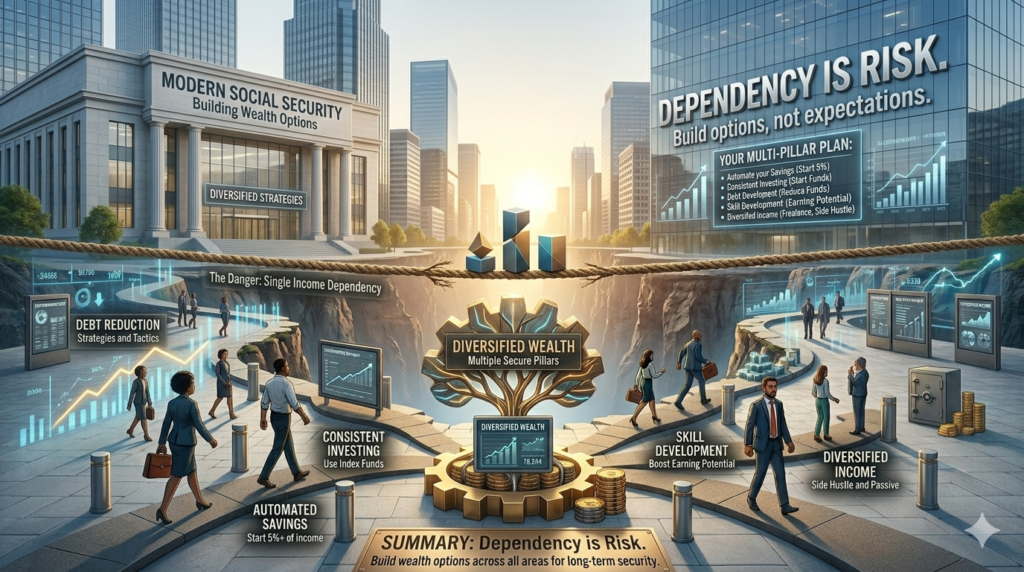
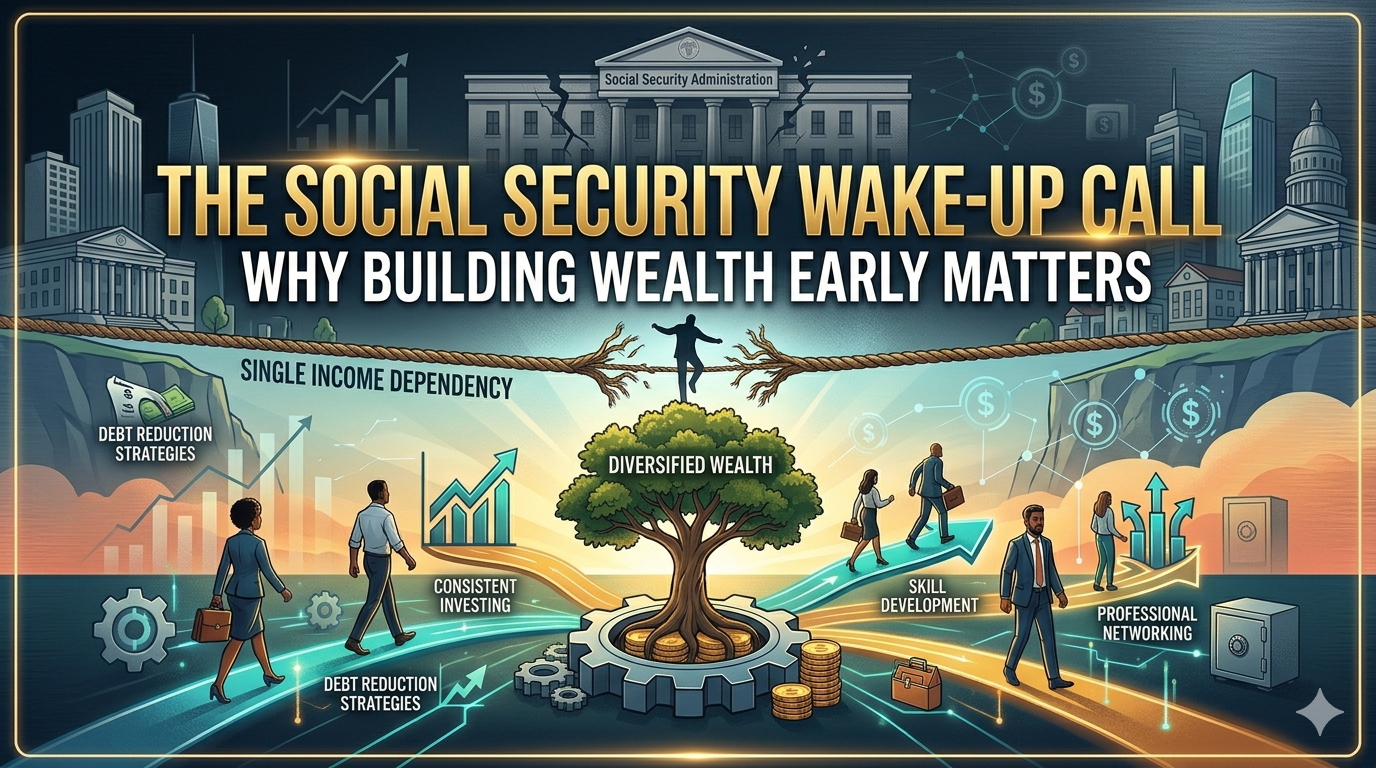
But more importantly, the real issue isn’t what happens to The Social Security in 2033 or 2050. The real issue is something much more fundamental: dependency is risk.
When you depend on a single income source—whether that’s The Social Security, an employer pension, or even a job—you’re exposed to forces completely outside your control. Policy changes, economic downturns, health issues, industry disruption, corporate restructuring. The list goes on. The Social Security has survived recessions, wars, and political upheaval for nearly 90 years. But that doesn’t make The Social Security risk-free. And it certainly doesn’t make The Social Security enough to live on alone.
The people sleeping well at night in today’s uncertain economic climate aren’t the ones obsessing over The Social Security policy changes. They’re the ones who realized decades ago that depending on a single income source—like relying only on The Social Security—was never the real plan. They built multiple income streams. They developed valuable skills. They invested. They saved. They created options.
The Lesson Hidden in the Numbers
Let’s look at what the numbers actually tell us.
The average The Social Security benefit in 2024 is around $1,900 per month. That’s roughly $22,800 per year in The Social Security income. For some retirees, that’s a meaningful supplement to pension income or investments. For others, it’s their primary income source.
Now, what does $22,800 actually buy you in retirement? Depending on where you live and your lifestyle, it might cover basic living expenses. It might not. Run the numbers for your situation—your home costs, healthcare, inflation, the activities you want to enjoy.
Here’s the uncomfortable truth: The Social Security was never designed to be your entire retirement income. The architects of The Social Security intended it as a safety net—a foundation you’d build on with savings, investments, and other income sources. But the reality is most people rely on The Social Security as if it were a complete retirement plan.
But millions of Americans are approaching or have reached retirement with The Social Security as their primary income. That’s not because the system failed them. It’s because they never built the other pieces of the financial foundation beyond what The Social Security could provide.
The Social Security “crisis” isn’t really a crisis about The Social Security itself. Rather, the real Social Security crisis is a wake-up call about financial preparedness. It’s a reminder that waiting for The Social Security or any government program to fund your future is a strategy that depends entirely on circumstances outside your control. The Social Security was never meant to be your only retirement income source.
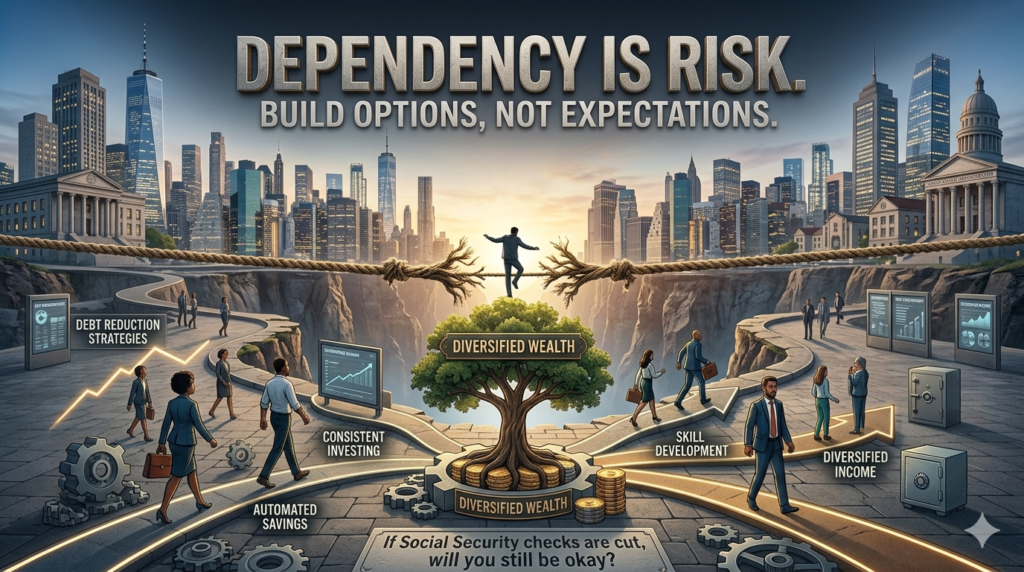
The question isn’t “Will The Social Security still be there?” The question is “Will you still be okay if The Social Security looks different than you expected?” The answer depends entirely on whether you’ve built a financial foundation beyond what The Social Security can provide.
The Wealth-Building Foundation: Habits That Matter Now
If you’re in your 20s, 30s, or 40s, you have something invaluable that people nearing retirement don’t: time. And time is the most powerful wealth-building tool that exists.
The people who aren’t stressed about The Social Security aren’t stressed because they’re confident in the government. They’re not stressed because they have a pension. They’re not stressed because they got lucky. They’re stressed-free because they built wealth using principles that don’t depend on The Social Security or any single system working perfectly.
Here are the habits that actually move the needle:
1. Automate Your Savings
The wealthiest people you know didn’t become wealthy by making conscious decisions to save money every single month. They automated it. Their paycheck hits their account, a percentage moves automatically to savings before they ever see it, and they live on what’s left.
This isn’t about willpower or sacrifice. It’s about systems. When you make saving automatic, you remove emotion from the equation. You don’t “try” to save. You save by default.
Start small if you need to. 5% of your paycheck. 10%. 15%. The percentage matters less than the consistency. Automate it, increase it by 1% every year, and in 10 years you’ll have built a substantial buffer without feeling like you “sacrificed.”
2. Diversify Your Income
The second principle that separates people who sleep well at night from those who don’t is this: they don’t depend on a single paycheck.
This doesn’t necessarily mean quitting your job and going freelance. It means building skills and income streams that exist outside your primary employment—income sources that are not dependent on The Social Security or government programs.
Maybe it’s a side business. Maybe it’s freelance work in your field. Maybe it’s a skill you’ve monetized. Maybe it’s rental income. Maybe it’s content creation. The specific vehicle matters less than the principle: you’re building income that doesn’t disappear if your employer restructures, if your industry changes, or if you choose to leave.
The difference between someone with one income stream and someone with three income streams isn’t just financial—it’s psychological. With multiple income sources, a setback in one area doesn’t feel like a crisis. It feels like an adjustment.
3. Invest Consistently
Investing isn’t for rich people. Investing is how regular people become wealthy.
If you’re not investing—whether through a 401(k), IRA, or taxable brokerage account—you’re leaving the most powerful wealth-building tool on the table. Compound interest is real. A dollar invested at 25 has 40 years to grow. A dollar invested at 45 has 20 years. The difference is staggering.
You don’t need to be a stock picker. You don’t need to beat the market. You don’t need to understand every investment vehicle. You need to invest in a diversified portfolio—index funds are fine—and do it consistently for decades.
The magic isn’t in the investment. The magic is in the consistency and the time.
4. Build Skills With Market Value
The most overlooked form of wealth building is skill development. Your earning potential is a form of wealth. When you develop skills that are valuable in the marketplace—whether that’s a technical skill, a creative skill, or a business skill—you increase your lifetime earning potential.
This matters for two reasons. First, higher income accelerates all the other wealth-building strategies. Second, valuable skills make you less vulnerable to economic disruption. If your field changes, you can adapt. If your industry shrinks, you can pivot.
Commit to continuous learning. Read in your field. Take courses. Develop expertise. The investment of time and money in your own skill development will pay dividends across your entire lifetime.
Building Digital Income: The Modern Wealth Accelerator

Here’s where the modern economy creates an opportunity that previous generations didn’t have: the ability to build income that scales beyond your hourly labor.
Your job trades your time for money. There’s only so many hours in a week. But the internet creates the possibility of building income that isn’t limited by your time.
This could look like many things:
Content Creation: If you have expertise, a perspective, or knowledge that people value, you can build an audience around it. A blog, YouTube channel, podcast, or newsletter. The income might come from advertising, sponsorships, or products you sell to that audience. But the key is: you create once and sell many times.
Digital Products: An online course, template, checklist, or software tool. You invest time upfront creating something valuable, then sell it repeatedly with minimal additional effort. This isn’t get-rich-quick. But it is get-wealthy-gradually if you do it consistently.
Affiliate Income: Recommending products or services you genuinely use and getting paid when someone purchases through your link. This requires trust and audience, but it’s a scalable form of income.
Professional Services: Consulting, coaching, freelance work in your field. This still trades time for money, but it often pays significantly more per hour than traditional employment and offers flexibility.
Community Building: Creating a membership, community, or subscription where people pay for ongoing access to your knowledge, community, or exclusive content.
None of these are “get rich quick.” All of them require real work, consistency, and patience. But here’s the key: they create income that doesn’t depend on Social Security policy, employer decisions, or economic downturns in your specific industry.
The person building a loyal audience of 10,000 people who value their perspective has created something with real financial value. The person who created a course that generates $500 a month in passive income has created something that will be there in retirement. These aren’t lottery tickets. They’re strategic wealth-building.
The Mindset Shift That Changes Everything
Here’s the mental shift that separates people who are financially secure from those who are perpetually anxious:
Instead of asking “Will the system take care of me?” they ask “How do I take care of myself?”
It’s not cynicism about institutions. It’s maturity about personal responsibility.
The Social Security debate highlights something important: you cannot fully control what happens to government programs, employer benefits, or economic systems. What you can control is your own financial preparedness.
You can control whether you save automatically or hope to save someday. You can control whether you build skills that increase your earning potential. You can control whether you build multiple income streams or depend on one. You can control whether you invest in your future or spend everything you make.
When you make these choices—when you take responsibility for your own financial foundation—the Social Security conversation changes. It’s no longer stressful. Benefits might be cut by 10% or 20% in the future? That’s manageable when Social Security is a supplement to a diversified financial life, not your entire retirement plan.
Starting Today: Your Action Plan
You don’t need to overhaul your entire financial life this week. But you can start building a more secure future with some immediate actions:
This Week: Automate 5% of your paycheck to a savings account. If it’s already automated, increase it by 1%.
This Month: Have an honest conversation with yourself about your current income streams. How many are there? How dependent are you on a single job? What’s one skill you could develop that would make you more valuable?
This Quarter: Open an investment account if you don’t have one. Invest $500. Then set it to invest $100 automatically every month.
This Year: Build one additional income stream. It doesn’t need to make thousands of dollars. It needs to exist.
The Real Security Isn’t Political
The people who feel secure about their future aren’t secure because they trust politicians. They’re not secure because they believe Social Security will never change. They’re secure because they’ve built a financial foundation that doesn’t depend on any single source of income being perfect.
The Social Security conversation is important. Policy matters. But the real wake-up call isn’t about politics. It’s about dependency.
When you build wealth early—through saving, investing, skill development, and diversified income—you don’t just create financial security. You create freedom. Freedom from anxiety about policy changes. Freedom from desperation if your job situation changes. Freedom to make choices based on what you want, not on what you have to do.
The good news? You don’t need to be rich to start. You need to be intentional. You need to be consistent. You need to understand that the responsibility for your future is yours, and that’s actually empowering.
Your future financial security isn’t guaranteed by any system. And that’s not a crisis—it’s an opportunity. Because it means your financial security is something you can build, starting today.