
Cryptocurrency has gone from a niche experiment to a trillion-dollar asset class that shows up in headlines, group chats, and investment apps everywhere. If you’re between 18 and 35, chances are you’ve felt the pull. Maybe a friend made money on Bitcoin. Maybe an influencer swears Ethereum is “the future.” Maybe you’re just tired of watching cash lose value while everyone else seems to be building something.
That pull creates a real question: does crypto actually belong in a serious cryptocurrency wealth strategy, or is it just noise dressed up as opportunity?
Here’s the honest answer: it depends. Not on hype, not on fear, but on your goals, your risk tolerance, and how crypto fits into a broader plan. Too many people treat crypto as a lottery ticket instead of an investment decision. That’s where the real danger lives — not necessarily in the asset itself, but in how people approach it.
Building a genuine cryptocurrency wealth strategy means stepping back from the noise and asking a more useful question: does this asset actually serve my long-term financial goals, or am I just reacting to what everyone else is doing? That distinction separates investors who build lasting wealth from those who chase short-term excitement and end up disappointed. A thoughtful cryptocurrency wealth strategy isn’t about predicting the next big price move — it’s about understanding how a volatile, relatively new asset class fits into a plan you can stick with for years, not weeks.
This article breaks down what cryptocurrency actually is, why it attracts so many investors, the risks you need to understand before you put in a single dollar, and how it compares to traditional wealth-building tools like stocks, index funds, and real estate. By the end, you’ll have a practical framework for deciding whether — and how — crypto fits into your own cryptocurrency wealth strategy, along with the questions worth asking before you invest a single dollar.
What Is Cryptocurrency?
Cryptocurrency is a form of digital money that exists only electronically. Unlike the dollars in your bank account, most cryptocurrencies aren’t issued or controlled by a government or central bank. Instead, they run on a technology called blockchain — a shared, public ledger that records every transaction across a network of computers.
Bitcoin, launched in 2009, was the first cryptocurrency. It was created partly as a response to the 2008 financial crisis, when trust in traditional banks and financial institutions took a serious hit. The idea was simple but radical: what if money could exist without a middleman?
Since then, thousands of cryptocurrencies have emerged, each with different purposes. Ethereum, for example, isn’t just digital money — it’s a platform that allows developers to build applications directly on its blockchain, from lending platforms to digital art marketplaces.
The core difference between cryptocurrency and traditional money comes down to control and structure. Traditional currency is centralized: banks and governments manage supply, transactions, and security. Cryptocurrency is decentralized: no single entity controls it, and transactions are verified by a distributed network instead of a bank.
This distinction matters because it shapes both the appeal and the risk of crypto investing — and it’s the first thing to understand before deciding whether digital assets deserve a place in your cryptocurrency wealth strategy.
Why Cryptocurrency Attracts Investors
It’s worth understanding why crypto has pulled in so much attention and capital, especially from younger investors building their first portfolios.
Growth potential. Early investors in Bitcoin and Ethereum saw returns that far outpaced traditional markets. That history — even though it doesn’t guarantee future results — is a major draw for people chasing financial freedom faster than a traditional 9-to-5 savings path allows.
Innovation. Blockchain technology isn’t just about currency. It’s being explored for supply chain tracking, digital identity, healthcare records, and more. Investors aren’t just buying a coin; some are betting on the underlying technology reshaping entire industries.
Accessibility. You don’t need a broker, a minimum balance, or banking hours. Anyone with a smartphone and internet access can buy, sell, or hold cryptocurrency. For young people, freelancers, and digital entrepreneurs without easy access to traditional financial infrastructure, that accessibility is genuinely significant.
Decentralization. For investors who value financial independence from banks and governments, decentralization isn’t just a technical feature — it’s a philosophy. It appeals to people who want more direct control over their money.
Global adoption. More companies, payment platforms, and even some governments are integrating cryptocurrency into everyday financial systems. That growing legitimacy makes it harder to dismiss as a passing trend, even for skeptics.
These factors explain the appeal of building a cryptocurrency wealth strategy in the first place. But appeal isn’t the same as suitability — and that’s where risk enters the conversation.
The Risks Every Investor Should Understand

No conversation about a cryptocurrency wealth strategy is complete without an honest look at what can go wrong. This isn’t about fear — it’s about clarity.
Volatility. Crypto prices can swing dramatically within hours, not just months. A double-digit percentage drop in a single day isn’t unusual. This kind of volatility can test even experienced investors emotionally and financially, especially those who haven’t mentally prepared for how sharp the swings can be.
Regulation. Governments around the world are still figuring out how to regulate cryptocurrency. New laws, tax rules, or restrictions can shift the market quickly, and regulatory uncertainty adds a layer of risk that traditional assets like stocks generally don’t carry to the same degree. A policy change in one country can ripple through global crypto markets within hours, something long-term investors need to factor into any cryptocurrency wealth strategy built around this asset class.
Security risks. Unlike a bank account, cryptocurrency held in a digital wallet can be permanently lost if you forget a password, lose access to your wallet, or fall victim to a hack. There’s often no customer service line to call and no institution to make you whole. This is a meaningful departure from traditional banking, where deposit insurance and fraud protections offer a safety net that most of the crypto space simply doesn’t have.
Scams and fraud. The crypto space has attracted its share of bad actors — fake projects, pump-and-dump schemes, and fraudulent “investment opportunities” promising guaranteed returns. If something promises risk-free profits, that’s a red flag, not a green light. Beginners are especially vulnerable here, since the fast-moving, jargon-heavy nature of crypto can make it hard to distinguish a legitimate project from an elaborate scheme designed to separate people from their money.
Emotional investing. Because prices move so fast, crypto can trigger impulsive decisions — buying out of FOMO (fear of missing out) or selling out of panic. Emotional decision-making is one of the biggest wealth destroyers in any asset class, but it’s amplified in crypto’s volatility. Investors who check prices constantly are especially prone to this, since frequent exposure to price swings tends to invite frequent, often poorly-timed reactions.
Market uncertainty. Cryptocurrency doesn’t have the multi-decade track record that stocks or real estate have. There’s simply less historical data to predict long-term behavior, which makes risk management especially important.
None of this means crypto is inherently bad. It means it demands respect, research, and a clear-eyed understanding of what you’re getting into before it earns a place in your portfolio.
Cryptocurrency vs Traditional Investments
To evaluate where crypto fits, it helps to compare it against the tools most people already use for wealth building.
Stocks. Stocks represent ownership in a company and are backed by real business operations, earnings, and assets. They’re generally less volatile than crypto and have over a century of market history. Liquidity is high, and long-term stability is well documented, though returns are typically more modest than crypto’s historical highs.
Index funds. Index funds spread your money across many companies, reducing risk through built-in diversification. They’re a cornerstone of passive investing and long-term wealth building because they require little active management and have historically delivered steady growth over decades.
Bonds. Bonds are essentially loans to governments or corporations that pay interest over time. They’re lower-risk and lower-return, often used to balance out riskier assets like stocks or crypto within a portfolio.
Real estate. Real estate offers potential appreciation, rental income, and tangible ownership. It’s less liquid than crypto or stocks — you can’t sell a house in minutes — but it has historically been a reliable long-term wealth-building vehicle.
Cash savings. Cash is the most liquid and stable option, but it offers little to no growth and can actually lose purchasing power over time due to inflation.
When you line these up side by side, cryptocurrency stands out for its high growth potential and accessibility, but it also carries meaningfully higher volatility and less historical stability than any of these traditional options. That’s not a reason to avoid it entirely — it’s a reason to treat it as one piece of a diversified plan, not the whole plan.
Should Cryptocurrency Be Part of Your Wealth-Building Strategy?
This is the real question, and the honest answer is: it depends on you.
A thoughtful cryptocurrency wealth strategy starts with a few key considerations:
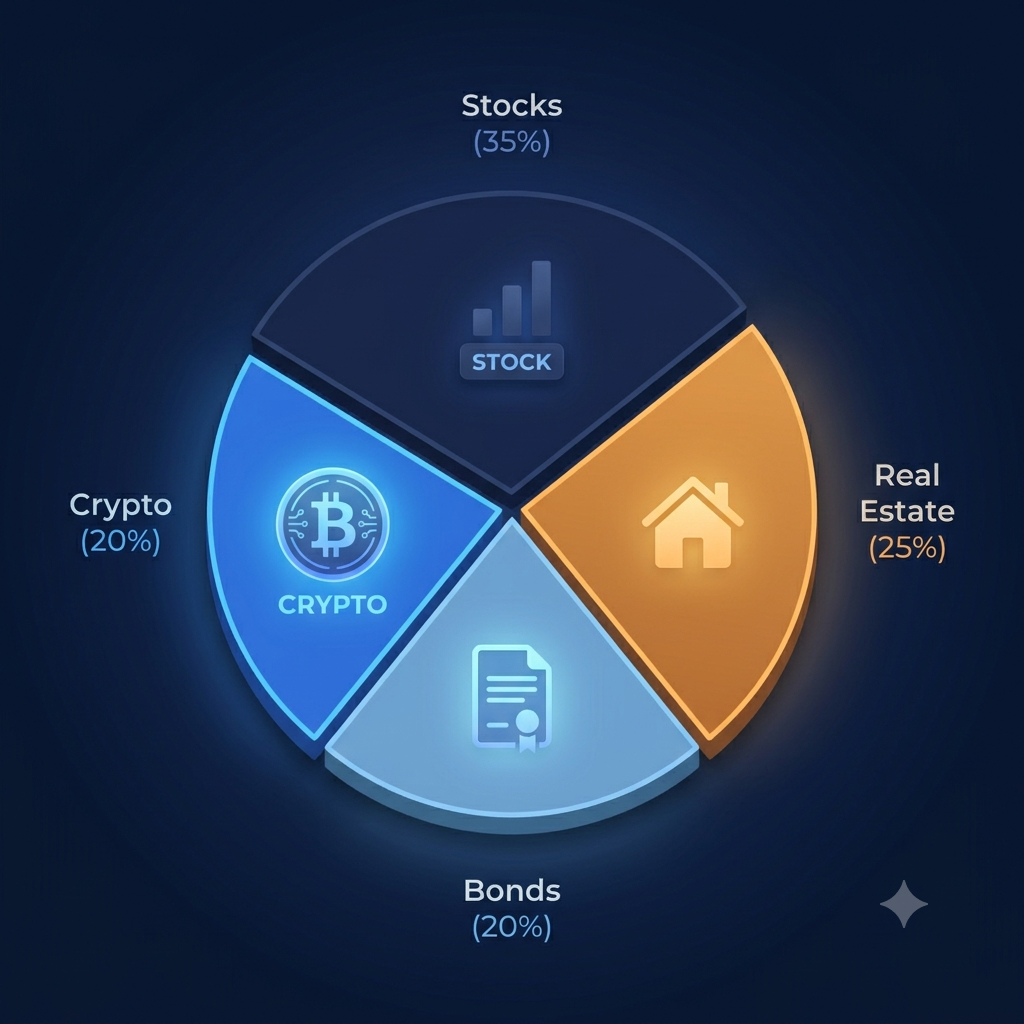
Diversification. Wealth-building fundamentals haven’t changed just because a new asset class exists. Spreading investments across different types of assets — stocks, real estate, bonds, and potentially crypto — helps manage risk. Putting all your money into any single asset, including crypto, undermines that principle.
Risk tolerance. Some people can watch a 30% drop in their portfolio and stay calm. Others lose sleep over a 5% dip. Be honest with yourself about how much volatility you can handle without making panicked decisions.
Financial goals. Are you investing for retirement decades away, or a goal five years out? Crypto’s volatility may be easier to stomach with a longer time horizon, since there’s more time to ride out downturns.
Time horizon. The longer your investment timeline, the more room you have to absorb short-term swings. Someone investing for a goal next year faces very different risk than someone investing for a goal 20 years out.
Emergency savings. Before investing in anything volatile, most financial planning approaches emphasize having a cash emergency fund in place first — typically enough to cover several months of expenses. Investing money you might need on short notice, especially in a volatile asset, creates unnecessary financial stress.
The exact role crypto plays — if any — should depend entirely on your personal circumstances, not on what a friend or influencer is doing. Crypto can complement a diversified investment strategy, but it shouldn’t replace the fundamentals: consistent saving, diversified investing, and a long-term mindset.
Common Mistakes Beginners Make
Watching others navigate crypto — successfully and unsuccessfully — reveals a pattern of avoidable errors:
- Investing without research. Buying an asset because it’s trending, without understanding what it does or why it has value, is speculation, not investing.
- Following influencers blindly. Social media personalities aren’t fiduciaries. Their incentives (views, engagement, sometimes paid promotions) don’t always align with your financial wellbeing.
- Chasing hype. Jumping in after a huge price run-up, driven by excitement rather than analysis, often means buying at the top.
- Panic selling. Selling during a downturn out of fear locks in losses and abandons any long-term thesis you might have had.
- Ignoring security. Failing to use secure wallets, strong passwords, and two-factor authentication leaves your assets vulnerable to theft.
- Investing money they cannot afford to lose. This is the most important rule in any high-volatility asset class. If losing the investment would derail your rent, bills, or emergency fund, it’s too much.
Avoiding these mistakes won’t guarantee profit, but it dramatically reduces unnecessary risk.
A Practical Framework for Evaluating Cryptocurrency
Before investing in cryptocurrency — or adjusting your existing exposure — run through these questions honestly:
- Do I understand what I’m buying? Can you explain, in simple terms, what this cryptocurrency does and why it might have long-term value?
- Does this investment fit my long-term plan? Is this decision aligned with your broader financial goals, or is it a reaction to market noise?
- Can I tolerate significant price swings? Could you watch this investment drop 40% without panic-selling or losing sleep?
- Have I diversified my portfolio? Is crypto one part of a broader strategy, or is it the majority of your investments?
- Am I investing based on facts instead of emotions? Is this decision driven by research, or by fear of missing out?
If you can answer these honestly and the answers align with a calm, informed “yes,” crypto may have a reasonable place in your cryptocurrency wealth strategy. If not, it may be worth revisiting your approach before investing further.

Building Wealth Beyond Cryptocurrency
It’s worth remembering that no single asset — crypto included — is a shortcut to financial freedom. Lasting wealth is built through habits and decisions that compound over time:
Saving consistently. Wealth starts with the discipline to save before you spend, regardless of what the markets are doing.
Building digital assets. Beyond crypto, digital products, content platforms, and online businesses can create ongoing income streams that don’t depend on market volatility.
Investing in skills. Your ability to earn is often your greatest asset. Continuously developing valuable skills tends to pay dividends far beyond any single investment.
Diversification. Spreading risk across multiple asset types — not just multiple cryptocurrencies — protects your overall financial picture.
Long-term discipline. The investors who build real wealth are rarely the ones chasing the next big trend. They’re the ones who stick to a plan through market ups and downs.
Cryptocurrency can be one tool in this bigger picture, but it works best as a complement to these fundamentals, not a replacement for them.
Conclusion
Cryptocurrency isn’t inherently good or bad for your wealth-building journey — it’s a tool, and like any tool, its value depends on how it’s used. The investors who benefit most from crypto tend to be the ones who approach it with the same discipline, research, and patience they’d apply to any other investment.
A real cryptocurrency wealth strategy isn’t about chasing the next big trend or avoiding crypto out of fear. It’s about understanding your goals, knowing your risk tolerance, and making decisions based on facts rather than emotions. The strongest cryptocurrency wealth strategy is one you can actually stick with through both bull markets and downturns, not one built around a single lucky trade.
Wealth isn’t built overnight, and it isn’t built by any single asset — crypto included. It’s built through consistent habits, diversified decisions, and a long-term mindset that outlasts market noise. Whether or not crypto plays a role in your plan, the principles behind a sound cryptocurrency wealth strategy stay the same: research over hype, discipline over emotion, and a long-term view over short-term excitement.
Take a moment to review your own wealth-building strategy. Does it reflect a clear plan, or is it being pulled along by hype and headlines? Revisiting your cryptocurrency wealth strategy — or building one for the first time — might be the most valuable investment decision you make this year.
Key Takeaways
- Cryptocurrency is decentralized digital money built on blockchain technology, fundamentally different from traditional currency.
- Crypto attracts investors through growth potential, innovation, accessibility, decentralization, and global adoption.
- Major risks include volatility, regulatory uncertainty, security vulnerabilities, scams, and emotional investing.
- Compared to stocks, index funds, bonds, and real estate, crypto offers higher potential returns but significantly less stability and history.
- A sound cryptocurrency wealth strategy treats crypto as one piece of a diversified portfolio — not a replacement for foundational wealth-building habits.
- Avoid common mistakes like chasing hype, following influencers blindly, and investing money you can’t afford to lose.
- Use a simple framework — understanding, alignment, risk tolerance, diversification, and emotional discipline — before investing in any cryptocurrency wealth strategy.
- Ultimately, a strong cryptocurrency wealth strategy is measured by consistency and discipline, not by short-term gains or losses.