Most people believe the fastest path to wealth is a higher salary. Work harder, get promoted, earn a bigger paycheck, and eventually the money problems disappear. It sounds logical. It’s also one of the most expensive myths in personal finance.
A raise feels good for a month. Then rent goes up, a new expense appears, and the extra income quietly vanishes into a lifestyle that grew to match it. Meanwhile, the people who actually build lasting wealth are playing a different game entirely. They’re not just earning income — they’re building things that keep producing value long after the work is done.
That’s the core idea behind the digital wealth blueprint: a practical shift from trading hours for a paycheck to owning digital assets that generate income independently of your time. This isn’t about luck, inheritance, or a lucky stock pick. It’s a learnable process, and this guide walks through exactly how it works — from understanding the mindset shift to building your own 12-month roadmap.
What Is a Digital Wealth Blueprint?
A digital wealth blueprint is a structured plan for turning your skills, time, and knowledge into digital assets — things like websites, products, or systems — that continue generating income after the initial work is done. It’s the practical framework that separates people who stay financially stuck from people who build long-term freedom.
Twenty years ago, building wealth outside of a job usually required capital. You needed money to buy real estate, start a storefront, or launch a franchise. Today, the barrier has mostly disappeared. A laptop, an internet connection, and consistent effort are often enough to start.
Four forces make this possible:
Digital assets. Unlike a car or a physical inventory, a digital asset — a course, an app, an article, a piece of software — doesn’t wear out. It can be sold or used again and again at almost no additional cost.
Scalability. A freelancer selling one hour of consulting can only sell 24 hours a day. A digital product, once built, can be sold to one customer or ten thousand without much more effort.
Ownership. A job pays you for showing up. An asset pays you for having built something of value, whether or not you show up today.
Leverage. The internet lets one person reach a global audience. A single well-written article or a single software tool can work for you continuously, reaching people you’ll never personally meet.
This is the foundation every asset owner builds on, and it’s the first mental shift required before any tactics matter.
Employee Mindset vs Asset Owner Mindset
The difference between staying financially stuck and building real freedom often comes down to how a person thinks about work, risk, and time. The table below breaks down the core differences.
| Factor | Employee Mindset | Asset Owner Mindset |
|---|---|---|
| Income | Fixed, tied to hours worked | Variable, tied to value created and owned |
| Risk | Feels safe short-term, risky long-term (single income source) | Feels risky short-term, safer long-term (diversified sources) |
| Freedom | Limited by employer’s schedule and rules | Determined by the owner’s own decisions |
| Time | Traded directly for money | Invested upfront to be paid back repeatedly |
| Scalability | Capped by hours in a day | Largely uncapped once the asset is built |
| Decision making | Made by someone else | Made by the individual |
| Long-term wealth | Slow, dependent on raises | Compounding, dependent on ownership |
Neither mindset is a moral failing — most people are raised to think like employees because school and culture rarely teach asset building. But recognizing the pattern is the first step to changing it. You don’t need to quit your job to start thinking like an asset owner. You need to start building alongside it.
Why Salary Alone Rarely Creates Wealth
A steady paycheck feels like progress, but several forces work quietly against it — which is exactly why a digital wealth blueprint treats salary as a starting point, not a destination.
Lifestyle inflation. As income rises, spending tends to rise with it. A bigger apartment, a nicer car, more takeout — each one feels justified in isolation, but together they erase the extra income before it can be redirected into the kind of digital wealth blueprint assets that actually compound.
Taxes. Salary income is usually taxed at the highest possible rate, deducted before the money even reaches a bank account. Asset-based income, including the business and investment income at the core of most digital wealth blueprint strategies, often comes with more favorable tax treatment.
Inflation. Prices rise every year. If a salary doesn’t rise faster than inflation, real purchasing power actually shrinks, even while the number on the paycheck looks bigger — another reason a digital wealth blueprint focuses on owned assets rather than a fixed wage.
Limited hours. There are only so many hours in a day, and a job caps how many of them can be sold. No amount of hustle changes that math, which is precisely the ceiling a digital wealth blueprint is designed to remove.
Income ceiling. Most roles have a defined pay band. Even strong performers eventually hit a ceiling that no longer moves regardless of effort.
Dependence on one employer. A salary depends entirely on one company’s decisions. A layoff, a restructuring, or a shift in the market can end that income overnight, with little warning.
None of this means quitting a job is the answer. It means a job alone is rarely enough to build lasting wealth — it needs to be paired with the kind of owned, asset-based income a digital wealth blueprint is built around, so income doesn’t disappear the moment an employer changes course.
What Digital Assets Actually Build Wealth
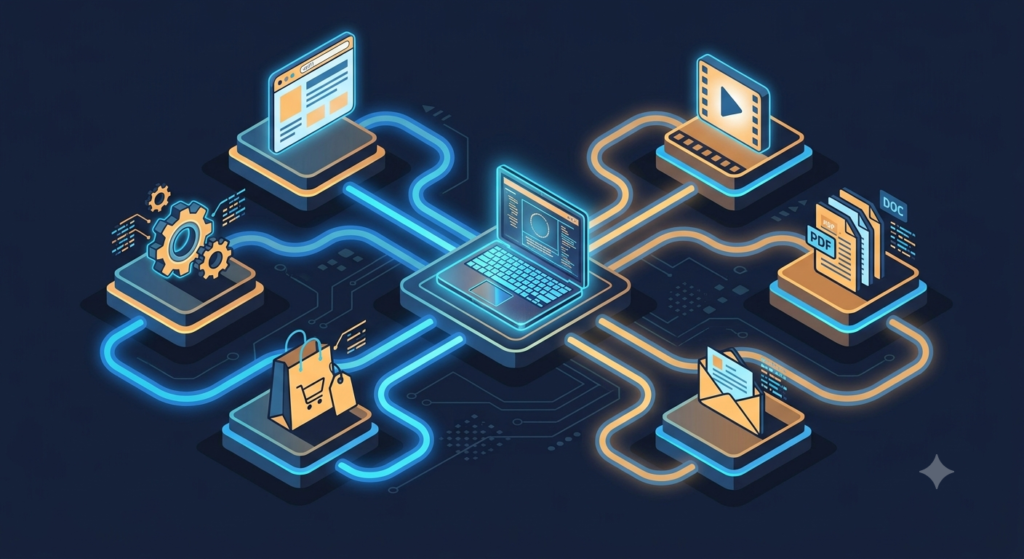
Not every digital asset works the same way. Some take longer to build but pay off for years. Others can be launched quickly but need constant attention. Understanding the differences helps you pick the right starting point for your own digital wealth blueprint.
Websites and blogs. A content website built around a specific topic can earn through advertising, affiliate links, and product sales. It takes months to gain traction through search engines, but a well-ranked article can keep earning for years with minimal upkeep — one of the most beginner-friendly assets in any digital wealth blueprint.
YouTube channels. Video content can generate ad revenue, sponsorships, and audience trust that translates into product sales. The startup difficulty is moderate — consistency and production quality matter more than expensive equipment.
Digital products. Templates, spreadsheets, guides, and printables solve a specific problem for a specific audience. They’re relatively fast to build and can be sold repeatedly with no extra production cost per sale, making them a popular first asset in a digital wealth blueprint.
Online courses. A course packages expertise into a structured learning experience. It takes more upfront work than a simple digital product, but it can command a higher price and build long-term authority.
Software and apps. Software is harder to build without technical skill, but it tends to scale the best. A useful tool can generate recurring subscription income for years.
Email newsletters. A newsletter builds a direct relationship with an audience that isn’t controlled by a social platform’s algorithm. It monetizes through sponsorships, product promotion, and paid subscriptions.
Communities. Paid communities — around a skill, hobby, or profession — generate recurring income in exchange for ongoing access, support, and connection.
Templates. Design, business, and productivity templates solve a narrow problem quickly. They’re one of the easiest digital assets for a beginner to launch as the first step of a digital wealth blueprint.
Books and ebooks. Self-published books build authority and can generate passive royalty income long after the writing is finished.
Affiliate websites. These earn commission by recommending products or services. They rely heavily on trust and useful content, and search visibility takes patience to build.
Automation systems. Tools and workflows that save businesses time — from scripts to no-code systems — can be sold as one-time setups or ongoing services.
A quick way to compare these options is by looking at three factors: how hard they are to start, how quickly they can generate income, and how far they can scale within a broader digital wealth blueprint.
Fast to start, slower to scale: templates, digital products, and freelance-adjacent offers. These can bring in a first sale within weeks, but growth usually requires building several products or expanding into a wider catalog.
Slower to start, built for scale: websites, YouTube channels, and email newsletters. These take months of consistent publishing before they gain meaningful traction, but once they do, they tend to keep growing with less added effort per unit of income.
Hardest to start, highest ceiling: software, apps, and paid communities. These require more upfront skill or coordination, but they often produce the most durable, recurring income once established.
There’s no single “correct” asset to start a digital wealth blueprint with. A writer with strong research skills might start with a content website. A designer might start with templates. Someone comfortable on camera might start with video. The right first step is the one that uses skills you already have, so the learning curve is shorter and the first version can go live sooner.
Every one of these can become part of a working digital wealth blueprint. The right starting point depends on existing skills, available time, and what kind of asset feels sustainable to build consistently. Many successful asset owners eventually combine two or three of these into a single digital wealth blueprint — a blog that feeds an email list, which then sells a digital product — rather than relying on just one.
The Four Stages of Digital Wealth

Every asset owner moves through the same general stages of a digital wealth blueprint, whether they realize it or not.
Stage 1: Learn. This is where most people either get stuck or move forward. Learning means studying a specific skill — writing, design, video, coding — enough to produce something useful, not necessarily becoming an expert first. A beginner might spend a few weeks learning the basics of SEO writing before publishing the first piece of their digital wealth blueprint.
Stage 2: Build. This is where the first real asset takes shape — the first article, the first product, the first video. It won’t be perfect, and it doesn’t need to be. The goal is a finished, usable version, not a flawless one.
Stage 3: Monetize. Once an asset exists and starts attracting attention, monetization comes next — ads, affiliate links, direct sales, or subscriptions. This stage is about testing what audience members are actually willing to pay for.
Stage 4: Scale. With a working, monetized asset, scaling means producing more of what works, reinvesting profits, and sometimes bringing in help. This is where a digital wealth blueprint starts to look like a real business instead of a side project.
Each stage builds on the one before it. Skipping straight to monetization without building something valuable first is one of the most common reasons beginners give up on their digital wealth blueprint early.
Common Mistakes That Keep People Stuck
Most people who fail to build digital wealth aren’t failing because of bad luck. They’re repeating a small set of avoidable mistakes.
- Waiting for perfection. Nothing gets published because it’s never “ready.” Progress requires publishing before it feels perfect.
- Buying too many courses. Learning becomes a substitute for doing. At some point, action has to replace research.
- Chasing trends. Jumping from idea to idea prevents any single asset from gaining traction.
- Not publishing consistently. Sporadic effort rarely builds the momentum that search engines and audiences reward.
- No consistency. A single burst of effort followed by months of silence resets progress instead of building on it.
- No long-term thinking. Expecting results in weeks when most digital assets take months to gain traction.
- Ignoring marketing. Building something valuable isn’t enough if no one knows it exists.
- Trying everything at once. Splitting focus across five platforms and asset types often means none of them get built properly.
Avoiding these mistakes is often more valuable than learning a new tactic. Consistency and focus outperform cleverness almost every time.
Your 12-Month Digital Wealth Blueprint
A full year, broken into quarters, gives enough time to move through all four stages without rushing.
Months 1–3: Foundation. Choose one type of digital asset that fits your skills and interests, and resist the urge to research every option first. Spend the first few weeks learning the core skill involved — writing, video, design, or basic tech — through free or low-cost resources rather than expensive courses. By the end of month one, aim to have published something, even if it’s rough. By month three, aim for a small but real body of work: a handful of articles, a few videos, or a first version of a product. The goal during this stage is momentum, not mastery.
Months 4–6: Consistency. Keep producing on a regular, predictable schedule — weekly is a reasonable target for most formats. This is where most people quit, because results are still small and the work can feel repetitive. Traffic, followers, or sales may barely move during this stretch. That’s normal. Consistent output during this period is what search engines, algorithms, and audiences reward later, often with a delay of several months between the effort and the visible result.
Months 7–9: Monetization. With a growing body of work behind you, start testing income methods — affiliate links, a small digital product, ad placements, sponsorships, or a simple paid offer. Introduce only one or two monetization methods at a time so it’s clear what’s actually working. Pay close attention to what your audience responds to, rather than assuming a method will work just because it worked for someone else.
Months 10–12: Optimization and Scale. Double down on what’s working. Improve your best-performing content or product rather than constantly starting new projects, and quietly retire what isn’t gaining traction. Start reinvesting early income into growth — better tools, outsourced help for repetitive tasks, or paid promotion where it clearly makes sense. By the end of the year, the goal isn’t necessarily full-time income. It’s a working system: a repeatable process for producing, publishing, and monetizing that can keep compounding into year two.
This roadmap isn’t rigid, and real progress rarely moves in a straight line. Some people move faster, some slower, and setbacks are part of the process. What matters most is following the underlying sequence — learn, build, monetize, scale — rather than skipping ahead or abandoning a stage before it has time to work.
Conclusion
Building real wealth rarely comes from a bigger paycheck alone. It comes from a shift in thinking — from trading time for money to owning assets that work independently of your schedule. The digital wealth blueprint isn’t a shortcut or a guaranteed formula. It’s a sequence: learn a skill, build something real, test what people will pay for, and scale what works.
It’s worth repeating that this shift doesn’t require quitting a job, taking on debt, or having a large audience to start. It requires picking one type of digital asset, learning enough to produce a first version, and publishing it before it feels ready. The employee mindset optimizes for safety today. The asset owner mindset accepts short-term uncertainty in exchange for something that compounds over time — an article that keeps ranking, a product that keeps selling, a tool that keeps saving people time long after the work of building it is finished.
Progress in the first few months will likely feel slow, and that’s expected. Most digital assets take time to gain traction, and the gap between effort and visible results is exactly where most people give up. The ones who keep publishing through that gap are usually the ones who eventually look back and realize the blueprint worked, even though it didn’t feel like it at the time.
Anyone can start this process, regardless of current income or experience. The people who succeed aren’t necessarily the most talented — they’re the ones who publish consistently, adjust based on real feedback, and stay patient long enough for their first asset to gain traction. There’s no perfect month to begin, no ideal amount of savings required, and no shortage of unfinished plans among people who never took the first step. The best time to start building is today, with whatever skill or resource is already available.