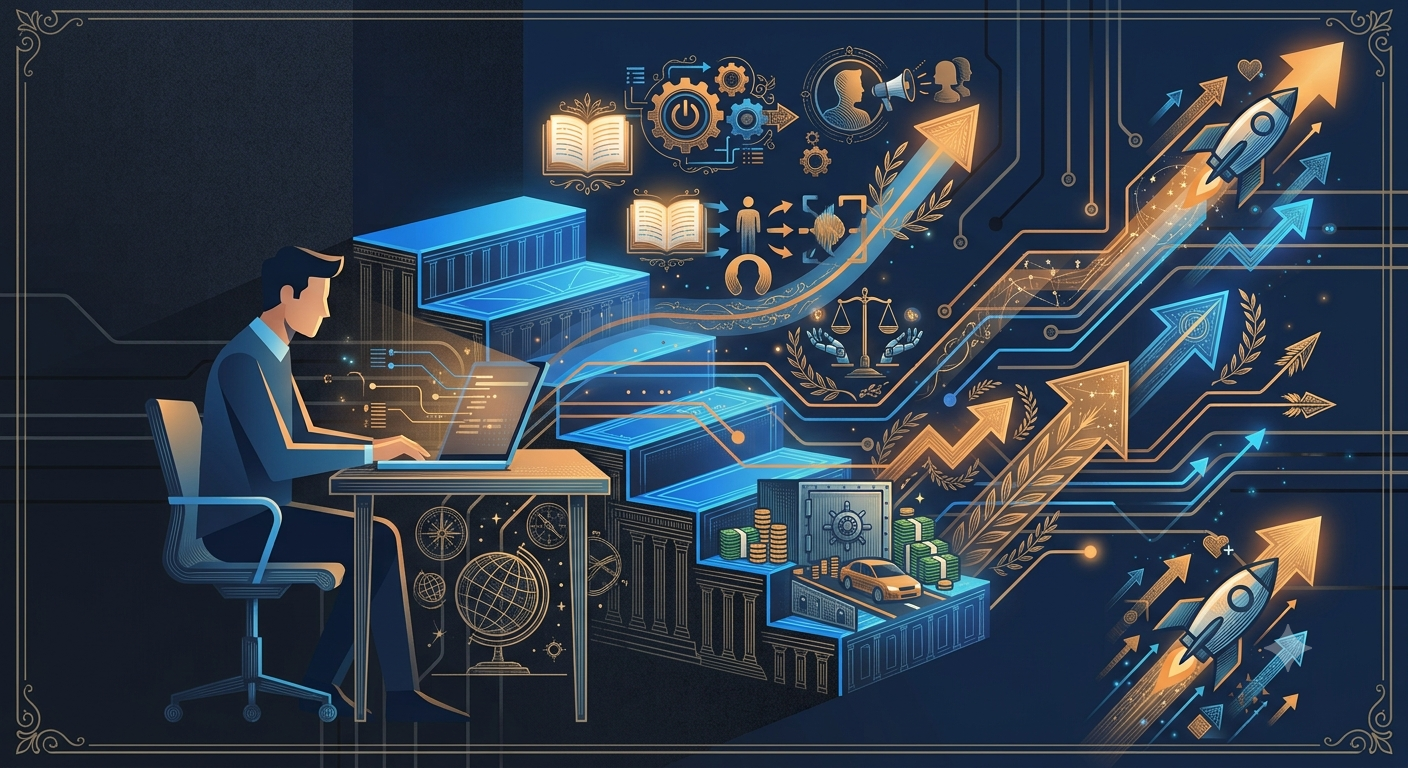
Every generation gets one moment where the old playbook stops working and a new one takes its place. For our parents, it was the shift from farms to factories. For millennials, it was the internet. For everyone reading this right now, it’s AI — and building wealth in the age of AI is quickly becoming the single most important financial skill of the next decade.
This isn’t a story about robots taking jobs. It’s not a hype piece about overnight riches either. It’s a practical, beginner-friendly roadmap for how ordinary people — students, freelancers, side-hustlers, and anyone starting from zero — can use this shift to build real, lasting wealth.
If you’ve felt uncertain about where you fit into an AI-powered economy, this article is for you. By the end, you’ll understand exactly how the rules of wealth creation have changed, what the new rules are, and how to start applying them this week.
Why Wealth Creation Has Changed
For most of modern history, wealth was built through a fairly predictable formula: get an education, get a stable job, save a portion of every paycheck, and let time and compound interest do the rest. That formula worked reasonably well for decades because the tools of value creation — factories, distribution networks, media channels, capital — were locked behind institutions. You needed a company, a bank, or a large budget to reach an audience or build a product.
The internet cracked that formula open. Suddenly, a single person with a laptop could publish, sell, and reach millions without owning a factory or a printing press. AI is now finishing what the internet started. It’s removing the second major barrier to value creation: skill and speed.
Today, a beginner with no design background can produce professional graphics in minutes. Someone with no coding experience can build a working app. A solo content creator can research, write, edit, and publish faster than an entire team could a decade ago. This is the essence of building wealth in the age of AI — the tools that once required a team, a budget, or years of training are now available to anyone willing to learn how to use them.
This doesn’t mean effort has disappeared. It means the type of effort that matters has changed. Instead of grinding for decades inside one company hoping for a promotion, people who understand how to combine AI, digital platforms, and real skills can build income streams in a fraction of the time it used to take.
The people who recognize this shift early — and adapt instead of resist — are the ones positioned to benefit the most. That’s what the rest of this guide is about.
The Old Rules vs. The New Rules
Before diving into the specific rules, it helps to see the shift side by side. The old wealth-building model wasn’t wrong — it simply reflected the tools and opportunities available at the time. The new model builds on top of it, using technology as leverage.
| Old Rules of Wealth Building | New Rules of Wealth Building (AI Era) |
|---|---|
| One employer, one income stream | Multiple income streams, often digital |
| Wealth tied to job title or salary | Wealth tied to skills and owned assets |
| Slow, manual skill development | AI-accelerated learning and execution |
| Local audience or customer base | Global, internet-connected audience |
| Capital required to start a business | Ideas and consistency required to start |
| Job security through tenure | Security through adaptability |
| Save first, invest later | Build income-generating assets early |
Notice that the new rules don’t eliminate the value of hard work, patience, or financial discipline. They simply add new tools on top of timeless principles. Building wealth in the age of AI means keeping what worked — consistency, patience, financial literacy — while upgrading the methods to match the moment.
10 New Rules of Building Wealth in the Age of AI
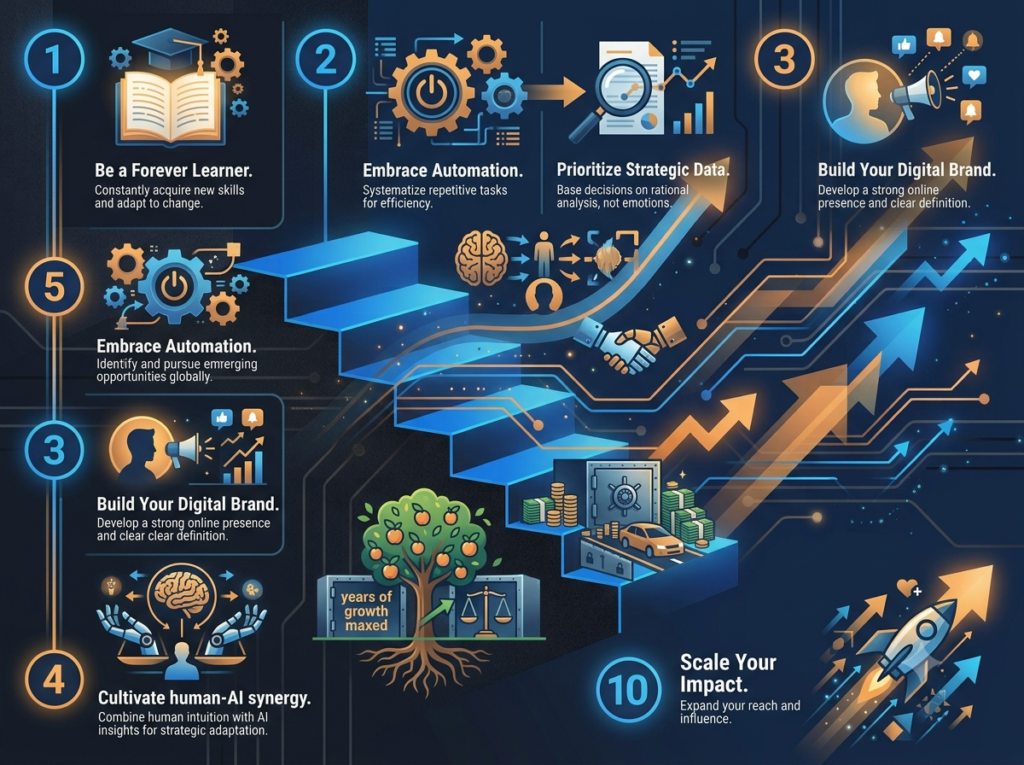
These ten rules form the core framework of this guide. Each one includes why it matters, a real-world example, and a simple way beginners can start applying it immediately.
1. Learn AI Instead of Fearing It
Why it matters: The biggest wealth gap forming right now isn’t between the rich and the poor — it’s between people who understand how to use AI tools and people who avoid them out of fear or confusion. Learning AI doesn’t require a technical degree. It requires curiosity and consistent, small practice.
Real-world example: A freelance writer who learns to use AI for research and first drafts can take on more clients without sacrificing quality, effectively multiplying their hourly output.
How beginners can apply it: Spend 20 minutes a day experimenting with one AI tool relevant to your field — writing, design, coding, or research. Treat it like learning a new piece of software, not a mysterious force.
2. Build Digital Assets, Not Just Active Income
Why it matters: Active income stops the moment you stop working. Digital assets — a blog, a course, an email list, a niche website — keep generating value while you sleep. This is one of the clearest paths to building wealth in the age of AI, because AI dramatically lowers the cost and time required to create these assets.
Real-world example: A beginner blogger uses AI-assisted research and outlining to publish consistently, growing an audience that eventually generates income through ads, affiliate links, or digital products.
How beginners can apply it: Pick one digital asset — a blog, a newsletter, or a simple digital product — and commit to building it for the next 90 days.
3. Focus on High-Value, Human-Centered Skills
Why it matters: AI is excellent at speed and pattern recognition. It’s still weak at judgment, taste, strategy, and genuine human connection. The people who thrive won’t be the ones competing with AI — they’ll be the ones directing it.
Real-world example: A marketer who understands consumer psychology can use AI to generate ad copy variations, then apply human judgment to choose the version that will actually resonate.
How beginners can apply it: Identify one skill that combines strategy or communication with AI tool usage, and invest an hour a week strengthening it.
4. Create Multiple Income Streams
Why it matters: Relying on a single income source has always been risky, but AI has made it easier than ever to diversify. A single skill set can now be repackaged into content, coaching, products, and services with far less effort than before.
Real-world example: A graphic designer with one client base can use AI to create templates, sell them as digital products, and build a passive stream alongside client work.
How beginners can apply it: List your current skills, then brainstorm one additional income stream that could come from repackaging what you already know.
5. Build Systems Instead of Relying on Motivation
Why it matters: Motivation fades. Systems don’t. AI makes it easier to build repeatable systems for content creation, customer service, marketing, and research — meaning your output no longer depends on how you feel that day.
Real-world example: A content creator sets up a repeatable weekly system: AI-assisted research on Monday, writing on Tuesday, editing on Wednesday, publishing on Thursday — regardless of motivation levels.
How beginners can apply it: Turn one task you do repeatedly into a documented, repeatable process this week.
6. Use AI to Increase Productivity, Not Replace Effort
Why it matters: The goal isn’t to let AI do everything — it’s to remove friction so your effort goes further. People who treat AI as a productivity multiplier consistently outperform people who either ignore it or over-rely on it.
Real-world example: A small business owner uses AI to draft customer emails, then personally reviews and personalizes each one — cutting response time in half without losing the human touch.
How beginners can apply it: Identify the most time-consuming part of your work and test whether AI can handle the first draft or first pass.
7. Develop a Personal Brand
Why it matters: In a world where AI can produce content quickly, trust and recognition become more valuable, not less. People buy from people they know, like, and trust — and a personal brand is the fastest way to build that trust at scale.
Real-world example: Two creators publish similar content, but the one who has consistently shared their personality, values, and story builds a loyal audience faster than the one who stays anonymous.
How beginners can apply it: Start sharing your process, not just your results — what you’re learning, testing, and building.
8. Keep Learning Continuously
Why it matters: AI tools evolve quickly, but the underlying skill of learning how to learn is what actually compounds over time. People who stay curious and adaptable will always find a way to apply new tools to their advantage.
Real-world example: A professional who dedicates just a few hours a month to exploring new AI tools stays consistently ahead of peers who only learn when forced to.
How beginners can apply it: Set a recurring monthly reminder to explore one new tool or skill relevant to your goals.
9. Solve Real Problems
Why it matters: Wealth, at its core, is a byproduct of solving problems for other people. AI doesn’t change this principle — it changes how quickly and affordably you can solve those problems.
Real-world example: A beginner notices a recurring question in an online community, creates a simple guide or tool to answer it, and turns that solution into a small digital product.
How beginners can apply it: Pay attention to the questions people around you keep asking, and treat each one as a potential opportunity.
10. Think Long-Term
Why it matters: AI can accelerate output, but wealth still compounds over years, not days. The biggest risk in this new era isn’t moving too slowly — it’s chasing shortcuts and abandoning projects before they have time to grow.
Real-world example: A creator who sticks with one niche website for two years, steadily improving it with AI-assisted content, outperforms someone who jumps between five different projects in the same timeframe.
How beginners can apply it: Choose one project and commit to a minimum 12-month timeline before judging whether it’s “working.”
How AI Gives Small Businesses a Competitive Advantage
One of the most overlooked parts of building wealth in the age of AI is what it means for small, independent businesses. For the first time, solo entrepreneurs and small teams can access capabilities that used to require entire departments.
Content creation: AI helps beginners draft blog posts, product descriptions, social captions, and scripts far faster, freeing up time to focus on strategy and quality control.
Customer support: Small businesses can use AI-powered chat tools to handle common customer questions instantly, improving response time without hiring a full support team.
Marketing: AI tools help generate ad copy variations, email sequences, and campaign ideas, allowing small businesses to test more strategies with a fraction of the traditional budget.
Research: Market research that once took weeks — competitor analysis, audience insights, trend spotting — can now be done in hours, giving small businesses faster, more informed decisions.
Automation: Repetitive tasks like scheduling, follow-up emails, and basic bookkeeping can be automated, freeing up time for the work that actually grows the business.
SEO: AI assists with keyword research, content structuring, and on-page optimization, helping small websites compete more effectively in search results.
Product creation: From digital templates to simple online courses, AI lowers the cost and time required to turn knowledge into a sellable product.
Business operations: Simple AI-driven systems can handle scheduling, basic customer segmentation, and reporting — tasks that used to require dedicated staff.
Together, these advantages mean a single motivated beginner can now compete with businesses many times their size — provided they focus on the right skills and stay consistent.
| Traditional Business | AI-Powered Business |
|---|---|
| Requires significant upfront capital | Can often start with minimal cost |
| Slow content and marketing production | Rapid content and campaign creation |
| Research takes days or weeks | Research takes hours |
| Support requires a dedicated team | AI assists with first-line support |
| Growth tied closely to headcount | Growth tied to systems and leverage |
Common Mistakes People Make
Not everyone who tries to adapt to this new landscape succeeds — and the reasons why are worth understanding before you start.
Waiting too long to learn AI. The learning curve is much smaller than most people assume. Every month spent waiting is a month of lost compounding.
Chasing every new AI tool. New tools launch constantly, and chasing all of them creates distraction instead of progress. Pick a few core tools and master them.
Depending only on AI. Outsourcing all judgment and creativity to AI produces generic, forgettable work. The winners combine AI speed with human insight.
Ignoring human creativity. Original thinking, storytelling, and taste are becoming more valuable, not less, as AI-generated content becomes more common.
Avoiding digital skills entirely. Some beginners assume digital skills are “not for them.” In reality, most of these skills are learnable within weeks of consistent, focused practice.
| High-Leverage Skills | Low-Leverage Skills |
|---|---|
| Directing AI tools strategically | Repetitive manual tasks with no system |
| Writing, storytelling, communication | Tasks with no scalable output |
| Building and owning digital assets | Trading time for money with no leverage |
| Data-informed decision making | Guessing without measuring results |
| Systems and process design | One-off, non-repeatable effort |
A 90-Day Action Plan
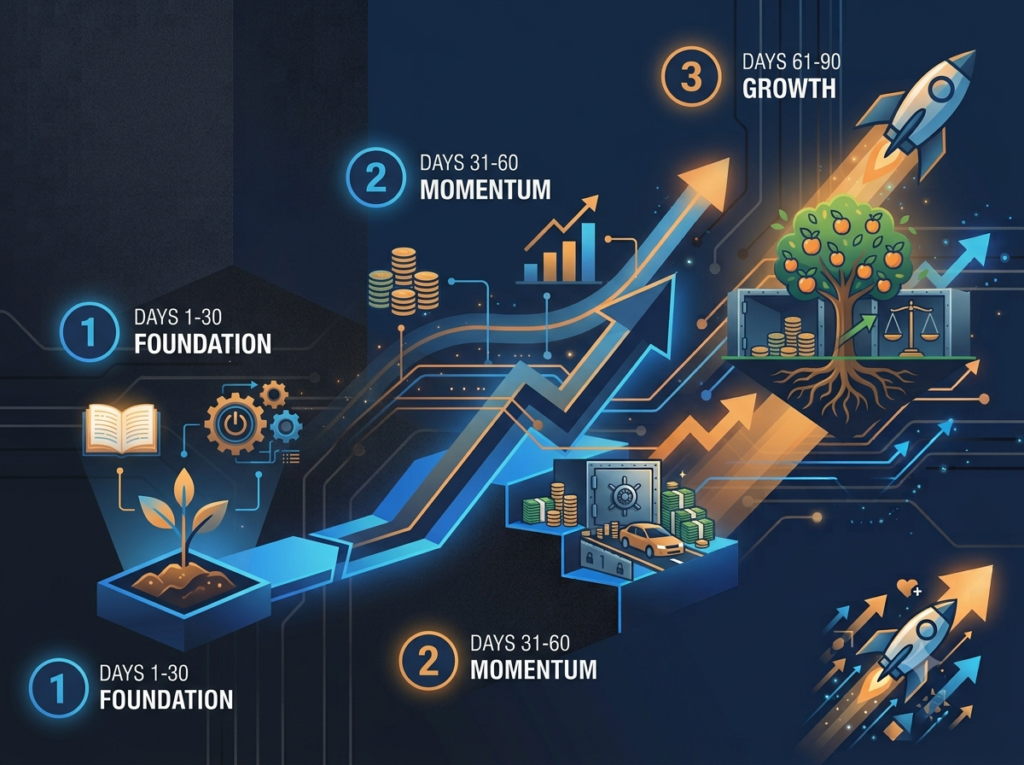
Here’s a practical roadmap for beginners who want to start building wealth in the age of AI without feeling overwhelmed.
Days 1–30: Foundation
- Choose one niche or skill area to focus on
- Learn the basics of one or two AI tools relevant to that niche
- Start a simple digital asset — a blog, newsletter, or content channel
- Set a weekly content or output schedule
Days 31–60: Momentum
- Publish consistently using your new system
- Test one additional income stream idea
- Study what’s working by tracking basic metrics
- Begin building a small personal brand presence
Days 61–90: Expansion
- Refine your system based on what’s performing
- Launch a simple digital product or service offer
- Reinvest early income into learning or tools
- Set a 12-month goal to keep long-term focus
| Active Income | Digital Assets |
|---|---|
| Freelance client work | Niche website or blog |
| Hourly consulting | Digital courses or templates |
| Traditional employment | Email list and audience |
| Gig work | Content library (YouTube, blog, podcast) |
15 Actions to Start Building Wealth in the Age of AI
- Pick one niche or focus area
- Choose two AI tools to learn this month
- Spend 20 minutes daily practicing with AI tools
- Start one digital asset (blog, newsletter, or channel)
- Document one repeatable content or work system
- Identify one high-value skill to strengthen
- List your current skills and one way to repackage them
- Share your learning process publicly, even in small posts
- Set a 90-day commitment to one project
- Track basic metrics weekly
- Automate one repetitive task
- Research one real problem your audience faces
- Create one simple digital product outline
- Reinvest early earnings into skills or tools
- Set a 12-month vision for your main project
Conclusion
AI is not replacing the people who create value — it’s giving the people who learn and adapt more opportunities than ever before. The tools have changed, the speed has changed, and the barriers to entry have dropped dramatically. But the underlying principles of wealth — solving real problems, building assets, staying consistent, and thinking long-term — remain exactly the same.
Building wealth in the age of AI isn’t about chasing every trend or fearing obsolescence. It’s about choosing to learn, choosing to build, and choosing to stay consistent while the tools around you get more powerful every year.
The beginners who succeed at building wealth in the age of AI rarely have any special advantage when they start. They don’t have more money, more connections, or more free time than everyone else. What they have is a willingness to start before they feel ready, and the discipline to keep showing up after the initial excitement fades. That combination — early action plus long-term consistency — is what turns a simple 90-day plan into a real, compounding income stream over time.
If there’s one idea worth remembering from this entire guide, it’s this: building wealth in the age of AI is not a race against the technology. It’s a race against your own hesitation. The tools will keep improving whether you use them or not. The only question is whether you’re building alongside them or watching from the sidelines.
Start small. Learn one tool. Build one asset. Commit to one system. The compounding begins the moment you start.