You can earn a great salary and still be broke in twenty years. That sounds harsh, but it’s true for millions of people who trade their time for money and never build anything that outlives the paycheck.
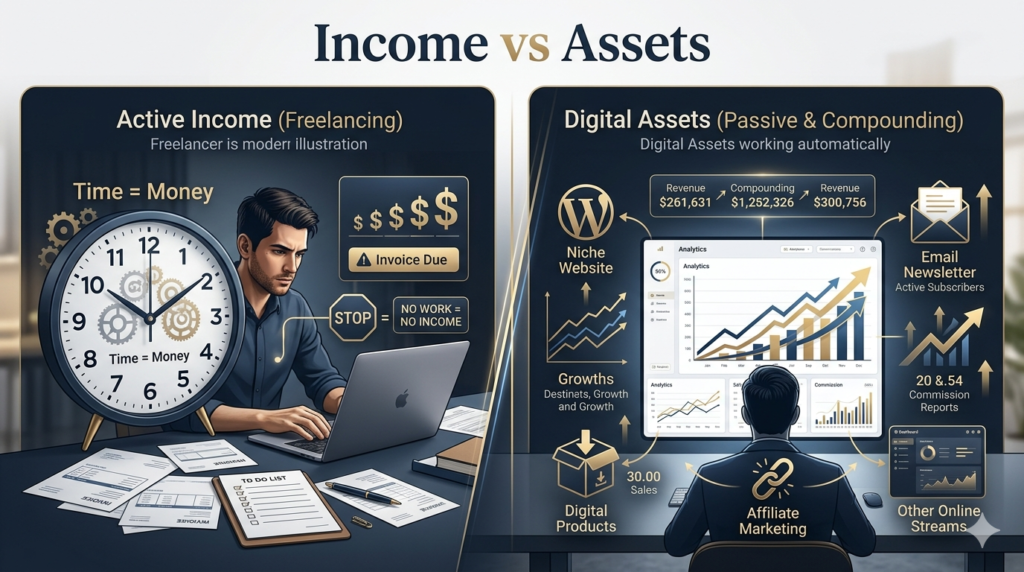
Here’s the problem: income is not the same thing as wealth. Income is money you earn by showing up and doing the work, day after day. The moment you stop working, it stops coming in. Wealth, on the other hand, is built on assets — things you own that keep generating value whether you’re actively working on them or not.
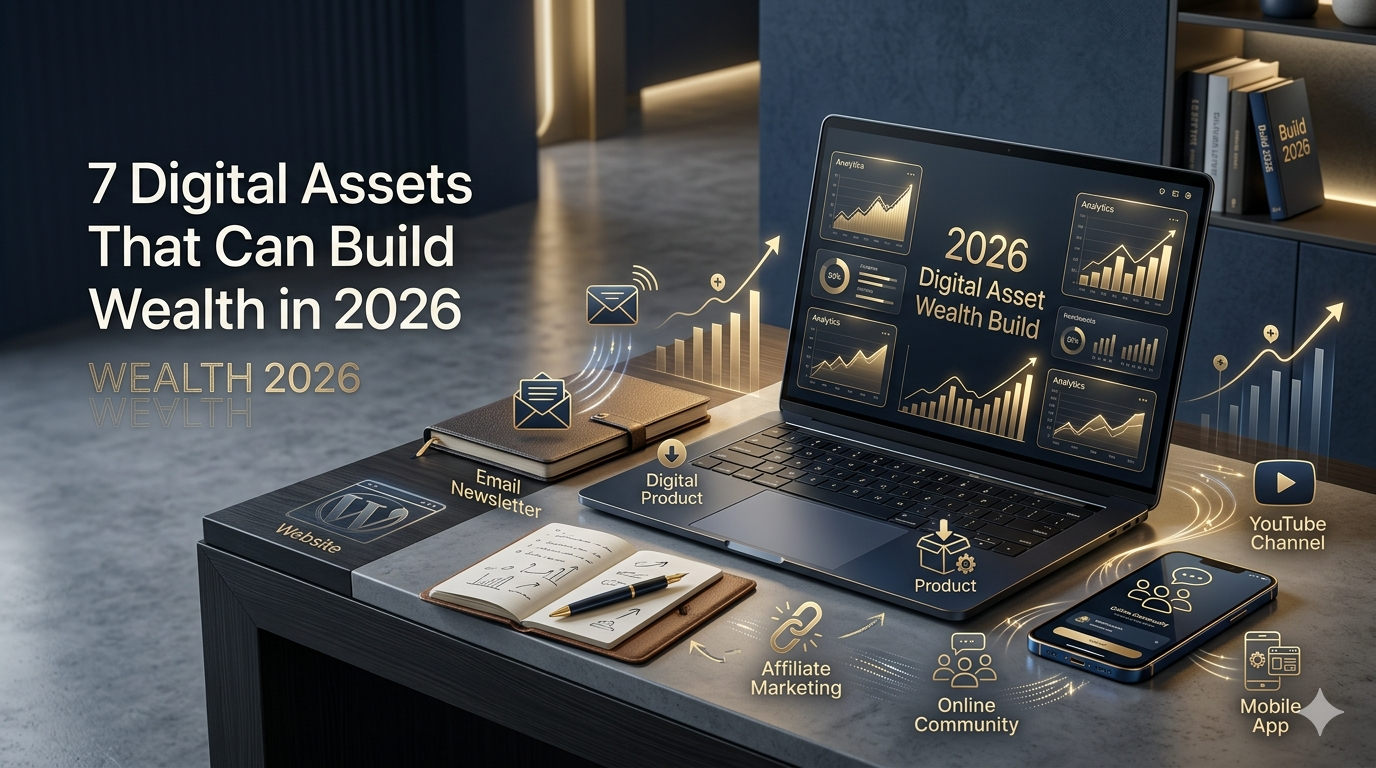
This is where digital assets come in. A digital asset is something you build once, in digital form, that continues to produce value, traffic, or income long after the initial work is done. Think of a website that ranks on Google and earns affiliate commissions while you sleep, or a digital product that sells to a new customer every day without you lifting a finger.
In this guide, you’ll learn exactly what digital assets are, why they matter more than ever in 2026, and seven specific digital assets you can start building today — even with a small budget and a few hours a week. We’ll also cover the mistakes that quietly kill most people’s progress, and a simple 90-day plan to get your first asset off the ground.
What Are Digital Assets?
A digital asset is any digital creation that holds ongoing value and can generate income, traffic, or audience attention over time. Unlike a freelance gig or a job, a digital asset doesn’t disappear the moment you stop actively working on it.
Common examples include websites, email lists, online courses, mobile apps, and YouTube channels with a back catalog of videos. What makes them “assets” instead of just “projects” is that they keep working for you after the initial investment of time or money.
This is different from a service-based business, where you’re paid only for the hours you personally put in. A graphic designer who charges per project is generating online income. A graphic designer who builds a library of design templates and sells them on autopilot is building a digital asset.
Why Digital Assets Matter More Than Ever in 2026
The creator economy has matured. It’s no longer a niche side hustle — it’s a legitimate path to financial freedom for people who treat it like a real business instead of a hobby. At the same time, traditional job security has gotten shakier, with layoffs, automation, and economic uncertainty pushing more young adults to look for income outside the 9-to-5.
Three forces are converging right now that make digital assets especially powerful:
- Low barriers to entry. You no longer need coding skills, a large team, or significant capital to launch a website, newsletter, or digital product.
- AI-assisted production. Tools for writing, design, and editing have cut the time needed to create high-quality content and products dramatically.
- Audience fragmentation. People are spending time across dozens of platforms, which means smaller, focused creators can build profitable niches that big brands ignore.
None of this means building a digital asset is easy or instant. It means the opportunity is real, but it still requires consistency and patience.
The Difference Between Income and Assets
This distinction is the foundation of real wealth building, so it’s worth slowing down on. Income pays your bills today. Assets pay your bills in five years, even if you decide to take a year off.
| Income | Digital Asset | |
|---|---|---|
| Stops if you stop working | Yes | No (after initial build) |
| Scales without more hours | Rarely | Often |
| Has resale or transfer value | No | Often yes |
| Compounds over time | No | Yes |
| Example | Freelance writing gig | Niche blog earning ad revenue |
A freelancer who writes ten articles a month earns solid online income. But if that same freelancer builds a niche website, writes articles for it consistently, and lets search traffic compound over two years, they now own something that can be monetized through ads, affiliate links, or even sold outright. That’s the shift from income to asset.
7 Digital Assets That Can Build Wealth in 2026
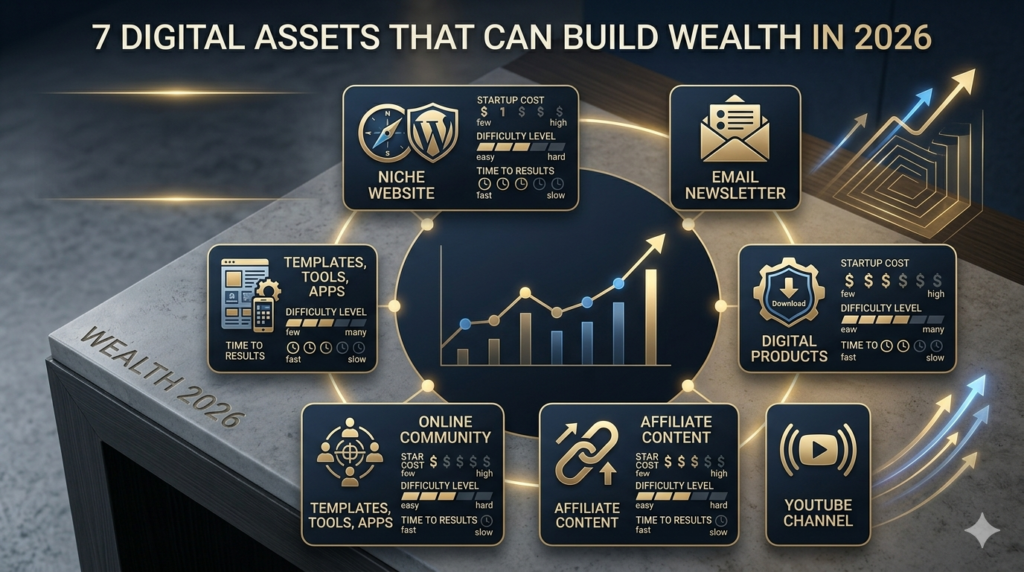
Here are seven digital assets worth considering, with realistic numbers on cost, time, and difficulty so you can choose one that fits your life right now.
| Digital Asset | Startup Cost | Time to See Traction | Difficulty |
|---|---|---|---|
| Niche website | $50–$300/year | 6–12 months | Medium |
| Email newsletter | $0–$30/month | 3–6 months | Low–Medium |
| Digital products | $0–$200 | 1–3 months | Low–Medium |
| YouTube channel | $0–$500 | 6–18 months | Medium–High |
| Affiliate content | $0–$200 | 4–9 months | Medium |
| Online communities | $0–$50/month | 3–9 months | Medium |
| Templates, tools, apps | $0–$1,000+ | 2–6 months | Medium–High |
1. Niche Websites
A niche website is a focused site built around one topic, like budgeting for students or home espresso setups. It earns money through display ads, affiliate links, and sometimes its own digital products.
- How it makes money: Ad networks (like Mediavine or Ezoic), affiliate commissions, and sponsored content once traffic grows.
- Startup cost: $50–$300 per year for hosting and a domain.
- Time required: A few hours a week for writing and optimization; meaningful traffic usually takes 6–12 months.
- Difficulty: Medium — requires consistent SEO content and patience.
- Best tools: WordPress, Rank Math or Yoast for SEO, and Google Search Console to track performance.
2. Email Newsletters
A newsletter is a direct line to your audience that no algorithm controls. Writers, marketers, and solopreneurs use newsletters to build trust and sell products directly to subscribers.
- How it makes money: Paid subscriptions, sponsorships, and promoting your own digital products or affiliate offers.
- Startup cost: Often free to start; paid tiers run $0–$30/month as your list grows.
- Time required: A few hours per week writing and growing your list.
- Difficulty: Low to medium — the hardest part is consistent, valuable writing.
- Best tools: beehiiv, ConvertKit, or Substack.
3. Digital Products
Digital products include ebooks, planners, templates, courses, and notion dashboards — anything you create once and sell repeatedly. This is one of the fastest digital assets to launch because there’s no inventory or shipping involved.
- How it makes money: Direct sales, often through a simple landing page or marketplace listing.
- Startup cost: Can be $0 if you design it yourself; $50–$200 if you hire help.
- Time required: A focused product can be built in a few weeks of part-time effort.
- Difficulty: Low to medium — the real challenge is marketing it, not making it.
- Best tools: Gumroad, Canva, or Notion for creation; Stripe for payments.
4. YouTube Channels
A YouTube channel is a library of videos that keeps earning views, and therefore ad revenue, long after you publish. The compounding effect is real: a video from two years ago can still bring in new viewers today.
- How it makes money: Ad revenue through the YouTube Partner Program, sponsorships, and affiliate links in descriptions.
- Startup cost: $0 with a smartphone; $200–$500 for basic lighting and a microphone.
- Time required: Several hours per video; consistent growth usually takes 6–18 months.
- Difficulty: Medium to high — video production and consistency are demanding.
- Best tools: CapCut or Premiere Pro for editing, TubeBuddy for optimization.
5. Affiliate Content
Affiliate content means recommending products or services and earning a commission when someone buys through your link. It works best when it’s built into an existing asset, like a blog, newsletter, or YouTube channel, rather than standing alone.
- How it makes money: Commission on sales, often 1%–50% depending on the product.
- Startup cost: Often $0 beyond whatever platform you’re publishing on.
- Time required: Ongoing content creation; commissions typically build over 4–9 months.
- Difficulty: Medium — requires genuine product knowledge and audience trust.
- Best tools: Amazon Associates, ShareASale, or Impact for finding affiliate programs.
6. Online Communities
A paid or free community — on Discord, Skool, or a private forum — turns an audience into a recurring relationship. People pay for access, accountability, and connection, not just information.
- How it makes money: Monthly or annual membership fees.
- Startup cost: $0–$50/month for hosting platforms.
- Time required: Daily light engagement; meaningful growth often takes 3–9 months.
- Difficulty: Medium — requires consistent presence and community management.
- Best tools: Skool, Discord, or Circle.
7. Templates, Tools, or Apps
This category includes spreadsheet templates, Notion systems, browser extensions, or simple apps that solve one specific problem well. It’s a strong fit for anyone with a practical, organized mindset, similar to building a planner or tracker.
- How it makes money: One-time sales, subscriptions, or licensing.
- Startup cost: $0 for templates; $500+ if you’re hiring a developer for an app.
- Time required: A few weeks for a template; months for an app.
- Difficulty: Medium to high, depending on technical complexity.
- Best tools: Notion, Google Sheets, Gumroad, or no-code app builders like Bubble.
How Beginners Should Choose Their First Digital Asset
Don’t try to build all seven at once. Pick one based on three honest questions about yourself.
- What skill do you already have or enjoy practicing? Writers lean toward niche sites or newsletters. Talkers lean toward YouTube. Organizers lean toward templates and digital products.
- How much time can you realistically commit each week? Be honest — five focused hours weekly beats fifteen sporadic ones.
- How much risk tolerance do you have? Free or low-cost assets like newsletters and digital products let you test ideas before spending real money.
A simple rule: choose the asset that overlaps with something you’d do even if no one paid you for it. That overlap is what keeps you consistent past the slow early months.
Common Mistakes to Avoid When Building Digital Assets
Most digital assets don’t fail because the idea was bad. They fail because of a handful of avoidable habits.
- Chasing too many platforms at once. Spreading thin across five platforms usually means mastering none of them.
- Quitting during the “flat” phase. Almost every digital asset has a slow middle period before growth becomes visible. Most people quit right before it would have paid off.
- Confusing activity with progress. Posting constantly without checking what actually converts wastes time you don’t get back.
- Ignoring your audience’s actual problems. Building what you want to make instead of what people want to buy is one of the fastest ways to stall out.
- Treating it like a lottery ticket instead of a business. Digital assets compound through consistency, not luck or a single viral moment.
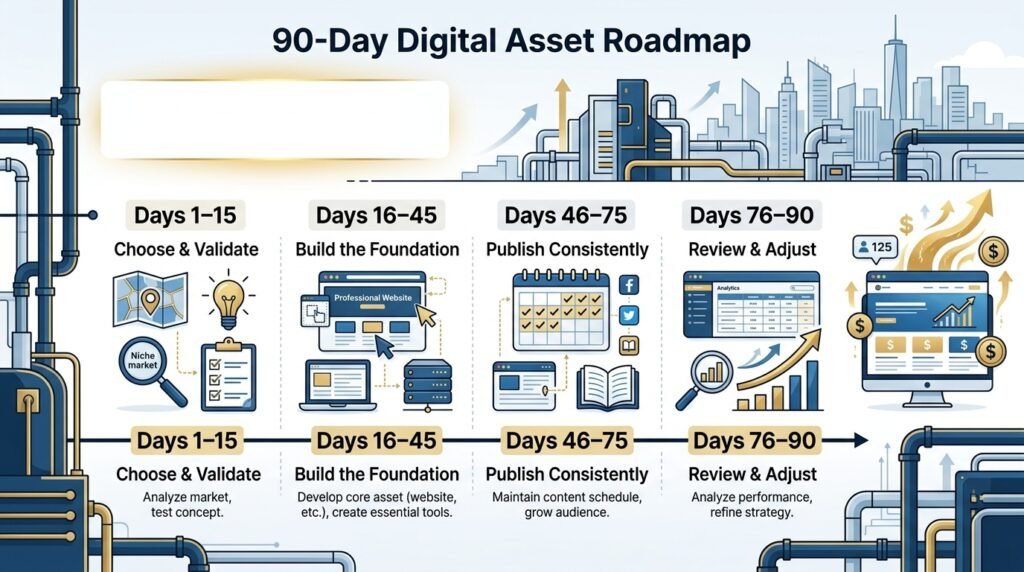
A 90-Day Plan to Start Building A 90-Day Plan to Start Building Your First Digital Asset
Building digital assets can feel overwhelming when you look at creators who have spent years growing their businesses. The good news is that you don’t need years to get started—you just need a clear plan for the next 90 days.
The goal of this plan isn’t to make you rich overnight. The goal is to help you stop consuming information and start building digital assets that can generate value for years.
Days 1–15: Choose and Validate
Pick one of the digital assets from the list above and commit to it for the next three months. Resist the urge to build multiple digital assets at once.
Spend these first two weeks researching your niche, studying competitor content, and confirming there’s real demand before investing significant time or money.
Ask yourself:
- What problems do people repeatedly ask about?
- Are people already spending money in this niche?
- Can I consistently create content or products around this topic for the next year?
Remember: successful digital assets solve specific problems for specific audiences. A smaller niche with clear demand is often better than a broad topic with endless competition.
Days 16–45: Build the Foundation
Now it’s time to create the basic infrastructure behind your digital asset.
Set up your platform—whether that’s a website, newsletter signup page, YouTube channel, online community, or product listing.
Focus on launching, not perfecting.
Publish your first articles, record your first videos, or release the first version of your product, even if it feels unfinished.
Most people stay stuck because they spend too much time planning and not enough time building digital assets.
Days 46–75: Publish Consistently
Choose a publishing schedule you can realistically maintain.
That might mean:
- One article each week
- One newsletter every Friday
- One video every ten days
Consistency matters more than intensity when building digital assets.
A simple system you follow for months will outperform an ambitious plan you abandon after two weeks.
Ignore vanity metrics during this stage. Your focus should be building skills, gathering feedback, and creating content that strengthens your digital asset over time.
Days 76–90: Review and Adjust
Use basic analytics to understand what’s working.
Look for patterns:
- Which topics attract the most attention?
- Which products generate interest?
- Which content drives clicks, subscribers, or sales?
Double down on what gains traction and quietly remove what doesn’t.
The best digital assets improve over time because they’re built using real feedback and real data.
By day 90, you probably won’t be wealthy.
But you’ll have something far more valuable: a real digital asset with data, experience, and momentum behind it instead of just another idea sitting in a notebook.
That’s how digital assets are built—not through perfection, but through consistent action, patience, and a willingness to improve over time.
Key Takeaways
- Income and wealth are not the same thing — income stops when you stop working; assets keep producing value.
- A digital asset is something you build once that continues to generate traffic, audience, or income over time.
- The seven assets covered here — niche websites, newsletters, digital products, YouTube channels, affiliate content, communities, and templates or tools — all fit different skills, budgets, and time commitments.
- Choosing one asset and committing to it for 90 days beats spreading yourself across five half-finished projects.
- Multiple income streams matter, but they should ideally come from owned assets, not just more jobs stacked on top of each other.
Frequently Asked Questions
Conclusion
Building wealth in 2026 isn’t about working more hours or chasing the next trending side hustle. It’s about shifting your effort from pure income generation toward owning digital assets that continue producing value long after the work is done.
Whether you start with a niche website, a newsletter, or your first digital product, the principle stays the same: ownership—not effort alone—is what builds lasting wealth.
The truth is, most people spend years trading time for money and wonder why financial freedom always feels out of reach. They work harder, but they never build anything that works for them in return.
Don’t make that mistake.
Pick one digital asset from this list. Commit to the 90-day plan. Give it the time and consistency it needs to grow.
Some days it will feel slow. Your traffic may be low. Your subscriber count may barely move. You may wonder if your efforts are worth it.
Keep building anyway.
Because every article you publish, every email you send, and every product you create is another brick in something you own.
You do not need seven income streams. You do not need a perfect strategy. You do not need to know everything before you begin.
You just need to start building one asset consistently.
Remember, every successful creator, entrepreneur, and business owner started where you are now: with uncertainty, limited resources, and no guarantee of success. The difference is that they chose to keep building when results were still invisible.
Small actions repeated over months become assets. Assets built over years become freedom.
By the end of 90 days, you may not have life-changing income. But you’ll have something far more valuable: proof that you can create an asset instead of simply earning a paycheck.
And once you learn how to build one digital asset, you can build another.
That’s how real wealth is created—not through luck or shortcuts, but through patience, ownership, and consistent action.
Your future income depends on what you do today. Your future wealth depends on what you choose to build.