Most people trade hours for dollars their entire life. Work a shift, get paid. Stop working, stop earning. It’s a loop that never builds wealth — it just keeps you afloat.
There’s a different model. It’s slower at first, often frustrating, and nobody talks about the boring middle part. But it works: build something once, and let it keep paying you.
That’s the entire idea behind digital assets. In 2026, more people are realizing that owning income-generating assets online is one of the smartest ways to build long-term wealth — not because it’s easy, but because it’s the only model that scales without scaling your time.
This article breaks down exactly what digital assets are, why they outperform active income over time, and ten specific assets you can start building right now — even with a small budget and no audience yet.
Here’s what you’ll walk away with:
- A clear definition of what counts as a real digital asset
- Why asset-based income beats trading time for money long-term
- Ten digital assets, with honest breakdowns of cost, difficulty, and income potential
- A 90-day plan to get your first asset off the ground
What Are Digital Assets?
A digital asset is anything you create or own online that keeps generating value after the initial work is done. It’s not a side hustle you have to show up for every day. It’s something that works in the background.
Think of the difference between freelance writing and writing an ebook. Freelance work pays once per project. An ebook can sell for years without you touching it again.
Common examples of digital assets include:
- Websites and blogs that earn affiliate or ad revenue
- Digital products like templates, planners, and ebooks
- Online courses
- Email newsletters with paid subscriptions
- YouTube channels with ad and sponsorship income
- Apps or software products
- Stock photos, videos, or design files
- Paid communities or memberships
The common thread: you build it once, and it can sell, rank, or get viewed indefinitely without 1:1 time input from you.
Why Digital Assets Build Wealth Faster Than Active Income
This sounds backwards at first. Active income — freelancing, consulting, a job — usually pays faster and more predictably than a brand-new digital asset.
But speed isn’t the same as wealth. Active income has a hard ceiling: your hours. There are only so many hours you can sell, and the moment you stop working, the income stops.
Digital assets don’t have that ceiling. A course can sell to 5 people or 5,000 people with the same amount of work from you. An affiliate site can earn from search traffic at 2 a.m. while you sleep. That’s the entire mechanism behind compounding online income — effort goes in once, and the output keeps multiplying.
This doesn’t mean digital assets are passive from day one. Most take months of unpaid effort before they earn a cent. The payoff is that the curve eventually bends upward without more input from you — something active income can never do.
The Difference Between Active Income and Asset-Based Income

It helps to separate these clearly, because most people blend them without realizing it.
Active income requires continuous effort to maintain. Examples: a job, freelance gigs, one-off consulting, services you sell by the hour.
Asset-based income comes from something you built that keeps generating value independently. Examples: a blog post still ranking from two years ago, a digital product still selling on autopilot, a newsletter sponsorship that recurs monthly.
Most successful creators and entrepreneurs don’t pick one over the other — they use active income to fund their life while building assets on the side. Over time, the asset income replaces the active income. That’s the actual transition point most people mean when they talk about financial freedom.
10 Digital Assets That Generate Income for Years
Here’s the practical part — ten specific digital assets, with realistic numbers, not hype.
Before diving in, it helps to know that not every digital asset fits every person. Some require money upfront, others require time, and a few require a specific skill you either already have or need to learn. The goal isn’t to pick the “best” digital asset in some abstract sense — it’s to pick the digital asset that matches what you’re actually willing to put in over the next year. Below, each digital asset is broken down by cost, income potential, difficulty, and who it tends to suit best. Whichever digital asset you land on, the fundamentals below stay the same.
1. Affiliate Niche Websites
How it works: You build a website around a specific topic, publish content that ranks in search engines, and earn commissions when readers buy products through your links. This digital asset relies almost entirely on organic search traffic.
- Startup cost: Low ($100–$500 for hosting, domain, basic tools)
- Income potential: Moderate to high once traffic compounds; many sites earn $500–$10,000+/month after 1–2 years
- Difficulty: Moderate — requires SEO and content consistency
- Time to build: 6–18 months to meaningful traffic
- Best suited for: Writers, researchers, bloggers comfortable with long-term SEO work
2. Digital Products (Ebooks, Templates, Planners, Printables)
How it works: You create a one-time-purchase digital asset solving a specific problem, then sell it through your own site or a platform like Gumroad.
- Startup cost: Very low — mostly your time
- Income potential: Low to moderate per sale, but scalable with traffic or an audience
- Difficulty: Low to start, harder to scale without distribution
- Time to build: Days to weeks for the product itself
- Best suited for: Creators with an existing audience, niche experts, designers
3. Online Courses
How it works: You package expertise into structured video or written lessons and sell access, often at a higher price point than simpler digital assets.
- Startup cost: Low to moderate (filming/editing tools, hosting platform fees)
- Income potential: High per customer, but requires credibility to sell
- Difficulty: High — both teaching skill and marketing matter
- Time to build: 1–3 months to produce, longer to gain traction
- Best suited for: People with proven expertise and some existing audience
4. Membership Websites
How it works: Members pay a recurring fee for ongoing access to content, tools, or community — making this digital asset one of the most predictable on this list.
- Startup cost: Low to moderate
- Income potential: High — recurring income compounds predictably
- Difficulty: High — requires consistent new value to prevent churn
- Time to build: 3–6 months to launch, ongoing to maintain
- Best suited for: Coaches, niche experts, content creators with loyal followings
5. Email Newsletters
How it works: You build a subscriber list and monetize through sponsorships, paid tiers, or promoting your own products. This digital asset compounds slowly but builds real trust over time.
- Startup cost: Very low
- Income potential: Moderate to high once list size and engagement grow
- Difficulty: Moderate — consistency is the hard part
- Time to build: 6–12 months to monetizable size
- Best suited for: Writers, marketers, anyone good at building recurring income through trust
How it works: You publish video content and earn through ad revenue, sponsorships, and affiliate links, with older videos continuing to earn views indefinitely — turning each upload into a small standalone digital asset.
- Startup cost: Low (a phone and free editing software is enough to start)
- Income potential: Wide range — from minimal to six figures depending on niche and consistency
- Difficulty: High — competitive, and the algorithm rewards a small percentage of creators heavily
- Time to build: 1–2 years for meaningful monetization
- Best suited for: People comfortable on camera or with strong scripting/editing skills
7. Mobile Apps or SaaS Products
How it works: You build software that solves a recurring problem and charge a subscription or one-time fee. Of every digital asset on this list, this one scales the most efficiently.
- Startup cost: Moderate to high (unless you can code yourself)
- Income potential: Very high — software scales without added labor per customer
- Difficulty: Very high — technical skill or budget required
- Time to build: 3–12 months minimum
- Best suited for: Developers, or non-technical founders willing to invest in development
8. Print-on-Demand Brands
How it works: You design products (apparel, mugs, prints) that are printed and shipped by a third party only when ordered, making this digital asset light on upfront inventory risk.
- Startup cost: Low
- Income potential: Low to moderate per sale; needs volume or a strong brand
- Difficulty: Moderate — design and marketing both matter
- Time to build: 1–3 months to launch
- Best suited for: Designers, niche communities, meme/trend-savvy creators
9. Stock Photography, Video, and Design Assets
How it works: You upload photos, footage, or design templates to marketplaces and earn royalties every time someone licenses them. Each file becomes its own tiny digital asset inside a larger library.
- Startup cost: Low to moderate (equipment if you don’t already own it)
- Income potential: Low per file, but compounds with a large library
- Difficulty: Moderate — quality and volume both matter
- Time to build: Ongoing; income grows as your library grows
- Best suited for: Photographers, videographers, designers with existing skills
10. Digital Communities
How it works: You build a paid community (Discord, Circle, Skool, etc.) around a shared interest or goal, charging membership for access and connection. This digital asset depends more on people than on product.
- Startup cost: Low
- Income potential: Moderate to high with strong retention
- Difficulty: High — requires active moderation and ongoing value
- Time to build: 2–4 months to launch, ongoing to sustain
- Best suited for: Community-minded creators, coaches, niche leaders
Ten different paths, ten different timelines — but every digital asset on this list shares the same underlying mechanic: build once, earn repeatedly. None of them are truly passive on day one. What makes a digital asset valuable isn’t how little effort it takes to start, but how little effort it takes to maintain once it’s actually built and working. Pick one digital asset from this list and treat it as your starting point, not your only option.

Which Digital Asset Is Best for Beginners?
If you’re starting from zero, digital products and email newsletters are usually the most realistic entry points. Both have low startup costs, don’t require existing technical skills, and can be built around knowledge you already have.
Affiliate websites are a close second — slower to pay off, but very beginner-friendly in terms of skill requirements.
Avoid starting with SaaS products, membership sites, or YouTube unless you already have some relevant skill or audience. Those have higher payoffs but a much steeper learning curve and more ways to stall out.
How to Choose the Right Digital Asset Based on Your Skills
Instead of picking the “best” digital asset in theory, match it to what you already have:
- Good at writing? Start with a niche blog or newsletter.
- Comfortable on camera? YouTube or a course is a natural fit.
- Strong design skills? Templates, print-on-demand, or stock assets.
- Technical background? A simple SaaS tool solving one specific problem.
- Built a small but loyal following already? A membership site or paid community.
The asset that fits your existing skills will always beat the “trendiest” option, because you’ll actually finish building it.
Common Mistakes That Prevent Digital Assets From Growing
Most digital assets don’t fail because the idea was bad. They fail because of how they were built and maintained:
- Switching ideas too early. Most assets take 6–12 months before traction is visible. Quitting at month two looks like failure but is usually just the normal timeline.
- Building before validating. Spending months on a product nobody asked for is the most common — and most expensive — mistake.
- No distribution plan. A great product with zero traffic earns nothing. Traffic and audience matter as much as the asset itself.
- Treating it like a side project forever. Assets that get occasional attention grow occasionally. Consistency compounds; neglect doesn’t.
- Ignoring data. Not tracking what’s converting, what’s ranking, or what’s churning means flying blind.
How AI Can Help You Build Digital Assets Faster
AI tools won’t build a successful asset for you, but they remove a lot of the friction that used to slow people down:
- Content creation: Drafting blog posts, scripts, and product copy faster, leaving more time for strategy and promotion
- Research: Validating ideas, analyzing competitors, and identifying content gaps in minutes instead of days
- Design: Generating templates, mockups, and visuals without hiring a designer for every small task
- Customer support: Automating FAQs and onboarding for membership sites or SaaS products
The advantage goes to people who use AI to move faster on a solid strategy — not to people who use it as a replacement for one. A site full of AI-generated filler with no real value behind it won’t hold up over time.
The 90-Day Action Plan to Build Your First Digital Asset
You don’t need a perfect plan. You need a clear one.
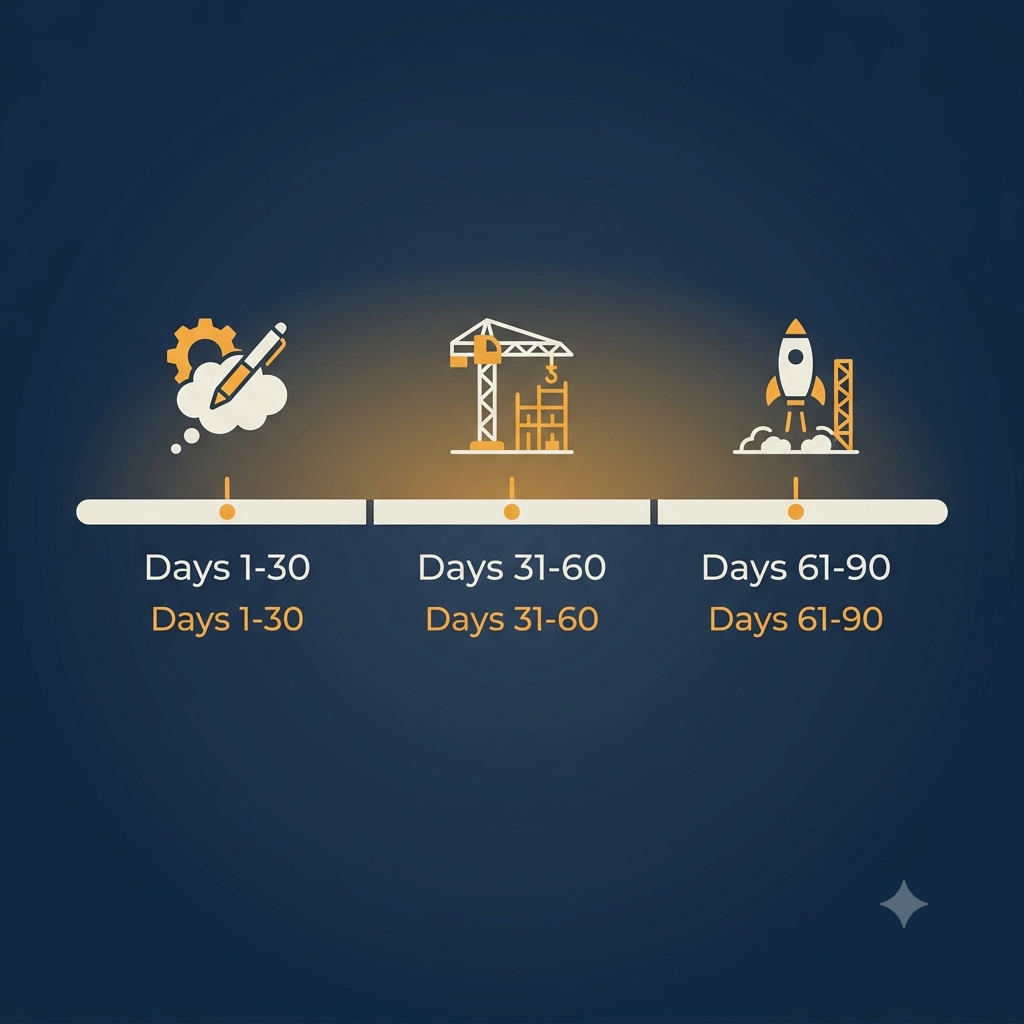
Most people overthink this stage because they’re trying to plan for every possible outcome before they start. That’s backwards. A 90-day plan works because it forces movement, and movement is what separates a real digital asset from an idea that stays in your notes app forever. Every digital asset on this list follows roughly the same arc: validate, build, launch. The timeline below applies whether you’re building a newsletter, an affiliate site, or a digital product.
Days 1–30: Choose and Validate
- Week 1: Pick one digital asset based on your skills (not what’s trending)
- Week 2: Research existing competitors and identify a specific gap or angle
- Week 3: Validate the idea — ask in communities, run a small poll, check search demand
- Week 4: Outline exactly what you’re building and set a launch date
This first month is where most digital assets quietly die before they’re even built. People skip validation because it feels slow, then spend three months building a digital asset nobody wanted. Thirty minutes of research now saves thirty days of wasted effort later.
Days 31–60: Build the Core Asset
- Week 5–6: Build the minimum version — first product draft, first 5 blog posts, first course module
- Week 7: Set up the infrastructure (payment processing, hosting, email list)
- Week 8: Get feedback from 5–10 real people before launching publicly
This is the stage where your digital asset actually starts to take shape. Resist the urge to perfect every detail before showing it to anyone. A rough version of a digital asset that real people have tested is worth more than a polished one that’s never left your laptop.
Days 61–90: Launch and Promote
- Week 9: Launch to your existing network, however small
- Week 10–11: Promote consistently through one or two channels (don’t spread thin)
- Week 12: Review what worked, what didn’t, and set goals for the next 90 days
A launch isn’t a finish line — it’s the point where your digital asset starts generating real data. Watch what people respond to, fix what’s broken, and treat this first 90 days as round one of an ongoing process, not a one-time sprint.
Key Takeaways
- Digital assets generate income independently of your daily time input, unlike active income.
- The biggest advantage of digital assets is that effort compounds instead of resetting every day.
- Beginners should start with low-cost, low-skill-barrier digital assets like digital products or newsletters.
- Most digital assets take 6–12 months of consistent effort before showing real traction.
- AI can speed up the building process, but it can’t replace a real strategy or distribution plan for your digital asset.
- The fastest path to financial freedom isn’t one big asset — it’s consistently shipping and improving one digital asset at a time.
Conclusion
Wealth doesn’t come from earning more. It comes from owning more — specifically, owning digital assets that keep paying you after the work is done.
Every digital asset on this list started as someone’s first attempt, built with no audience, no guarantee, and usually some doubt about whether it would work. The ones that succeeded simply kept going past the slow, unrewarding middle stretch that makes most people quit building their digital asset too early.
You don’t need to build all ten digital assets. You need to build one. Pick the digital asset that matches your skills, give it 90 days of real effort, and start today — not when conditions feel perfect, because they won’t.ecause they won’t.