Check your bank balance right now. Then check your analytics dashboard. If the second number looks impressive and the first one hasn’t moved, you don’t have a content problem — you have a content income streams problem, and it’s more common than you think.
You posted three times this week. Your views are up. Your comments are up. Your bank account looks exactly the same as it did last month.
This is the part nobody talks about: traffic doesn’t pay your rent. Views don’t create wealth. Engagement is nice, but it’s not income — and a lot of creators spend years confusing the two, mistaking attention for actual progress toward financial freedom.
The creators actually making money in 2026 figured out something simple: content is supposed to be an asset, not a performance. Once you stop treating content as something you make for attention and start treating it as something that builds content income streams, everything changes. The shift isn’t dramatic — it’s a change in what question you ask before you hit publish.
This article breaks down seven realistic content income streams you can build this year, how to choose the right ones for where you are now, and how to turn one piece of content into multiple paydays instead of one viral moment that fades by next week. None of this requires a bigger audience, a better camera, or a lucky algorithm break. It requires a system, and systems are exactly what most creators skip.
Here’s why this matters more in 2026 than ever before: platforms are more saturated, attention is more fragmented, and the creators who win aren’t the loudest ones — they’re the ones who built content income streams that don’t depend on any single platform’s mood. If you’re tired of watching your numbers go up while your income stays flat, this is the fix.
Why Most Content Creators Stay Stuck
Most creators stay stuck for one simple reason: they’re optimizing for the wrong metric.
Views, likes, and follower counts feel like progress. They’re easy to track and they give you a quick dopamine hit. But none of them directly pay you. They’re proxies for attention, not proof of online income — and confusing the two is the single biggest reason creators struggle to build real content income streams.
Here’s where the disconnect usually happens:
- Chasing platforms instead of owning assets. Algorithms change, reach drops, and income built entirely on one platform can disappear overnight, taking your only content income streams down with it.
- Confusing audience size with audience value. A small list of buyers beats a massive list of scrollers every time, and buyers are what actually fund content income streams.
- Avoiding monetization out of fear of “selling out.” This single mindset block delays income by months, sometimes years, and keeps creators from ever testing real content income streams.
- Never diversifying. One income stream means one point of failure, and one point of failure means your entire digital business rests on a single decision you don’t control.
The good news: none of this requires more content. It requires a shift in what you’re building with the content you already make. The raw material for content income streams is usually already sitting in your archive, unmonetized.
The Difference Between Content and Digital Assets
Content is something you create. A digital asset is something that keeps working after you’ve moved on to the next thing — and this distinction is the foundation of every successful content income streams strategy.
A blog post is content. A blog post that ranks on Google for years and funnels readers into an email list is a digital asset. A YouTube video is content. A YouTube video that sells a digital product in every description is part of a real digital business generating ongoing content income streams instead of a one-time spike in views.
This distinction matters because it changes how you plan. Instead of asking “what should I post today,” you start asking “what does this piece of content build toward.” That single question is the difference between a hobby and a business, and it’s the question behind every durable set of content income streams.
Examples:
- A freelancer’s blog post about pricing strategy becomes a lead magnet for new clients for years.
- A newsletter writer’s single deep-dive issue gets repurposed into a paid mini-course, turning one piece of writing into one of several content income streams.
- An affiliate marketer’s product comparison page keeps earning commissions long after it was written, proving that well-built content income streams don’t need constant new output to keep paying out.
Why One Income Stream Is Risky

Relying on a single source of income — even a good one — is one of the riskiest moves in digital entrepreneurship.
Platforms change algorithms. Sponsors cut budgets. Affiliate programs adjust commission rates without warning. If your entire income depends on one of these, you don’t actually control your income — the platform or partner does.
Examples:
- A YouTuber who relied entirely on ad revenue saw earnings drop 40% after a platform algorithm update reduced video reach.
- An affiliate marketer lost a major income source overnight when a brand cancelled its affiliate program.
- A freelancer who depended on one retainer client had to scramble when that client cut their budget.
Multiple content income streams protect you from exactly this kind of shock. If one stream dips, the others keep your business stable while you adjust. This is the core argument for diversification: it’s not about earning more from every direction at once, it’s about making sure no single decision outside your control can wipe out your income overnight.
Think of it the way investors think about a portfolio. Nobody puts their entire savings into one stock, no matter how promising it looks. Content income streams work the same way — each one is a separate bet, and the goal is to make sure no single bet determines your financial outcome. A creator with three modest content income streams is almost always in a stronger position than one with a single large stream, even if the total revenue looks similar on paper.
There’s also a psychological benefit that gets overlooked. When your entire income depends on one source, every algorithm update or client email feels like a potential crisis. When you’ve built multiple content income streams, a dip in one becomes a manageable inconvenience instead of an emergency. That stability changes how you make decisions — you negotiate from a stronger position, you’re less likely to accept bad terms out of desperation, and you can afford to walk away from partnerships that don’t serve your audience.
The creators who build the most durable content income streams usually start by stress-testing their current setup. Ask yourself: if my biggest income source disappeared tomorrow, what would happen? If the answer is “I’d be in serious trouble,” that’s the clearest signal you need a second or third stream — not eventually, but now.
7 Content Income Streams You Can Build in 2026
You don’t need all seven. You need two or three content income streams that fit your audience and your strengths. Here’s the full menu.
1. Affiliate Marketing
Recommend products you actually use and earn a commission on sales. This works best when it’s embedded naturally into content you’d create anyway, like tutorials, reviews, or “what I use” posts.
Example: A budgeting blogger links to the apps and tools they personally use, earning commissions without changing their content style at all.
2. Digital Products
Templates, swipe files, planners, prompt packs, guides — anything downloadable that solves a specific problem. Digital products are one of the fastest ways to generate passive income because they’re created once and sold repeatedly.
Example: A productivity creator turns their personal planning system into a $19 digital planner that sells on autopilot.
3. Membership Communities
A paid space — Discord, Circle, Patreon — where your most engaged followers pay monthly for deeper access, accountability, or exclusive content. This builds the kind of recurring revenue that makes income predictable.
Example: A fitness creator runs a $15/month accountability group alongside their free YouTube content.
4. Sponsorships
Brands pay to be featured in your content. This works best once you have a clearly defined audience, since brands pay for relevance, not just reach.
Example: A niche finance newsletter with 4,000 highly engaged subscribers earns more per sponsorship slot than a generic newsletter with 40,000 passive ones.
5. Email Newsletters
A direct line to your audience that you actually own, unlike social platforms. Email marketing consistently outperforms social reach for conversions because it reaches people who already opted in to hear from you.
Example: A freelance writer’s weekly newsletter becomes the main channel that books new client work, not their portfolio site.
6. Freelance Services
Your content becomes a portfolio that attracts clients without you ever pitching. This is often the fastest stream to activate because it monetizes skills you already have.
Example: A designer’s Instagram showing their process attracts client inquiries directly in the comments and DMs.
7. Online Courses
A structured, paid way to teach what you know in depth. Courses take more upfront effort than digital products, but they command higher prices and build authority at the same time.
Example: A coach turns years of one-on-one client work into a self-paced course that sells while they sleep.

How to Choose the Right Monetization Model
Not every stream fits every creator. Choosing the wrong one wastes time you don’t have to waste.
Ask yourself these three questions before building any new stream:
- Does my audience already trust me on this topic? Trust is what converts content into sales.
- Can I create this without burning out? Sustainable income beats a stream that collapses in three months from exhaustion.
- Does this match how my audience already engages? A highly visual audience responds differently than a deeply analytical one.
A general rule: start with the stream that requires the least upfront building and the most existing trust. For most creators, that’s affiliate marketing or a simple digital product, not a full course.
How to Build an Audience That Buys
A big audience that never buys is worth less than a small audience that trusts you completely.
Audience growth for monetization purposes looks different than growth for vanity metrics. You’re not optimizing for the widest reach — you’re optimizing for the right reach.
What actually builds a buying audience:
- Consistent value delivered in a specific niche, not scattered general advice.
- Visible proof that you’ve solved the problem you’re talking about.
- Direct interaction that builds real relationships, not just broadcasted content.
- A clear identity people can describe in one sentence — this is personal branding doing its job.
Example: A creator who consistently shares their own freelance income breakdowns builds far more buyer trust than one who only shares generic tips.
The Content-to-Cash Framework
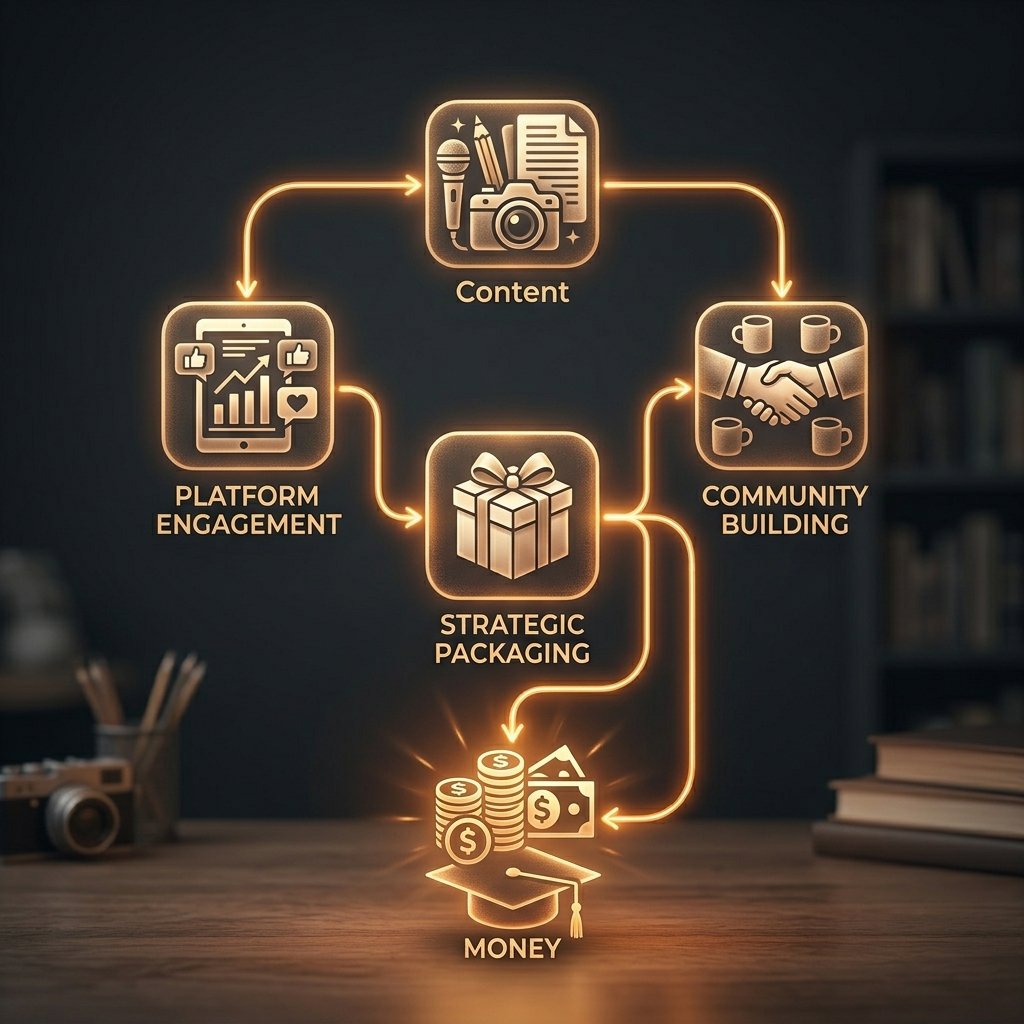
Here’s a simple framework to turn any piece of content into income, instead of letting it disappear after 48 hours.
- Create the core piece. A blog post, video, or newsletter issue built around a real problem your audience has.
- Attach one monetization path. An affiliate link, a product mention, or a lead magnet — pick one, not five.
- Repurpose into at least two formats. Turn a blog post into a newsletter section and a short video clip.
- Route traffic to an owned asset. Email list, product page, or community — somewhere you control.
- Track which content actually converts. Double down on what generates income, not just what gets views.
This is the backbone of treating content marketing as a revenue system instead of a guessing game.
Common Monetization Mistakes to Avoid
These mistakes quietly slow down income for creators who are otherwise doing everything right.
- Launching too many streams at once. Spreading effort across seven income streams usually produces worse results than mastering two.
- Ignoring the email list. Social platforms you don’t own can disappear or restrict reach at any time.
- Pricing too low out of fear. Underpricing digital products and courses signals low value and attracts the wrong customers.
- Skipping the trust-building step. Promoting before establishing credibility leads to weak conversion rates no matter how good the offer is.
- Treating monetization as a one-time event. Income streams need maintenance, updates, and occasional repositioning as your audience grows.
How AI Can Help You Scale Content Income Streams
AI doesn’t replace the strategy above — it speeds up the execution, if you use it correctly.
Practical ways to use AI for monetization:
- Draft first versions of product descriptions, sales pages, or email sequences faster.
- Repurpose one piece of content into multiple formats without starting from scratch each time.
- Analyze which topics in your content history get the most engagement, so you know what to monetize next.
The mistake is letting AI write the parts that actually build trust — your opinions, your results, your unique angle. Use it for speed on the repetitive parts, and keep the trust-building parts human.
Building Long-Term Wealth Through Content
Here’s the truth most creators don’t want to hear: the algorithm was never going to make you rich. Content income streams were always the actual goal — views were just the noise that got you there.
Every example in this article points back to the same idea. A blog post, a video, a newsletter issue — none of them are worth much on their own. What makes them valuable is what they’re connected to: an email list, a product, a service, a community. Content without a system behind it is just a performance that fades. Content with a system behind it is a digital business that keeps paying you long after you’ve moved on to the next idea.
You don’t need all seven content income streams from this article. You need one or two, built properly, with real trust behind them. Start with whichever stream matches what you already have — an engaged niche, a useful skill, a product idea you’ve been sitting on. Build that one stream until it’s stable, then add the next.
This is slower than chasing virality. It’s also the only path that actually compounds. Viral moments fade in days. Content income streams built on trust and owned assets keep generating revenue for years, through algorithm changes, platform shifts, and slow months.
The content you’re already creating is doing more work than you’re giving it credit for. The only thing missing is a clear destination for it. Pick one stream today, attach it to something you’re already publishing this week, and let that be the moment your content stopped being a hobby and started being an asset.
Key Takeaways
- Views and engagement are not income — they’re proxies that only matter if they convert into action.
- Multiple content income streams protect you from the risk of relying on one platform or partner.
- Trust converts better than reach, so build an audience that believes you, not just one that watches you.
- Start with one or two monetization models that match your existing strengths, not all seven at once.
- AI can speed up execution, but trust-building content should stay human.
Your content is already doing the hard work of building an audience. The only thing missing is a clear path from that content to actual income. Pick one stream from this list, build the simplest version of it this week, and let it run while you keep creating.