Open your feed right now. Count how many posts start with “In today’s fast-paced world” or end with “the choice is yours.” That’s not content fatigue you’re feeling — it’s pattern recognition. Your brain has quietly learned to spot AI before your eyes even catch the words. That instinct is exactly why AI content mistakes are becoming so costly in 2026.
People are tired of it, and they can tell when something was typed into a prompt box and published without a second look. Every time it happens, another small piece of trust disappears — and trust is the one thing AI content creation can’t fake forever.
Here’s the uncomfortable truth: publishing more content is no longer enough. In 2026, the creators winning aren’t the ones posting the most. They’re the ones their audience actually trusts. Anyone with a laptop can publish daily now, so daily publishing stopped being a competitive edge years ago.
That’s the real shift. AI didn’t kill content creation — it killed lazy content creation. The tools got better, the barrier to entry dropped to almost zero, and suddenly everyone’s competing in the exact same lane with the exact same prompts. The gap between creators who understand the difference between AI content creation done well and done lazily — and creators who don’t — is widening fast, and it’s only going to get wider.
This article breaks down the seven AI content mistakes quietly destroying brand authority right now, why they happen, and exactly how to fix them. Whether you’re a blogger, freelancer, affiliate marketer, coach, agency owner, or running an e-commerce store, these AI content mistakes apply to you. None of this is about avoiding AI — it’s about avoiding the version of AI content creation that quietly erodes everything you’ve built.
By the end, you’ll know exactly which habits are costing you credibility, and which small changes protect the trust you’ve worked hard to earn. Skip even one of these AI content mistakes unchecked, and it compounds quietly over months, showing up as flat engagement, lower conversions, and an audience that scrolls past without remembering your name. Catch it early, and the fix is usually faster than you’d expect.
Why Brand Authority Matters More in the AI Era
Anyone can generate a blog post in 30 seconds now. That’s exactly the problem.
When content becomes cheap and instant, the thing that separates you from everyone else isn’t your output — it’s your brand authority. Brand authority is what makes someone choose your newsletter, your course, your product, or your advice over a thousand other options that look almost identical on the surface.
Here’s what changes when AI is everywhere:
- Volume stops being impressive. Everyone can produce a lot of AI content creation. Output alone no longer signals expertise or effort.
- Trust becomes the scarce resource. People can’t verify expertise instantly, so they rely on signals like consistency, specificity, and real experience — the exact things lazy AI content creation skips.
- Audiences get pickier. They’ve been burned by generic advice before and now actively look for the real thing, often scrolling past anything that feels templated.
- Platforms adjust too. Search engines and social algorithms increasingly favor content that demonstrates real experience and original insight over recycled summaries, which is bad news for anyone repeating common AI content mistakes.
This is good news, actually. It means a smaller, more loyal audience built on real brand authority is worth more than a massive audience that doesn’t believe you. A thousand readers who buy what you recommend will always outperform a hundred thousand who scroll past without remembering your name — and that’s the entire point of avoiding AI content mistakes in the first place.
Why So Many Creators Are Misusing AI

Most creators aren’t misusing AI because they’re careless. They’re misusing it because they’re overwhelmed.
The pressure to post constantly across multiple platforms — a blog, a newsletter, three social channels, maybe a YouTube channel — makes AI tools feel like the only way to keep up. So people start treating AI as a replacement for thinking instead of a tool for thinking faster.
There’s also a financial pressure at play. Many creators are trying to build online income on tight timelines, and AI promises speed. Speed feels like progress, even when the output doesn’t actually move the business forward.
The result is a flood of AI content creation that technically answers a question but adds nothing new. No personal angle. No proof the writer actually tested anything. No reason to remember it five minutes later. That’s where these seven mistakes come from, and most creators are making at least two or three of them without realizing it.
AI Content Mistake #1: Publishing Without Human Editing
This is the most common — and most damaging — mistake on this list.
Unedited AI text has a recognizable rhythm: overly balanced sentences, vague transitions, and a tendency to restate the obvious. Readers notice it even if they can’t name what’s off. It feels smooth but hollow, like reading a summary instead of an opinion.
Examples:
- A freelancer sends a client blog draft straight from AI, and the client immediately spots the same phrasing used on competitor sites.
- An affiliate marketer publishes a “best product” roundup that reads like ten other roundups because no one rewrote it in their own voice.
- A coach posts a LinkedIn article that opens with “In today’s fast-paced digital landscape” — a phrase so overused it instantly signals unedited AI output.
The fix: Treat AI output as a first draft, not a final draft. Read it out loud. Cut anything that sounds like filler. Add a detail only you would know, and delete any sentence that could appear on literally any other website without changes.

AI Content Mistake #2: Losing Your Unique Brand Voice
If someone could swap your name for a competitor’s and the content would still make sense, you have If someone could swap your name for a competitor’s and the content would still make sense, you have a voice problem.
AI tools default to a neutral, slightly upbeat tone. That’s fine for a first pass, but if you never adjust it, your personal branding disappears into the noise — and so does your brand authority. Over time, your audience stops associating your content with anything specific to you, which makes them far easier to lose to the next creator making the same AI content mistakes.
Examples:
- A coach’s Instagram captions start sounding like generic motivational quotes instead of their usual blunt, no-fluff style.
- A YouTuber’s video scripts lose the sarcastic humor that originally built their audience, and comments start mentioning that “something feels off.”
- A finance newsletter that used to open with a sharp, opinionated take now opens with a neutral summary of the week’s news — and open rates quietly decline.
The fix: Build a short voice guide — your go-to phrases, your stance on common debates in your niche, your tone (direct, playful, skeptical, whatever it is). Feed that into your prompts and edits every time, and review it quarterly as your voice evolves. This single habit prevents one of the most common AI content mistakes before it ever reaches your audience.
AI Content Mistake #3: Prioritizing Volume Over Value
More posts doesn’t equal more growth. It often equals more noise — and more AI content mistakes hiding in plain sight.
Chasing AI content creation for its own sake leads creators to publish daily just to stay “consistent,” even when half of it doesn’t say anything new. This mistake is especially common among agencies trying to scale client output quickly, often at the expense of the client’s brand authority.
Examples:
- An agency promises clients “30 blog posts a month” and delivers thin, repetitive content that tanks engagement and search rankings.
- A newsletter writer doubles send frequency using AI drafts, and unsubscribe rates climb within weeks.
- A YouTuber posts three AI-scripted videos a week instead of one well-researched video, and average watch time drops sharply.
The fix: Set a value test before publishing: does this piece teach, prove, or solve something specific? If not, it’s not ready — no matter how fast it was to produce. One excellent piece a week will outperform seven mediocre ones almost every time, and it protects the brand authority you’ve spent months building.
AI Content Mistake #4: Skipping Fact-Checking and Verification
AI tools are confident even when they’re wrong. That’s a dangerous combination for anyone building authority.
Publishing inaccurate statistics, outdated information, or made-up sources is one of the fastest ways to lose audience trust permanently — and trust, once broken publicly, is extremely hard to rebuild.
Examples:
- A finance blogger publishes an AI-generated stat about average savings rates that turns out to be fabricated, and a sharp-eyed reader calls it out in the comments.
- An e-commerce brand’s product description includes a feature the product doesn’t actually have, leading to returns and negative reviews.
- A coach quotes a “study” in a sales page that doesn’t actually exist, damaging credibility when a potential client tries to find it.
The fix: Verify every number, claim, and source before publishing. If AI cites a study, find the actual study. If it can’t be found, cut the claim entirely rather than risk your credibility on something unverifiable.
AI Content Mistake #5: Creating Generic Content Anyone Can Copy
If your competitor could publish the exact same piece with zero changes, it’s not really yours.
This is the core problem with low-effort AI content creation: it produces the median answer, not the best one. It’s built to sound reasonable to everyone, which means it stands out to no one. Search engines are increasingly good at detecting this pattern, and so are readers.
Examples:
- Ten different “how to start a side hustle” posts that all list the same five ideas in the same order, with no original data or experience behind them.
- A coach’s lead magnet that reads like a summary of someone else’s framework instead of their own tested process.
- An e-commerce store’s product pages that read identically to five competitor stores using the same AI-generated template.
The fix: Add what AI can’t generate — your results, your failures, your specific process, your opinion on what most people get wrong. Specificity is the cheapest form of differentiation available to you right now.
AI Content Mistake #6: Ignoring Audience Relationships
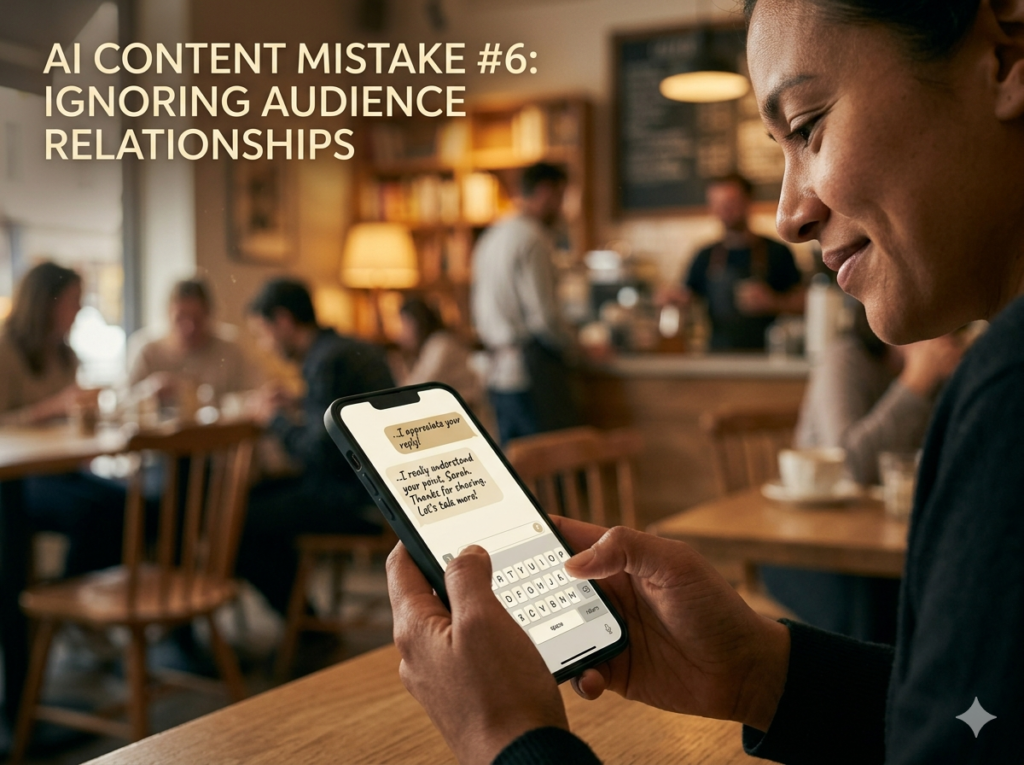
Content isn’t the relationship. It’s the doorway to one.
Creators who let AI handle replies, comments, and community interaction often don’t realize how quickly people notice the disconnect. A relationship built on automated responses isn’t really a relationship at all.
Examples:
- A creator uses AI to auto-respond to DMs, and followers start calling out the copy-paste tone publicly.
- A brand’s customer service replies feel scripted, and customers stop engaging with future posts or leaving reviews.
- An online coach’s “personalized” email replies are clearly templated, and a client mentions it during a cancellation request.
- A freelancer uses AI to handle client check-ins, and a long-term client leaves after feeling like “just another account” instead of a priority.
This is one of the most overlooked AI content mistakes because it doesn’t show up in analytics right away. Engagement might look stable for a while, even as trust quietly erodes behind the scenes. By the time unsubscribes or cancellations spike, the disconnect has usually been building for months — which makes it harder to trace back to the actual cause.
The fix: Use AI for drafting and research, but keep direct interaction human — especially replies, comments, DMs, and anything that feels personal. The few minutes this takes pays off in loyalty that automation can’t buy.
AI Content Mistake #7: Depending on AI Instead of Building Expertise
This is the long-term version of the problem. If you stop developing your own knowledge because AI can “just answer it,” your expertise quietly erodes.
That matters because content strategy built entirely on AI summaries has no depth to draw from when audiences ask harder questions or push back in real time.
Examples:
- A digital entrepreneur can’t explain their own course material in a live Q&A because they didn’t really write it themselves.
- A blogger’s “expert” articles fall apart under scrutiny from readers who know the topic well and start commenting with corrections.
- A freelance consultant struggles to answer client follow-up questions because their original proposal was AI-generated without real research behind it.
The fix: Use AI to speed up research and drafting, not to skip learning. Keep building real, testable knowledge in your niche, even when it’s slower than letting AI fill the gap.
The Human-First AI Content Checklist
Run any piece of content through this before publishing:
- Did a human edit this line by line?
- Does it sound like me, not a generic narrator?
- Is every fact, stat, and source verified?
- Does it include something only I could add (experience, opinion, result)?
- Would this stand out if a competitor published the same topic?
- Does it add real value, not just word count?
- Is there a clear next step for the reader?
If you can’t check most of these boxes, it’s not ready yet. This checklist takes two minutes to run and can save you from publishing something that quietly damages months of trust-building.
How to Use AI Without Damaging Your Brand Authority
AI isn’t the enemy of brand authority — misuse is. Used well, it speeds up the boring parts of content creation so you can spend more time on the parts that actually matter: original thinking, real examples, and direct connection with your audience.
Practical ways to use AI responsibly:
- Use it for first drafts, then rewrite key sections in your own voice.
- Use it for research summaries, then verify every claim independently before publishing.
- Use it for repetitive tasks like meta descriptions or social captions, not your core ideas or unique insights.
- Use it to brainstorm angles, then pick the one only you could write well based on your own experience.
- Keep a “proof layer” in every piece — a result, screenshot, client outcome, or personal example AI can’t fake or replicate.
This applies across digital entrepreneurship, freelancing, affiliate marketing, and content agencies alike. The tool doesn’t change. The discipline around how you use it does.

The Future of Trust and Content Creation Beyond 2026
As AI tools get better at sounding human, audiences will get better at spotting what’s real. That’s not a contradiction — it’s how trust markets work. The easier it becomes to fake authenticity, the more valuable genuine authenticity becomes.
Expect to see:
- Audiences rewarding creators who show their actual process, not just polished output.
- Content marketing shifting toward proof — case studies, screenshots, data, behind-the-scenes — over polished claims.
- The creator economy favoring smaller, trusted niches over broad, generic reach.
- Platforms continuing to adjust algorithms to reward original experience over recycled summaries.
- Verification becoming a selling point in itself, with creators openly showing receipts, raw footage, or unedited results to prove a claim is real.
- “Slow content” gaining traction as a quiet rebellion against AI-saturated feeds — fewer posts, more depth, longer shelf life.
This shift won’t happen overnight, and plenty of creators will keep chasing volume well past the point of diminishing returns. But the pattern is already visible across niches: the accounts and brands earning long-term loyalty are the ones willing to slow down and show their work.
That’s also where pricing power comes from. Audiences pay a premium for creators they trust completely, and that premium only grows as generic alternatives become free and instant. Trust stops being a nice-to-have and becomes the actual business model.
The creators who treat AI as a multiplier for real expertise — not a replacement for it — will be the ones still standing when the novelty wears off and audiences settle into who they actually trust.
Key Takeaways
- AI content mistakes happen when creators treat AI as a replacement for thinking, not a tool for speed.
- Unedited, generic AI content damages audience trust faster than no content at all.
- Your brand voice, personal experience, and verified facts are what AI can’t replicate.
- Volume without value hurts long-term growth, even if it looks productive short-term.
- The creators who win long-term combine AI speed with human expertise and judgment.