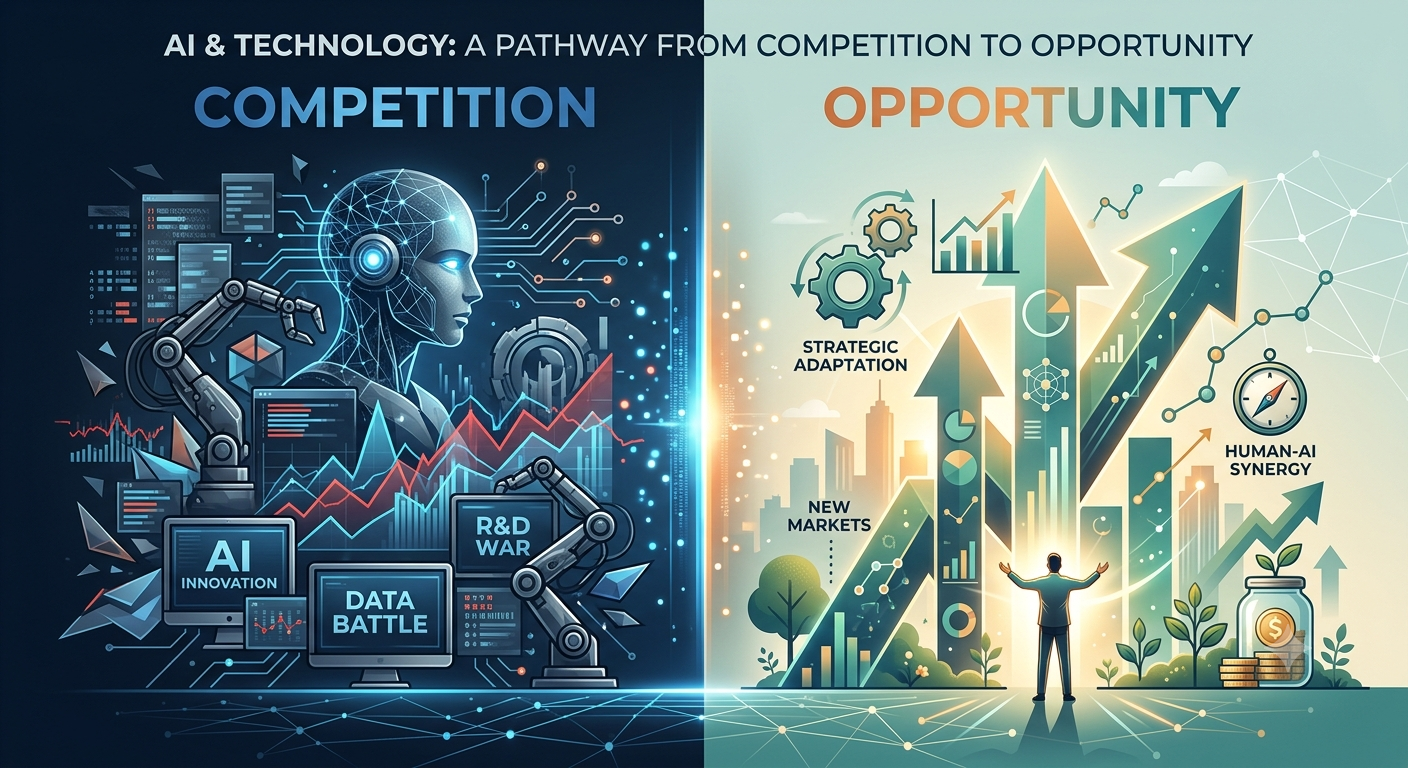
Every week brings a new AI headline. OpenAI ships an update. Anthropic releases a smarter model. Google folds AI deeper into search. Meta open-sources something new. It looks like a war between a handful of giant companies — and in the boardroom, it is one.
But if you’re building a digital business, that war isn’t happening to you. It’s happening for you.
Every time these companies compete, prices drop, tools improve, and access gets easier. That competition is the reason a solo creator today has capabilities that used to require a funded startup and a team of engineers. This is what using AI for digital business actually looks like in practice — not chasing headlines, but quietly absorbing the benefits of a fight you’re not even in.
This article isn’t about picking a winner. It’s about showing you how to use the AI race itself as leverage for your business.
Why the AI Race Actually Matters to You
Here’s the simple version of what’s happening. OpenAI, Anthropic, Google DeepMind, Meta, xAI, and others are all racing to build the most capable, most useful AI models. None of them wants to fall behind, so they’re pouring enormous resources into research, safety, and product development — and releasing new versions faster than ever.
Competition like this behaves the same way it does in any market. When several serious players are chasing the same customers, three things tend to happen: quality goes up, prices come down, and access gets easier. You’ve seen this before with cloud storage, streaming services, and smartphones. AI is going through the same cycle, just faster.
For a large corporation, this competition is about market share and valuation. For you, it’s about something more useful: cheaper tools, better output, and fewer excuses not to start.
Think about what happened with cloud storage a decade ago. When a handful of companies fought to offer more free storage than each other, the person who benefited wasn’t any of those companies — it was every small business owner who suddenly had enterprise-grade infrastructure for free. AI is following the same pattern, just moving faster because the stakes are higher and the technology improves in months instead of years.
There’s also a psychological shift worth naming. A lot of people see “AI race” headlines and feel like spectators — like this is a story happening in Silicon Valley boardrooms that has nothing to do with them. That mindset is the actual barrier. The moment you stop treating AI development as news and start treating it as infrastructure you get to use, the entire relationship changes. You’re not rooting for a team. You’re stocking a toolbox that keeps getting better for free, or close to it.
How AI Competition Is Reshaping Digital Business
A few years ago, “using AI in your business” mostly meant experimenting with a single chatbot. Today, competition between AI companies has changed what’s realistically available to an independent entrepreneur.
Models are getting genuinely better, not just bigger. Each new release tends to reason more clearly, write more naturally, and make fewer factual mistakes than the one before it. That directly affects the quality of what you can produce with AI assistance.
Costs are falling. When one company cuts prices or offers a stronger free tier to compete for users, others usually follow. Tools that once required a business budget are now available to anyone with a laptop and an internet connection.
Innovation cycles are shrinking. New features that used to take years to reach the public — better memory, longer context, more accurate research, multi-step automation — now show up in a matter of months, because no company can afford to sit still while a competitor moves.
Automation is becoming standard, not experimental. Tasks that used to require hiring — first-draft writing, customer support responses, basic research, scheduling — can now be handled with AI as a starting point, then refined by a human.
Barriers to entry are dropping. You no longer need technical skill to build a website, launch a product, or automate a workflow. AI tools increasingly do the technical heavy lifting, which levels the field between someone with $50,000 in funding and someone with a solid idea and a free account.
None of this required you to predict which company would “win.” It just required you to pay attention and use what became available.
Practical Ways to Put the AI Race to Work
Here’s that section with “AI” replaced by “artificial intelligence” throughout the body (numbered subheadings left as-is):
This is where competition turns into opportunity. Here are the areas where digital entrepreneurs are getting the most direct benefit from the current pace of artificial intelligence development.
1. Content Creation
Artificial intelligence-assisted writing tools have gone from clunky to genuinely useful for first drafts, outlines, and idea generation. The advantage isn’t letting artificial intelligence write your content for you — readers and search engines can usually tell. The advantage is using it to kill the blank page, then adding your own voice, examples, and judgment on top. A blogger who used to spend three hours on a first draft can now spend thirty minutes on a draft and two hours making it genuinely good.
2. SEO and Keyword Research
Artificial intelligence tools can now scan search intent, cluster related topics, and suggest content gaps in minutes — work that used to take hours of manual research. This doesn’t replace SEO strategy. It removes the grunt work so you can spend more time on the strategy itself: what your audience actually wants to know, and how you’re uniquely positioned to answer it.
3. Affiliate and Digital Marketing
Artificial intelligence helps affiliate marketers write more product comparisons, test more headlines, and personalize outreach at a scale that used to require a team. One person can now realistically run what used to take three.
4. Customer Support
Artificial intelligence chat tools can handle the repetitive 80% of customer questions — order status, FAQs, basic troubleshooting — freeing you to focus on the conversations that actually need a human. For a solo entrepreneur, this is the difference between customer support being a full-time job and being a manageable hour a day.
5. Coding and No-Code Development
You no longer need to know how to code to build a landing page, a simple app, or an automation workflow. Artificial intelligence coding assistants can generate working code from a plain-English description, and non-technical founders are using this to build products they couldn’t have built themselves two years ago.
6. Market and Competitor Research
Instead of manually digging through competitor websites and reviews, artificial intelligence can summarize what a market is doing, where the gaps are, and what customers are complaining about — turning a week of research into an afternoon.
7. Workflow Automation
The most underrated use of artificial intelligence in digital business isn’t content or marketing — it’s the boring stuff. Sorting emails, drafting responses, organizing tasks, summarizing meetings. These small automations add up to hours of reclaimed time every week, which is often the real bottleneck for a solo entrepreneur.
8. Email Marketing
Writing a single good email is easy. Writing a consistent weekly sequence that doesn’t feel repetitive is where most solo entrepreneurs burn out. Artificial intelligence tools can generate subject line variations, adapt one core message into multiple formats, and help maintain a consistent sending schedule — the kind of consistency that used to require an actual marketing team.
9. Product Creation
Digital products — templates, planners, mini-courses, ebooks — used to take weeks to go from idea to finished asset. Artificial intelligence shortens the production timeline dramatically: drafting the outline, generating first-pass copy, and even helping design supporting visuals. The idea and the quality control still have to come from you, but the production bottleneck that used to stop people from finishing is a lot smaller now.
What Falling AI Prices Actually Mean for You
It’s easy to skim past “artificial intelligence is getting cheaper” as a throwaway line, but it’s worth sitting with what that actually changes for a digital entrepreneur.
Two years ago, running a business with serious artificial intelligence assistance meant real monthly cost — often enough to make a beginner think twice before trying it. Competition changed that math. When one company offers a stronger free tier or a lower-priced plan to win users, competitors are pushed to match it or offer something better. You don’t have to negotiate, wait for a sale, or time your entry — the price pressure happens automatically, in the background, whether you’re paying attention or not.
This matters most for the people this article is written for: beginners, freelancers, and early-stage entrepreneurs who don’t have a marketing budget or a team. A few years ago, the gap between “well-funded startup” and “person with a laptop” was mostly a gap in what tools they could afford. That gap has narrowed dramatically. A solo creator today can access research, writing, and automation tools that would have required a funded team not long ago — and pay little or nothing for the privilege, simply because three or four large companies are fighting over the same customer base.
There’s a second effect that gets less attention: falling prices also lower the cost of experimentation. When a tool is expensive, you use it carefully and sparingly. When it’s cheap or free, you try more things, faster, with less fear of wasting money on an idea that doesn’t work. That shift — from cautious, rationed use to freewheeling experimentation — is quietly changing how many successful digital businesses actually get built. The winners aren’t always the most talented; often they’re the ones who tried the most variations before landing on what worked, and cheap access to artificial intelligence is what makes that volume of experimentation possible.
None of this requires you to track which company is cutting prices this month. You just need to stay a genuine user of these tools, so the benefit reaches you as it happens instead of six months later.
OpenAI vs. Anthropic: Different Tools for Different Jobs
Since these two names come up constantly, it’s worth addressing directly: this isn’t about which one is “better.” It’s about which one fits the task in front of you.
OpenAI’s models are widely used for broad creative writing, coding help, and general-purpose tasks, with a large ecosystem of integrations and third-party tools built around them. Anthropic’s Claude models are known for careful reasoning, longer documents, and following detailed instructions accurately — useful when you need consistency across a long piece of work or a nuanced task.
| Use Case | Often Strong Fit |
|---|---|
| Long-form writing with detailed instructions | Anthropic (Claude) |
| Broad general assistant tasks & integrations | OpenAI |
| Careful, multi-step reasoning | Anthropic (Claude) |
| Rapid experimentation with plugins/tools | OpenAI |
Most experienced digital entrepreneurs end up using more than one AI tool, matching the tool to the task rather than committing to a single provider. That flexibility is itself a benefit of the competition — you get to choose, and switching costs are low.
Mistakes That Cancel Out the Advantage
Access to powerful AI tools doesn’t automatically translate into a better business. Here’s where entrepreneurs commonly lose the advantage they had:
Using AI without a strategy. Opening a chatbot and typing “write me a blog post” with no plan behind it produces generic content that doesn’t serve any real goal.
Publishing AI output unedited. Raw AI drafts are a starting point, not a finished product. Skipping the editing step is the fastest way to sound like everyone else using the same tool.
Relying on a single AI model for everything. Different tools have different strengths. Treating one as your only option limits what you can actually produce.
Skipping fact-checking. AI models can state incorrect information confidently. Anything factual — numbers, claims, quotes — needs to be verified before it goes live.
Chasing every new tool. New AI products launch constantly. Trying to adopt all of them spreads your attention thin instead of letting you master the few that actually move your business forward.
Removing the human element. The businesses that stand out aren’t the ones that sound the most “AI-polished.” They’re the ones that use AI for speed and still show a real person’s judgment, story, and perspective.
A Simple Framework to Build an AI-Powered Business
If you’re starting from zero, here’s a practical order of operations:
- Learn the basics. You don’t need to become a technical expert. Spend a few hours understanding what current tools can and can’t do well. Knowing the limits matters as much as knowing the capabilities — it’s what keeps you from over-trusting output that needs a second look.
- Plan before you prompt. Decide what problem you’re solving and for whom, before you open any tool. Artificial intelligence accelerates a plan — it doesn’t replace one. A vague goal produces vague output, no matter how good the model is.
- Create with a first draft, not a final product. Use the tool to generate options, outlines, and starting points, then apply your own judgment, examples, and voice on top.
- Market with assisted testing. Generate multiple headline or ad variations quickly, then let real data tell you which one works. Speed of testing, not just speed of writing, is the real advantage here.
- Automate the repetitive parts. Once you know what your business actually needs done every week, automate it so your time goes toward decisions, not tasks.
- Scale by reinvesting the time you save. The real payoff isn’t the content it produces — it’s the hours it gives back. Reinvest those hours into the parts of your business only you can do: relationships, strategy, and the creative decisions that actually differentiate you.
This isn’t a one-time setup. Revisit each stage every few months, because the technology underneath you is changing constantly. A workflow that made sense six months ago might already have a faster version available today.
The Real Opportunity
The race between companies will keep producing headlines. New models, bigger claims, bold predictions about who’s “winning.” None of that is the opportunity.
The opportunity is quieter than that: while these companies compete to build better tools, faster and cheaper, you get to use whatever they produce — without picking a side, without placing a bet, and without waiting for the dust to settle. The entrepreneurs who benefit most from this moment aren’t the ones trying to predict the winner. They’re the ones already building with what’s available today, and adjusting as better tools arrive.
You don’t need to choose the winning company. You need to start using artificial intelligence for digital business now, while the technology is improving faster than at any point before — and get better at it before your competitors do.
That’s the actual edge available right now. Not a prediction about which company ends up on top five years from now, but a decision you can make this week: pick one task in your business, hand the first draft of it to a tool, and see how much time comes back to you. Do that consistently, and this race stops being something you read about — it becomes something that’s quietly working in your favor every single day.
Conclusion: The Race Isn’t the Opportunity — Showing Up Is
By the time this race has a clear winner, it won’t matter much to you. A new model will already be out. A better price will already be live. The next “biggest leap yet” will already be old news. That’s the nature of a race this fast — there’s no finish line to wait for, only a pace to keep up with.
So the real question was never “which company should I bet on.” It’s “what am I doing with the tools already sitting in front of me, right now, for free or close to it.” That’s the entire opportunity in one sentence — and it’s available to you today, regardless of who’s ahead this quarter.
The entrepreneurs who come out of this moment ahead won’t be the ones who picked the right side. They’ll be the ones who treated every new release as one more tool added to their kit, kept building while everyone else was debating, and let their competitors spend time arguing about winners while they spent that same time getting work done.
You don’t need permission to start. You don’t need the “best” company. You just need to open a tool, hand it your next task, and see what comes back. Do that today.