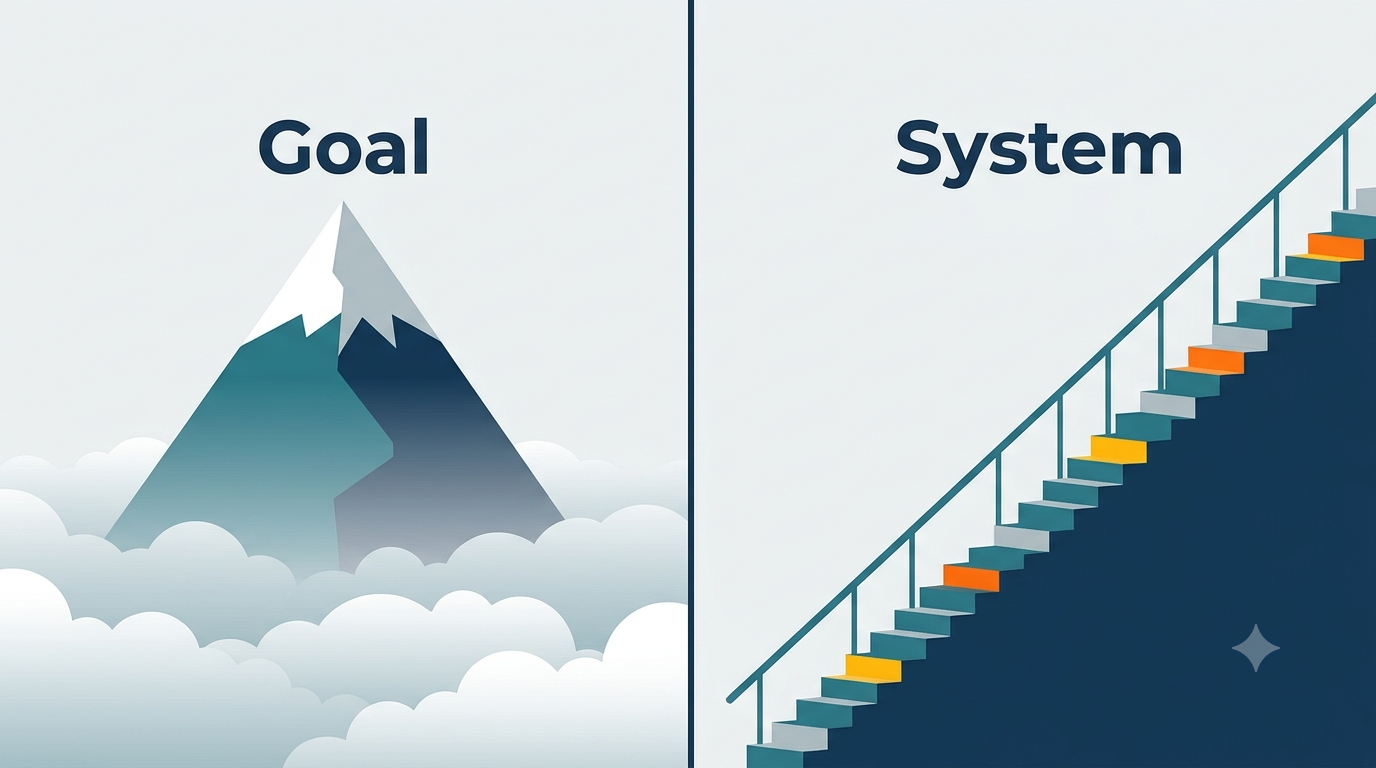
You’ve set the goal before. Lose 20 pounds. Save $10,000. Launch the side hustle. Read 50 books this year.
For about three weeks, you were unstoppable. Then life happened, motivation faded, and the goal quietly slipped off your to-do list — again.
This isn’t a willpower problem. It’s a systems vs goals problem, and once you understand the difference, you’ll never plan your future the same way again.
In this guide, we’ll break down why goals alone often fail, why systems quietly win, and exactly how to build one that lasts longer than your motivation does.
What Are Goals and Systems?
Before comparing systems vs goals, it helps to define both clearly, because most people confuse the two.
A goal is a specific outcome you want to achieve. It has a finish line. “Earn $5,000 a month from freelancing” is a goal. So is “run a marathon” or “get promoted.”
A system is the process you repeat to get there. It’s the daily or weekly routine that produces the outcome as a natural byproduct. Pitching two new clients every week is a system. Running three times a week, rain or shine, is a system.
James Clear, author of Atomic Habits, popularized this distinction by arguing that goals are about the results you want to achieve while systems are about the processes that lead to those results. That single idea reframes how ambitious people should actually plan their lives.
Here’s a simple side-by-side to lock in the difference.
Table 1: Goals vs Systems at a Glance
| Aspect | Goals | Systems |
|---|---|---|
| Definition | A specific, desired outcome | A repeatable process or routine |
| Time orientation | Future-focused | Present-focused |
| Feedback | Only at the finish line | Continuous, daily |
| Motivation needed | High, especially early on | Lower, because it’s automatic |
| Example | “Save $10,000 this year” | “Automatically save 15% of every paycheck” |
| What happens after it’s reached | Often a letdown or drift | Keeps producing results |
Neither one is the villain here. Goals give you direction. Systems give you traction. The systems vs goals debate isn’t about picking a winner and discarding the loser — it’s about understanding what each one is actually built to do.
Why Goals Alone Often Fail
Goals feel productive to set. Writing “start a business” in your notes app gives you a little dopamine hit, as if you’ve already made progress. But that feeling is deceptive.
Here’s why goals, on their own, tend to fall apart.
They rely on a finish line that keeps moving. Once you hit the goal, then what? Many entrepreneurs hit their first $10K month and feel strangely empty, because the goal was the destination, not a way of life.
They create an all-or-nothing mindset. Miss one gym session and the whole “get fit” goal can feel broken. This binary thinking — succeed or fail — is exhausting and unsustainable.
They depend on motivation, and motivation is unreliable. Motivation spikes when you set the goal and fades within days. If your plan needs daily motivation to survive, it was never a plan. It was a wish.
They ignore the actual mechanism of change. A goal doesn’t tell you what to do on a random Tuesday when you’re tired and unmotivated. A system does.
This is the core of the systems vs goals conversation: goals describe a destination without giving you a reliable vehicle to get there.
Why Systems Create Long-Term Success
Systems win because they don’t ask you to feel motivated — they ask you to follow a process, even on your worst day.
Think about compound interest. Nobody gets excited watching $50 a month grow in a savings account. But five years later, that boring, repeatable system has quietly built real wealth. That’s what a system does. It trades excitement for consistency, and consistency is what actually compounds.
Long-term success rarely comes from one dramatic decision. It comes from small, repeated actions that stack over time. A writer doesn’t become prolific by “wanting” to write a book. They become prolific by writing 500 words a day, every day, whether they feel inspired or not.
Systems also remove decision fatigue. When your morning routine, your savings plan, or your content schedule is automatic, you stop relying on willpower — which research shows is a limited resource that depletes throughout the day.
The Psychology Behind Successful Systems
Understanding the psychology here makes the systems vs goals shift much easier to apply.
1. Identity drives behavior more than outcomes do. Instead of “I want to save money,” a system-driven person thinks “I’m someone who saves automatically.” The Behavioral Scientist notes that habits are formed by repeated behavior in a stable context, and reforming them requires consciously changing that context and behavior. Systems change the context, which reshapes identity over time.
2. Small wins build dopamine loops. Every time you complete a system step — one workout, one cold email, one budget check — your brain releases a small hit of dopamine. That reward loop keeps you coming back, independent of whether the big goal has been reached yet.
3. Environment beats willpower. Systems usually involve environmental design: keeping your running shoes by the door, automating your savings transfer, blocking distracting apps during work hours. You’re not fighting your brain — you’re designing around it.
4. Progress feels safer than pressure. Goals often create anxiety because failure looms at the end. Systems reduce anxiety because “success” is simply showing up today, which is achievable and repeatable.
7 Reasons Systems Beat Goals
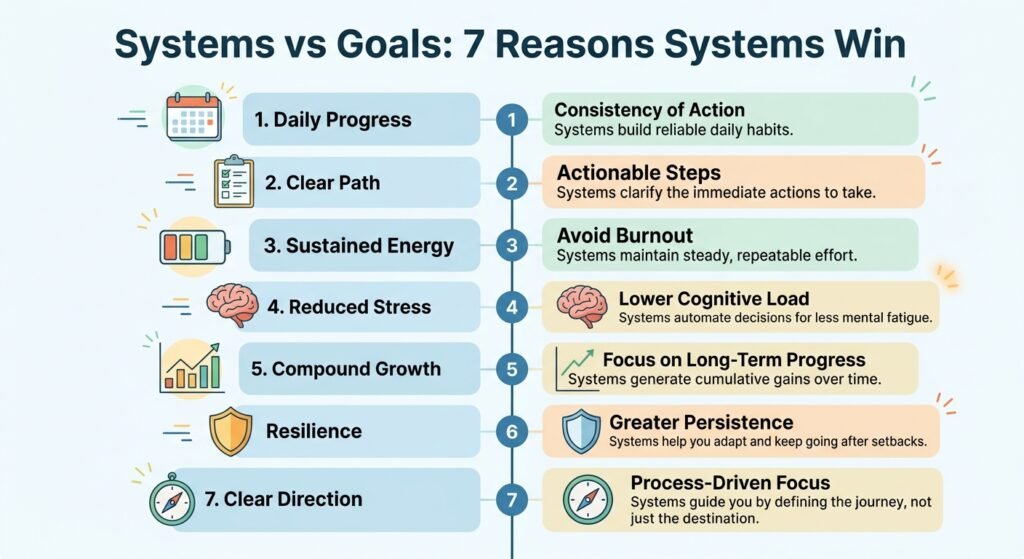
Here’s where the systems vs goals debate gets practical. These seven reasons explain exactly why systems consistently outperform goals for long-term success.
1. Systems Keep Working After the Goal Is Reached
A goal like “save $10,000” ends the moment you hit it. A system like “save 20% of every paycheck automatically” keeps building wealth indefinitely.
Example: Two freelancers each want to save $10K. One sets the goal and stops saving once they hit it. The other builds an automatic transfer system — and two years later, they’ve saved $40K without thinking about it once.
2. Systems Don’t Require Daily Motivation
Systems run on autopilot once they’re built. You don’t need to “feel like it” — you just follow the routine.
Example: A student who studies “when motivated” crams before exams. A student with a system — 45 minutes every evening at 7 PM — studies consistently regardless of mood.
3. Systems Provide Constant, Not Delayed, Feedback
Goals only tell you if you succeeded at the very end. Systems tell you daily whether you’re on track.
Example: Tracking “did I publish content today?” gives instant feedback. Tracking “did I hit 10K followers?” gives you an answer only months later, if ever.
4. Systems Reduce Decision Fatigue
Every decision you don’t have to make is energy saved for what matters.
Example: Meal-prepping every Sunday removes five daily decisions about what to eat, freeing up mental energy for deep work during the week.
5. Systems Scale Better Than Willpower
Willpower is finite. Systems, once automated, don’t get tired.
Example: An entrepreneur relying on willpower to “post on social media more” burns out within weeks. One with a content calendar and scheduling tool posts consistently for years.
6. Systems Build Compounding Skill, Not Just Compounding Outcomes
Repeating a process daily makes you better at the process itself, not just closer to a number.
Example: A beginner investor who researches one stock a week for a year becomes genuinely skilled at analysis — a goal like “make $5,000 trading” never teaches that skill directly.
7. Systems Protect You From Burnout and Failure Spirals
When a system has a bad day, you just repeat it tomorrow. When a goal has a bad month, it can feel like total failure.
Example: Missing one workout inside a system (“train 4x a week”) is a blip. Missing a month inside a rigid goal (“lose 15 lbs by June”) can feel like the whole plan collapsed.
Table 2: The 7 Reasons Systems Beat Goals
| # | Reason | Goal-Only Approach | System-Based Approach |
|---|---|---|---|
| 1 | Keeps working after success | Stops at the target | Keeps compounding |
| 2 | No daily motivation needed | Relies on willpower | Runs on routine |
| 3 | Constant feedback | Feedback only at the end | Feedback every day |
| 4 | Less decision fatigue | New decisions daily | Decisions made once |
| 5 | Scales better | Burns out over time | Sustains for years |
| 6 | Builds real skill | Focuses on the number | Focuses on the process |
| 7 | Prevents burnout spirals | Bad month feels like failure | Bad day is just a blip |
How to Build a System That Lasts
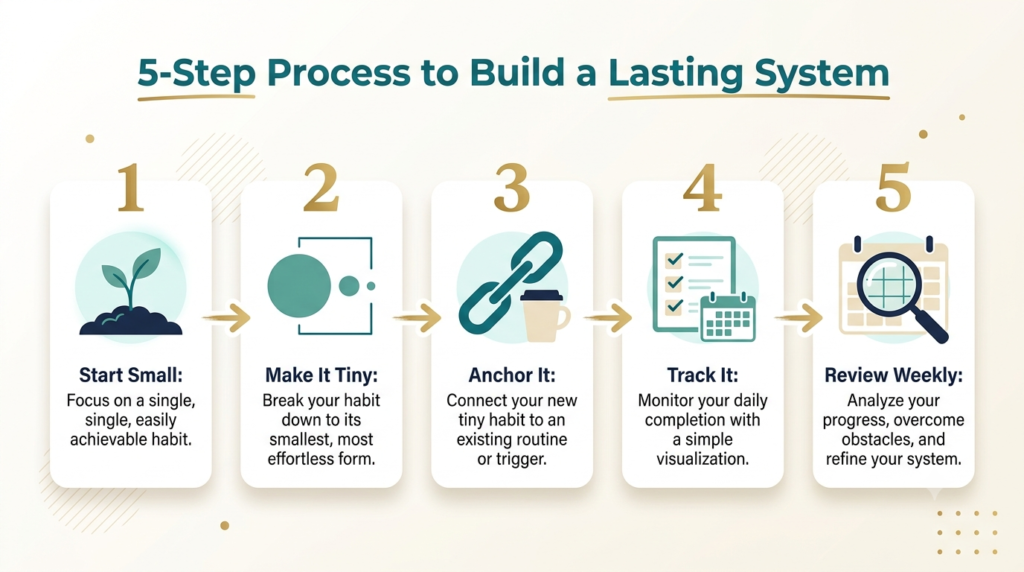
Knowing the theory behind systems vs goals is one thing. Actually building a system is another. Here’s a beginner-friendly framework.
Step 1: Start with your goal, but translate it into an action. Don’t discard your goal. Use it to define direction. “Build a six-figure online business” becomes “send five outreach messages every weekday.”
Step 2: Make the system embarrassingly small at first. The biggest mistake beginners make is starting too big. One page a day beats “write a book” as a starting system, because it’s nearly impossible to skip.
Step 3: Anchor it to an existing habit. Attach the new behavior to something you already do automatically. “After I pour my morning coffee, I write down three priorities for the day.”
Step 4: Track the process, not just the outcome. Use a simple habit tracker or checklist. Checking a box for “I did the system today” is more motivating than waiting weeks for outcome data.
Step 5: Review weekly, adjust monthly. Systems aren’t set in stone. Check in weekly to see what’s working, and make small adjustments monthly rather than overhauling everything at once.
Table 3: Building a System — Beginner vs Advanced
| Stage | Beginner Approach | Advanced Approach |
|---|---|---|
| Starting point | One tiny daily action | Multiple linked routines |
| Tracking | Simple checklist | Data dashboard or app |
| Review cycle | Weekly reflection | Weekly + monthly + quarterly |
| Flexibility | Rigid, fixed steps | Adaptive, adjusts to feedback |
| Focus | Consistency | Optimization |
Common Mistakes People Make
Even people who understand the systems vs goals concept still trip up when applying it.
Mistake 1: Building a system that’s too complex. A five-step morning routine with 12 habits sounds impressive but collapses fast. Simplicity survives; complexity doesn’t.
Mistake 2: Abandoning the system after one missed day. One missed day is data, not defeat. The “never miss twice” rule keeps small slips from becoming full collapses.
Mistake 3: Ignoring goals completely. Some people swing too far and drop goals altogether. Without a goal, a system has no direction — you need both.
Mistake 4: Not measuring anything. If you can’t see whether the system is working, you can’t improve it. Even a simple checkmark on a calendar counts as measurement.
Mistake 5: Copying someone else’s system exactly. A system that works for a morning person may fail for a night owl. Systems need to fit your actual life, not someone else’s highlight reel.
Table 4: Common Mistakes and Quick Fixes
| Mistake | Why It Fails | Quick Fix |
|---|---|---|
| Too complex | Hard to maintain, easy to quit | Start with one small step |
| Quitting after one miss | Turns a slip into a spiral | Apply the “never miss twice” rule |
| Dropping goals entirely | Loses direction and purpose | Keep one clear goal as your compass |
| No tracking | Can’t tell what’s working | Use a checklist or simple app |
| Copying others blindly | Doesn’t fit your lifestyle | Customize the system to your routine |
A Simple 30-Day Action Plan
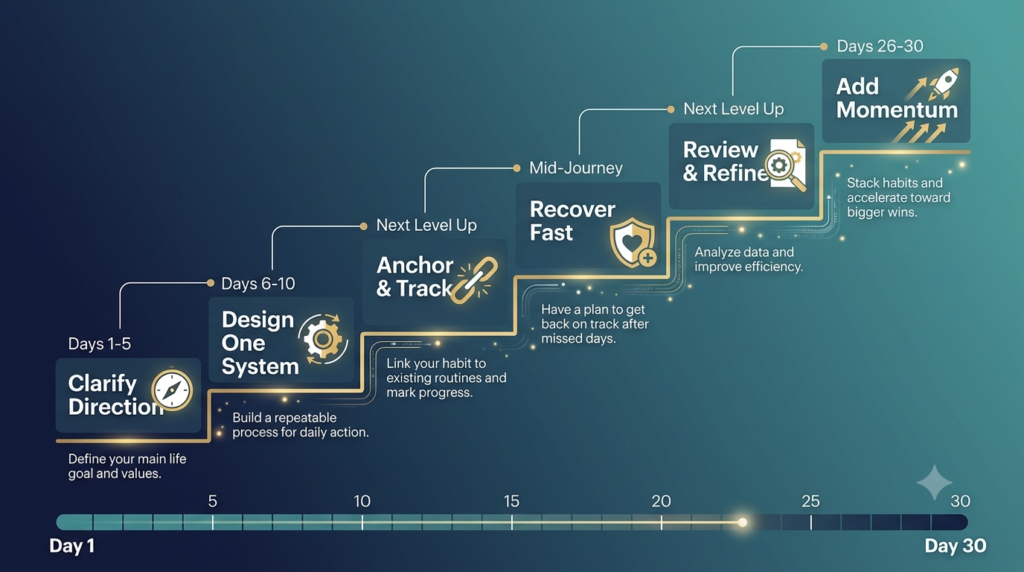
You don’t need a perfect plan to start applying the systems vs goals mindset. You need a simple one.
Days 1–5: Clarify direction. Pick one goal that matters most right now — financial, career, or personal. Write it down once. You won’t look at it daily; it’s just your compass.
Days 6–10: Design one tiny system. Choose a single, small daily action tied to that goal. Keep it under five minutes if you can.
Days 11–15: Anchor and track. Attach the system to an existing habit and start checking it off daily on a simple tracker.
Days 16–20: Expect a slip, and recover fast. You will miss a day. When it happens, use the “never miss twice” rule and move on without guilt.
Days 21–25: Review and refine. Look back at what’s working. Adjust timing, difficulty, or triggers — but don’t add complexity yet.
Days 26–30: Add one more system. Once the first system feels automatic, layer in a second small habit connected to a different area of your life.
Actionable Checklist: Turning Goals Into Systems
- Write down one clear, specific goal
- Break the goal into one small daily action
- Attach the action to an existing habit
- Choose a simple way to track it (app, journal, calendar)
- Set a weekly review day
- Apply the “never miss twice” rule
- Celebrate process wins, not just outcome wins
- Add a second system only after the first feels automatic
Systems vs Goals: The Real Takeaway
Here’s the honest truth: this was never really a fight between systems vs goals. Goals point you in the right direction. Systems are the vehicle that actually gets you there, day after day, whether motivation shows up or not.
If you only set goals, you’ll feel inspired in bursts and stuck in between. If you only build systems without any goal, you’ll stay busy without knowing why. The winning approach uses goals to choose the destination and systems to guarantee the journey — and that combination is what produces genuine long-term success.
Start small. Pick one goal. Design one tiny system around it. Track it for 30 days. That’s how real, lasting change actually begins — not with more motivation, but with a better process.
Your next step: Choose one goal today, and instead of writing another to-do list, build the one small system that will carry you toward it — even on the days you don’t feel like it.
Frequently Asked Questions
1. What’s the main difference between systems vs goals? A goal is the outcome you want, like earning a certain income. A system is the repeatable process that produces that outcome, like a weekly savings routine or a daily outreach habit.
2. Are goals completely useless if systems work better? No. Goals provide direction and purpose. Systems provide the consistent action needed to actually reach that direction. You need both working together.
3. Why do most goals fail within a few weeks? Most goals fail because they depend on motivation, which naturally fades. Without a system to support daily action, the initial excitement of goal setting isn’t enough to sustain progress.
4. How is habit systems different from goal setting? Goal setting focuses on defining a target outcome. Habit systems focus on the repeated behaviors that move you toward that outcome, regardless of how motivated you feel on a given day.
5. Can beginners really build a system without any planning experience? Yes. Start with one small daily action tied to your main goal, track it simply, and review weekly. Systems don’t require expertise — they require consistency.
6. How long does it take for a system to become automatic? Research on habit formation suggests it can take anywhere from a few weeks to a few months, depending on the complexity of the behavior and how consistently it’s repeated.
7. What should I do if I miss a day in my system? Follow the “never miss twice” rule. One missed day is normal. Two in a row starts to build a new, unwanted pattern, so prioritize getting back on track immediately.
8. How do I know if my system is actually working? Track the process itself, not just the outcome. If you’re consistently completing the daily action, the system is working, even if the final result takes longer to appear.
9. Is the systems vs goals approach only useful for business and money? No. It applies to fitness, relationships, learning, and personal development just as effectively as it applies to business and financial goals.
10. What’s the best first system for someone new to this approach? Pick something small and tied to your top priority, like saving a fixed amount automatically each payday or writing 200 words a day. Small, consistent systems build momentum fastest.