You wake up. Before your feet touch the floor, your thumb is already on your phone. Notifications. A red badge on Instagram. A TikTok your friend sent at midnight. Three unread messages. Two emails marked “urgent.” By the time you sit up in bed, you haven’t made a single decision today — but forty other companies already have. Nobody taught you to protect your attention before handing you a device engineered to take it.
This is normal now. It doesn’t feel like a crisis. It feels like Tuesday. Most people never stop to protect their attention, because no one ever told them it was something worth protecting in the first place.
But here’s the uncomfortable question worth sitting with: what if protecting your attention mattered more than protecting your money?
Money can be earned back. Lost time, lost focus, and lost momentum are harder to recover. Every minute your attention drifts toward something designed to hold it — not help you — is a minute you didn’t spend building a skill, a business, a relationship, or a future. Learning to protect your attention is, in many ways, the first financial decision of your day, made before you’ve even opened a banking app.
In this guide, you’ll learn why attention has quietly become the most valuable asset of the digital age, how your brain gets hijacked before you’re even aware of it, and what successful entrepreneurs, investors, and creators do differently to protect their focus. You’ll also get ten practical habits, a full daily routine, and a 15-point checklist you can start using today to protect your attention. Every section comes back to the same idea: when you protect your attention on purpose, you protect your ability to build wealth, skills, and a life you actually chose.
1. Why Attention Is the Most Valuable Asset Today
For most of modern history, money and information were the scarce resources. Now, attention is scarcer than both, which is exactly why so few people know how to protect their attention in the first place.
Information is abundant — nearly infinite, available in seconds. Money moves faster than ever, with more ways to earn, save, and invest than any previous generation had access to. But human attention hasn’t scaled at all. You still only have the same 24 hours, and roughly the same cognitive bandwidth, that people had a hundred years ago. If you don’t protect your attention deliberately, something else will claim it for you.
This imbalance created what researchers and marketers now call the attention economy — a marketplace where companies compete not for your money directly, but for your focus, because focus is what eventually leads to money. Social platforms, streaming services, news apps, and games are engineered by teams of behavioral designers whose entire job is to make it harder for you to protect your attention, keeping you looking, tapping, and scrolling for as long as possible.
Every extra minute you spend on a platform is revenue for someone else. That’s the business model. Your attention is the product being sold to advertisers, and you are, quite literally, the raw material — which is exactly why you have to protect your attention the way a business protects its most valuable asset.
This is why learning to protect your attention isn’t a productivity trend — it’s an economic skill. The people who understand how to protect their attention are the same people who tend to build wealth, skills, and influence faster than everyone else, because they’re not fighting a constant, invisible drain on their mental resources.
Think about how differently we treat money versus attention. Most people track their spending, set budgets, and think twice before a large purchase. Very few people apply that same scrutiny to protecting their attention. Yet a wasted afternoon of scattered focus can cost far more in lost opportunity than a wasted twenty dollars ever could. Reframing attention as a spendable resource — one with a daily budget, just like money — is often the first mental shift that makes protecting your attention feel urgent instead of optional.
The attention economy also rewards speed and volume over depth. Headlines are written to be clicked, not necessarily understood. Short videos are cut to maximize watch time, not comprehension. This creates an environment where the default mode of consumption trains your brain toward shallow processing, making it even harder to protect your attention and stay focused on what actually matters.
2. How Your Brain Gets Hijacked

Your brain didn’t evolve for infinite scrolling. It evolved to notice movement, novelty, and social signals — all things digital platforms now manufacture on demand, which is exactly why it takes real effort to protect your attention once you’re inside one of these systems.
Dopamine is the chemical driver behind this. It’s released not when you get a reward, but in anticipation of one. That’s why refreshing your feed feels compelling even when most of what you find is boring — your brain is chasing the possibility of something interesting, not the certainty of it. This is the same mechanism behind slot machines, and it’s built into nearly every major app you use, making it that much harder to protect your attention without a deliberate plan.
A few specific mechanisms make this worse:
- Notifications interrupt your train of thought with a small dopamine hit, training your brain to expect frequent interruption as normal instead of learning to protect your attention by default.
- Infinite scrolling removes natural stopping points, so there’s no built-in moment to ask, “should I keep going?”
- Multitasking feels productive but actually fragments attention, since your brain doesn’t truly multitask — it switches rapidly between tasks, losing efficiency each time.
Each of these hijacks a system that was designed to help you survive, not to help you build a business or finish a degree. Left unmanaged, these forces will always win, because they were built by teams whose job is to defeat your intentions — which is exactly why learning to protect your attention has to be intentional, not automatic.
3. The Hidden Cost of Lost Attention
The cost of losing your attention rarely shows up immediately. It shows up months and years later, as a pattern — and the longer you go without a plan to protect your attention, the more that pattern compounds.
Poor decisions. A fragmented mind makes reactive choices instead of thought-through ones — in relationships, spending, and career moves.
Lower productivity. Constant task-switching can take real time to recover from after each interruption, meaning a “quick check” of your phone often costs far more than the sixty seconds it appears to.
Missed opportunities. Ideas, conversations, and openings require presence to notice. A distracted mind misses signals that a focused one would catch.
Slower learning. Deep learning requires sustained attention. Skimming and multitasking create the illusion of learning without the retention.
Weaker relationships. Half-present conversations erode trust and connection over time, even when the other person doesn’t say anything about it.
Less creativity. Original ideas tend to surface in quiet, unstimulated moments — the same moments most people now fill with a screen instead of protecting their attention for something more valuable.
Lower income potential. Because attention drives skill-building, deep work, and decision-making, chronic distraction quietly caps how far your career, business, or investments can grow.
None of these costs are dramatic on their own. That’s what makes them dangerous — they compound silently, the same way a small daily expense compounds into real debt.
Consider two people with identical skills and starting points. One learns to protect her attention, setting aside two focused hours a day for learning and building. The other spends those same two hours in scattered, low-focus activity — some scrolling, some half-attentive work, some reactive messaging. After a single week, the difference is barely visible. After a year, one person has built a meaningful skill or a small business, while the other has consumed a large amount of content and built very little. The gap isn’t caused by one dramatic decision — it’s caused by thousands of small, distracted moments stacking up in one direction instead of the other.
This is also why lost attention is harder to recover than lost money. You can always earn more money. But the specific hours, ideas, and momentum lost to distraction on a given day are gone permanently. That permanence is exactly why you have to protect your attention like a protected asset, rather than treating it as unlimited.
4. Why Successful People Guard Their Attention
Across entrepreneurship, investing, writing, athletics, and content creation, one pattern shows up again and again: high performers treat their attention as a finite, valuable resource — not an infinite one. They protect your attention the same way they protect their money, and that habit shows up in almost everything they do.
Common behaviors tend to include:
- Batching communication. Instead of reacting to every message in real time, many successful professionals check email and messages at set times, protecting long stretches for focused work. This is one of the simplest ways to protect your attention without changing anything else about your day.
- Saying no by default. High performers tend to protect their calendar aggressively, treating unplanned requests as the exception rather than the rule — because every “yes” is really a decision about where to protect your attention next.
- Environment design. Many remove distractions physically — phones in another room, notifications off, single-tab work sessions — rather than relying on willpower alone to protect your attention.
- Scheduled deep work blocks. Rather than hoping focus happens, they build dedicated time for it, often in the morning before the day’s noise begins, when it’s easiest to protect your attention.
- Regular attention audits. Periodically reviewing where time and focus actually went, then adjusting — a habit built entirely around learning to protect your attention more deliberately each week.
These aren’t universal rules for every successful person, and results vary by individual and industry. But the underlying principle is consistent: protecting your attention is treated as seriously as protecting capital, because both compound over time.
5. Deep Work vs Shallow Work
Not all work is created equal, and understanding the difference is central to learning how to protect your attention.
Deep work is cognitively demanding, focused activity that pushes your abilities and creates real value — writing, coding, strategic planning, studying, or designing. It’s also where protecting your attention pays off the most.
Shallow work is logistical, low-focus activity that can be done while distracted — replying to routine emails, scheduling, administrative tasks.
The problem is that shallow work feels productive because it produces a constant stream of completed items. Deep work feels slower because progress is less visible day to day, even though it’s what actually builds skills, businesses, and income over time — which is exactly why it deserves your most protected attention.
Context switching — jumping between an email, a message, and a task, then back again — quietly taxes the brain each time, making even simple work take longer and feel more exhausting than doing it in one uninterrupted block. Every switch is a small failure to protect your attention.
A flow state, where focus becomes almost effortless and time seems to disappear, only tends to happen after a stretch of uninterrupted concentration — often 20 minutes or more. Every notification or “quick check” resets that clock, which is why so few people who don’t protect your attention ever experience flow at all.
Practical example: A freelance writer who blocks two uninterrupted hours in the morning will often produce more usable, higher-quality work than someone who writes in fifteen-minute fragments spread across an eight-hour day with constant interruptions.
A second example: An aspiring investor who spends thirty focused, uninterrupted minutes each week actually reading a company’s financial filings will typically understand that business better than someone who spends three scattered hours skimming headlines and social media commentary about the same stock. The quality of attention matters more than the quantity of time spent — proof that how you protect your attention matters more than how much of it you have.
This is also why “busy” and “productive” are not the same thing. A packed calendar full of shallow tasks can create the feeling of accomplishment while producing very little that compounds. Protecting time for deep work often means deliberately looking less busy in the short term, in exchange for producing something that actually matters in the long term.
Table 1: Shallow Work vs Deep Work
| Shallow Work | Deep Work |
|---|---|
| Low cognitive demand | High cognitive demand |
| Easily interrupted | Requires uninterrupted blocks |
| Feels busy | Feels effortful |
| Replaceable by others | Builds unique skill/value |
| Examples: email, scheduling, admin | Examples: writing, coding, strategy, studying |
6. 10 Powerful Habits That Protect Your Attention
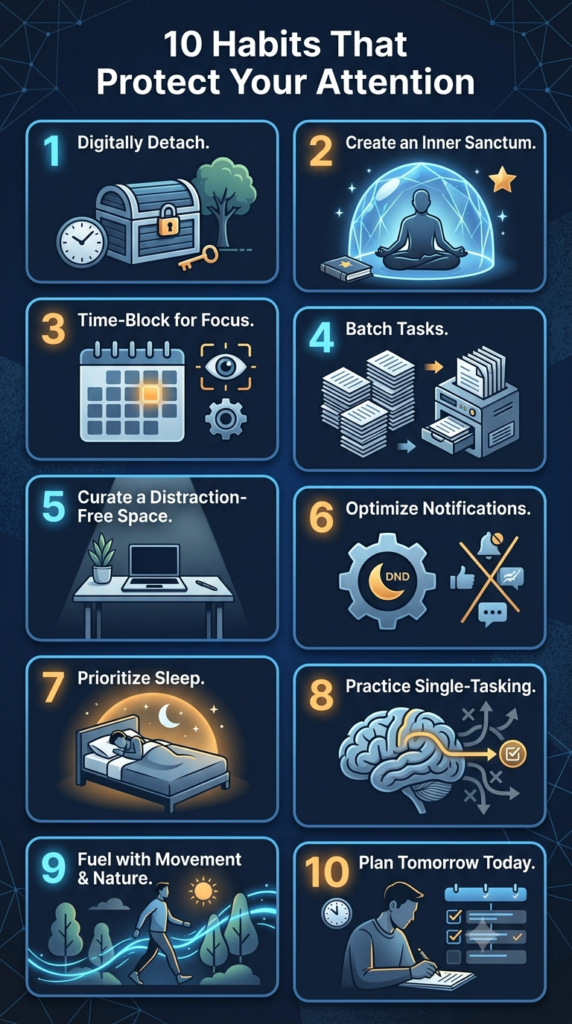
1. Phone-Free Mornings
Explanation: Delay checking your phone for the first 30–60 minutes after waking. Why it works: Starting the day reactively primes your brain for distraction all day long. How to implement: Charge your phone outside the bedroom overnight. Expected benefit: A calmer, more intentional start to your day.
2. Single-Tasking Blocks
Explanation: Work on one task, one tab, one window at a time. Why it works: Eliminates the hidden cost of context switching. How to implement: Close every tab except the one you’re using; use full-screen mode. Expected benefit: Faster, higher-quality output in less time.
3. Notification Audit
Explanation: Turn off all non-essential app notifications. Why it works: Removes constant external triggers for your attention. How to implement: Go into settings and disable notifications for every app except calls and messages from key contacts. Expected benefit: Fewer interruptions, lower background anxiety.
4. Time Blocking
Explanation: Assign specific hours to specific types of work. Why it works: Creates structure that protects deep work from shallow tasks. How to implement: Use a calendar to block 2-hour deep work sessions before checking messages. Expected benefit: Predictable, protected focus time daily.
5. The One-Tab Rule
Explanation: Keep only one browser tab open during focused work. Why it works: Removes the temptation of “quick” tab-switching. How to implement: Use a tab-limiting browser extension if needed. Expected benefit: Sustained concentration without micro-interruptions.
6. Scheduled Social Media Windows
Explanation: Check social media only during two or three set windows per day. Why it works: Prevents infinite scrolling from bleeding into work and rest time. How to implement: Set app timers or move apps off your home screen. Expected benefit: Reclaimed hours previously lost to passive scrolling.
7. Digital Minimalism Sweep
Explanation: Regularly delete unused apps and unsubscribe from noisy notifications. Why it works: Fewer digital inputs means fewer competing demands on focus. How to implement: Do a monthly 15-minute phone declutter. Expected benefit: A calmer, less cluttered digital environment.
8. Environment Design
Explanation: Physically arrange your workspace to remove distraction triggers. Why it works: Willpower is limited; environment does the work automatically. How to implement: Keep your phone in another room during deep work; use website blockers. Expected benefit: Less reliance on willpower to stay focused.
9. The Weekly Attention Audit
Explanation: Review where your time and focus actually went each week. Why it works: You can’t fix what you don’t measure. How to implement: Use a screen-time report or simple journal at the end of each week. Expected benefit: Growing self-awareness and better weekly adjustments.
10. Protected Deep Work Sessions
Explanation: Block non-negotiable time for your most important, focus-demanding work. Why it works: Ensures your highest-value work always gets your best attention. How to implement: Treat these blocks like unmissable meetings. Expected benefit: Consistent progress on the work that actually builds skills and income.
Table 2: Attention Killers vs Attention Protectors
| Attention Killers | Attention Protectors |
|---|---|
| Constant notifications | Notification audit |
| Multitasking | Single-tasking blocks |
| Infinite scrolling | Scheduled social media windows |
| Reactive mornings | Phone-free mornings |
| Cluttered apps/tabs | Digital minimalism sweep |
| No structure | Time blocking |
| Willpower-only approach | Environment design |
7. The Connection Between Attention and Wealth
Wealth building isn’t only about how much money you make — it’s about how well you use the resources that generate money, and attention is one of the most important of those resources.
Learning skills — coding, writing, marketing, investing analysis — all require sustained, focused attention. Fragmented attention produces shallow, forgettable learning.
Building businesses requires long stretches of strategic, uninterrupted thinking — for planning, problem-solving, and decision-making.
Creating content, whether for a blog, a newsletter, or a digital product, depends on focused creative output. Distracted creators produce generic, forgettable work; focused creators produce work that stands out.
Investing wisely requires the attention to research, evaluate, and think independently instead of reacting to headlines and social media hype.
Making better financial decisions — from budgeting to major purchases — happens when you’re present enough to think clearly instead of reacting impulsively.
In each case, the pattern is the same: focus is the input, and skill, income, or better decisions are the output. Protect the input, and the output tends to follow.
Table 3: Consumer Habits vs Creator Habits
| Consumer Habits | Creator Habits |
|---|---|
| Passive scrolling | Active, focused production |
| Reacting to trends | Building original work |
| Consuming others’ ideas | Developing personal skills |
| Short-term dopamine | Long-term skill compounding |
| Time spent, nothing built | Time spent, assets built |
Table 4: One Hour of Focus vs One Hour of Scrolling
| One Hour of Focus | One Hour of Scrolling |
|---|---|
| Skill or project progress | No lasting output |
| Compounds over weeks/months | Resets daily |
| Builds toward income or growth | Provides short-term entertainment only |
| Requires initial effort | Requires no effort |
| Long-term value | Short-term relief |
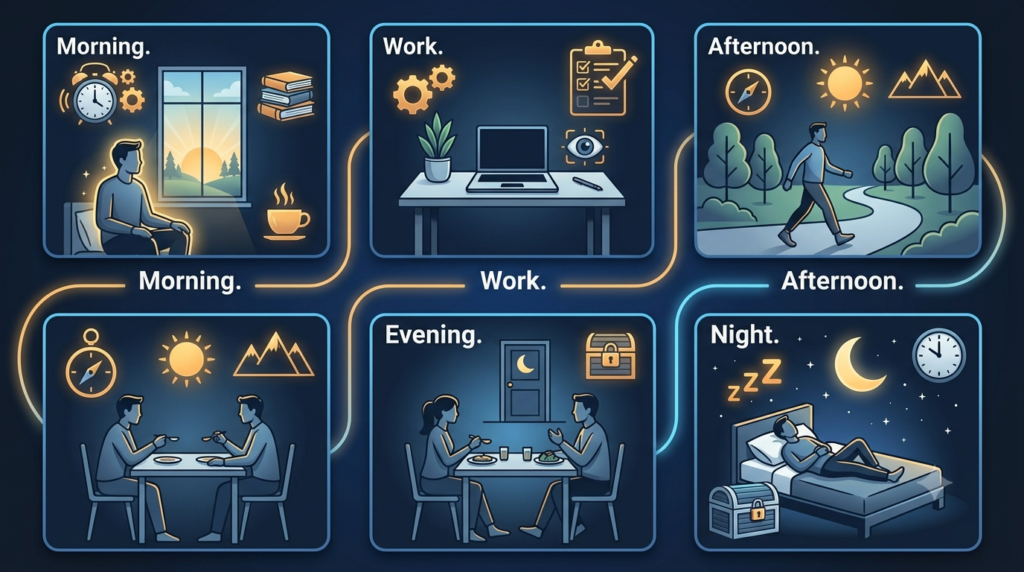
8. Create an Attention-Protecting Daily Routine
Morning: Delay phone use for the first 30–60 minutes. Use this window for a calm start — journaling, light movement, or planning your top priority for the day.
Work: Begin with your most demanding deep work task, before checking email or messages. Use time-blocked, single-tasking sessions with your phone out of reach.
Afternoon: Batch-process shallow work — emails, admin, scheduling — in a dedicated window rather than throughout the day. Take a genuine break away from screens.
Evening: Wind down deep work by early evening. Use scheduled social media windows if needed, but keep them time-boxed rather than open-ended.
Night: Avoid screens for at least 30 minutes before bed. Reflect briefly on what went well and what pulled your focus, so tomorrow’s routine can improve.
15 Ways to Protect Your Attention Starting Today
- Keep your phone out of the bedroom overnight.
- Turn off non-essential notifications.
- Do a phone-free first hour each morning.
- Time-block your most important task before checking messages.
- Use the one-tab rule during focused work.
- Schedule specific windows for social media instead of checking randomly.
- Batch emails and admin tasks into one or two daily blocks.
- Remove unused apps every month.
- Use a website blocker during deep work sessions.
- Protect at least one 90-minute deep work block daily.
- Avoid multitasking on important tasks.
- Do a weekly attention audit using screen-time data.
- Set a hard stop for screens before bed.
- Replace one scrolling session per day with a focused activity.
- Ask before every “quick check”: is this intentional, or reactive?
Conclusion
In today’s economy, attention is one of the most valuable assets you own — arguably more valuable than the money in your bank account, because attention is what determines how that money, and every future dollar, gets earned.
Every notification you ignore, every scrolling session you shorten, every deep work block you protect is a small deposit into a much bigger account: your skills, your business, your relationships, and your future income.
You don’t need to overhaul your entire life today. Start with one shift. Audit how you spent your attention yesterday — be honest about it — and choose one habit from this guide to apply today. Protect your attention the way you’d protect your savings, and watch how much more you’re able to build.