
Two friends graduated the same year, took entry-level jobs paying almost identical salaries, and lived in the same city. Ten years later, one owns a small rental property and a growing online business. The other is still living paycheck to paycheck, wondering where the money went.
Same income. Same opportunities. Wildly different outcomes.
What separated them wasn’t a lucky break, a rich relative, or a genius investment. It was a stack of small, repeated behaviors — the exact kind of habits that keep people poor quietly, invisibly, for years, until the gap between “comfortable” and “stuck” becomes impossible to ignore.
What if the biggest obstacle to building wealth isn’t your salary — but the habits that keep people poor that you repeat every day without noticing?
Financial outcomes are shaped by many factors: the economy, family background, access to opportunity, even luck. None of that should be dismissed. But of everything that shapes your financial life, your daily habits are one of the few things you fully control — which is exactly why the habits that keep people poor matter so much, and why replacing them is so powerful.
In this guide, you’ll learn the 10 most common habits that keep people poor, the psychology behind why smart, capable people fall into these habits that keep people poor without noticing, and the specific wealth building habits that replace each one. You’ll also get a 30-day habit reset plan, a self-assessment checklist, and practical tools to start shifting your financial trajectory today.
1. Why Small Habits Shape Your Financial Future
It’s tempting to believe wealth is built through one dramatic decision — a big promotion, a viral business idea, a lucky investment. In reality, wealth is almost always the by-product of small, boring, repeated actions compounding quietly in the background, while the habits that keep people poor compound quietly in the opposite direction.
The Compound Effect
Money compounds. So do habits. A habit that saves or earns you an extra $5 a day seems irrelevant in isolation. Repeated for ten years, and invested rather than spent, it becomes a meaningfully different financial future. This is the same compound effect that drives investing returns, except it starts with behavior, not capital. Among all the habits that keep people poor, underestimating compounding is arguably the root cause of most of them, and it’s often the first habit that keeps people poor without them ever noticing.
Behavior Over Time, Not Willpower in the Moment
People often frame financial success as a willpower problem — as though the wealthy simply “want it more.” Behavioral research suggests otherwise: consistent systems and environments outperform raw willpower, because willpower is a finite, fluctuating resource while systems run on autopilot. This is why the habits that keep people poor rarely look like one bad decision. They look like a repeated pattern that nobody bothered to redesign — and left unaddressed, these are the same habits that keep people poor for decades.
Identity-Based Habits
There’s a difference between someone who says “I’m trying to save money” and someone who says “I’m a saver.” The second framing, often called identity-based habit formation, ties behavior to self-image rather than a temporary goal. When a financial habit becomes part of your identity, it survives bad days, low motivation, and unexpected setbacks — the exact moments when the habits that keep people poor usually take over.
Consistency Beats Intensity
An occasional burst of financial discipline — one no-spend week, one aggressive savings month — rarely changes a financial trajectory. Consistency, even at a modest level, almost always outperforms intensity, because consistency is what allows compounding to actually happen. This single idea underlies nearly every wealth-building habit in this guide.
2. Why People Stay Stuck
Before breaking down the specific habits that keep people poor, it’s worth understanding why capable, intelligent people get stuck in them in the first place. It’s rarely about intelligence or effort. It’s about environment and psychology.
Comfort Zones
Familiar routines feel safe, even when they’re quietly working against you. Leaving a comfort zone — asking for a raise, starting a side business, cutting a habitual expense — triggers real discomfort, so many people simply avoid it, even when they know it’s costing them long-term.
Instant Gratification
Human brains are wired to weigh immediate rewards more heavily than distant ones. This is a well-documented driver of poor financial habits: a small reward today consistently beats a larger reward next year in how the brain evaluates it, even when the math clearly favors waiting.
Lack of Planning
Without a plan, money tends to flow toward whatever feels most urgent in the moment, not what matters most long-term. A lack of financial planning isn’t usually a lack of intelligence — it’s a lack of a default system to fall back on when life gets busy.
Decision Fatigue
Every financial choice — what to buy, what to skip, whether to invest — draws from a limited daily pool of mental energy. By the end of a long day, that pool is often empty, which is exactly when impulsive spending and poor financial habits tend to take over.
Environment
Your environment — the people you spend time with, the content you consume, the defaults on your accounts — shapes your habits more than motivation ever will. Redesigning environment is one of the most underrated ways to interrupt habits that keep people poor without relying on willpower at all.
3. The 10 Silent Habits That Keep People Poor
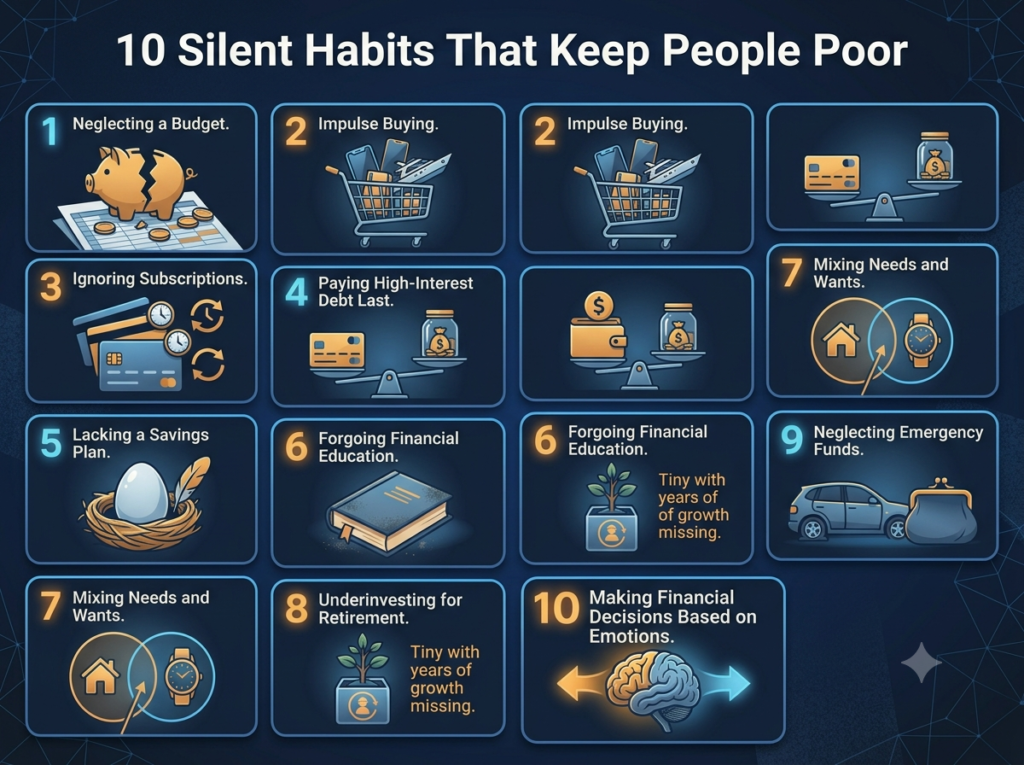
These are the specific, repeatable habits that keep people poor — often without them ever realizing it. Each one is common, understandable, and fully reversible.
1. Consuming More Than Creating
The habit: Spending far more time consuming content, entertainment, and information than producing anything of value.
Why people fall into it: Consumption is passive and immediately rewarding. Creation requires effort, patience, and tolerance for imperfect early results.
The psychology: Consumption offers a quick dopamine hit; creation offers a delayed, often uncertain reward. The brain naturally favors the former.
Real-life example: Someone scrolls for two hours a night, every night, but has never started the digital product, blog, or side skill they’ve talked about for years.
The fix: Flip the ratio deliberately. Even 30 minutes a day spent creating — writing, building, learning a monetizable skill — compounds into a meaningfully different skill set within a year.
2. Never Learning Valuable Skills
The habit: Staying at the same skill level for years, with no deliberate investment in learning anything new or marketable.
Why people fall into it: Learning feels optional when there’s no immediate deadline forcing it, so it’s the first thing pushed aside.
The psychology: Present bias makes today’s comfort feel more urgent than tomorrow’s skill gap, even though skill stagnation is one of the quieter habits that keep people poor over a decade.
Real-life example: A worker in a shrinking industry keeps doing the same tasks the same way, while a colleague quietly learns AI tools, data skills, or a digital trade on the side.
The fix: Treat one hour of weekly skill-building as non-negotiable — the same way you’d treat a bill payment.
3. Ignoring Opportunity Cost
The habit: Making financial and time decisions without ever asking, “what am I giving up by choosing this?”
Why people fall into it: Opportunity cost is invisible. Unlike a price tag, it doesn’t show up anywhere.
The psychology: People are much better at evaluating visible costs than invisible trade-offs, which is why opportunity cost is one of the most underestimated habits that keep people poor.
Real-life example: Choosing to binge a show instead of spending that same hour on a freelance skill that could eventually replace a full-time income.
The fix: Before a purchase or time decision, ask what else that money or hour could become in five years.
4. Constant Digital Distractions
The habit: Checking phones, social feeds, and notifications so frequently that deep, focused work rarely happens.
Why people fall into it: Apps are engineered for compulsive checking; the pull is designed, not accidental.
The psychology: Variable reward loops — the same mechanism behind slot machines — keep attention fragmented, making sustained, wealth-building focus difficult to sustain.
Real-life example: A freelancer sits down to work but checks their phone every few minutes, stretching a two-hour task into a five-hour afternoon.
The fix: Batch notifications, schedule focused blocks, and treat attention as a finite, valuable resource — because it is.
5. Living Without Goals
The habit: Drifting through months and years with no clear financial targets or timelines.
Why people fall into it: Goal-setting requires facing an uncomfortable gap between where you are and where you want to be.
The psychology: Without a specific target, the brain has no reference point for prioritizing decisions, so money and time default to whatever feels urgent.
Real-life example: Someone earns a raise and simply absorbs it into daily spending, because there was never a goal for where the extra money should go.
The fix: Set one specific, written, time-bound financial goal — not “save more,” but “save $3,000 in 6 months.”
6. Waiting Until You’re Ready
The habit: Delaying action on a business idea, investment, or skill until conditions feel perfect.
Why people fall into it: Waiting feels responsible. It disguises fear of failure as caution.
The psychology: This is a form of the planning fallacy combined with perfectionism — “someday” always feels safer than “today,” even though someday rarely arrives on its own.
Real-life example: Someone has wanted to start a side business for three years but is still “researching” instead of launching a rough first version.
The fix: Replace “ready” with “started.” A rough, imperfect launch teaches more in a month than years of preparation.
7. Avoiding Difficult Work
The habit: Consistently choosing easy, low-value tasks over harder tasks that would actually move the needle financially.
Why people fall into it: Difficult work triggers discomfort and the risk of visible failure; easy work feels productive without the risk.
The psychology: This is avoidance behavior — the brain protects against short-term discomfort even when it guarantees long-term stagnation.
Real-life example: Spending hours organizing a to-do list instead of making the one uncomfortable phone call — a client pitch, a salary negotiation — that could change income.
The fix: Identify the single most valuable, most avoided task each day, and do it first, before anything else.
8. Spending Everything You Earn
The habit: Increasing spending in lockstep with every raise or windfall, so savings never actually grow.
Why people fall into it: Lifestyle creep happens gradually and feels like a reasonable reward for hard work.
The psychology: Each new spending level quickly becomes the new “normal,” resetting the baseline for what feels necessary.
Real-life example: A raise leads to a nicer car payment and pricier habits, leaving the same $0 in savings as before the raise.
The fix: Automatically direct a fixed percentage of every raise or bonus into savings or investments before it ever reaches your spending account.
9. Comparing Yourself to Others
The habit: Making financial decisions based on what peers, influencers, or neighbors appear to have, rather than actual goals.
Why people fall into it: Social comparison is a deeply wired human instinct, amplified enormously by social media.
The psychology: Curated online lifestyles create a distorted, unrealistic benchmark, fueling comparison-driven spending that has little to do with genuine priorities.
Real-life example: Financing a vacation or upgrade to match what looks like a friend’s lifestyle online, without knowing their actual financial situation.
The fix: Audit spending against your own written goals, not against anyone else’s visible lifestyle.
10. Never Investing in Yourself
The habit: Treating personal and financial education, courses, tools, and skill development as unnecessary expenses rather than investments.
Why people fall into it: Self-investment has a delayed, uncertain payoff, which makes it easy to deprioritize in favor of guaranteed, immediate spending.
The psychology: People discount future benefits heavily compared to present costs — a bias that quietly undercuts long-term earning potential.
Real-life example: Skipping a skill-building course that costs a few hundred dollars, while spending far more than that on entertainment in the same year.
The fix: Reframe self-investment as a category of its own — a fixed, protected portion of income set aside specifically for growth.
4. Habits That Build Wealth Instead
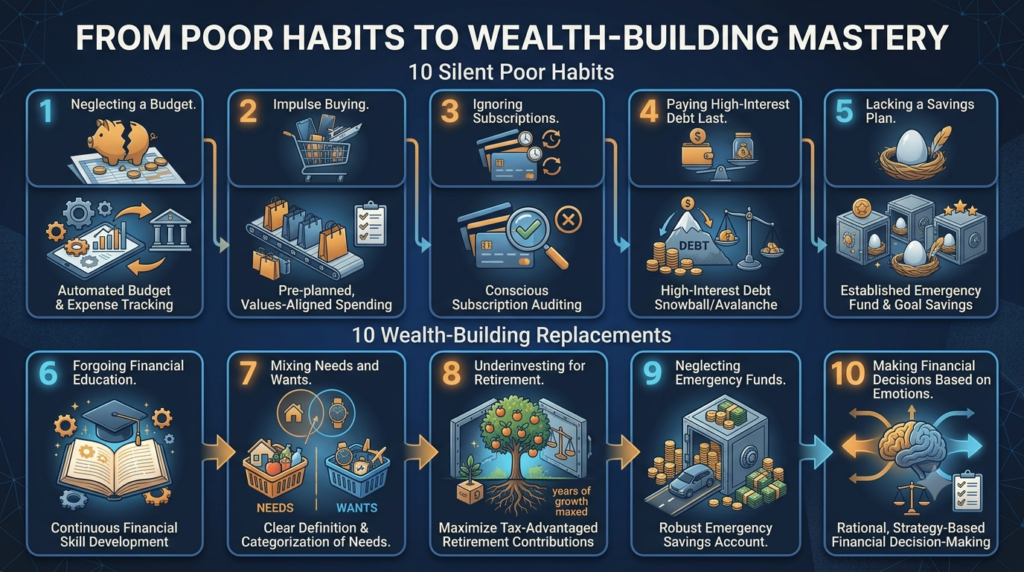
Every poor financial habit above has a direct, learnable replacement. This is where wealth-building habits start to take shape.
Table 1: Poor Habit vs. Wealth-Building Habit
| Poor Habit | Wealth-Building Habit |
|---|---|
| Consuming more than creating | Creating consistently, even in small amounts |
| Never learning valuable skills | Weekly deliberate skill-building |
| Ignoring opportunity cost | Weighing trade-offs before every major decision |
| Constant digital distractions | Scheduled, protected focus blocks |
| Living without goals | Specific, written, time-bound goals |
| Waiting until you’re ready | Starting imperfectly and improving over time |
| Avoiding difficult work | Doing the hardest task first |
| Spending everything you earn | Automating savings before spending |
| Comparing yourself to others | Measuring progress against your own goals |
| Never investing in yourself | Treating self-investment as a protected budget line |
Table 2: Immediate Reward vs. Long-Term Reward
| Situation | Immediate Reward | Long-Term Reward |
|---|---|---|
| Skipping a course | Extra cash today | Higher earning ceiling for years |
| Impulse purchase | Instant satisfaction | Delayed financial security |
| Scrolling instead of building | Entertainment now | A monetizable skill later |
| Spending a raise | Lifestyle upgrade | Compounding investment growth |
| Avoiding a hard conversation | Comfort today | Career or income growth |
Table 3: Consumer Mindset vs. Creator Mindset
| Consumer Mindset | Creator Mindset |
|---|---|
| Watches trends | Builds within trends |
| Buys convenience | Builds systems |
| Reacts to content | Produces content |
| Spends free time passively | Invests free time in skills |
| Measures success by lifestyle | Measures success by assets built |
Table 4: Daily Habit → Five-Year Financial Impact
| Daily Habit | Approximate Five-Year Impact |
|---|---|
| Saving/investing $5 a day consistently | A meaningful investment base, compounded |
| One hour weekly of skill-building | A marketable, income-relevant new skill |
| Reducing daily distraction by 1 hour | Roughly 1,800+ reclaimed hours for creation |
| Automating 10% of every paycheck | A protected savings habit that never relies on willpower |
| Investing in one course per year | A stacked, compounding skill set over five years |
5. The 30-Day Habit Reset Plan
Real change doesn’t happen from reading — it happens from a structured, week-by-week reset. This plan is designed to interrupt the most common habits that keep people poor one week at a time, replacing them with wealth building habits one deliberate step at a time.
Week 1: Awareness
- Track every dollar spent and every hour of screen time for 7 days, no judgment yet — this is where the habits that keep people poor usually surface first.
- Identify which of the 10 habits that keep people poor shows up most in your own life.
- Write one specific, time-bound financial goal to start replacing habits that keep people poor with wealth building habits.
Week 2: Environment
- Remove or limit the biggest digital distraction (app limits, notification cleanup) — one of the easiest habits that keep people poor to interrupt through environment alone.
- Automate one savings or investment transfer, even a small one; automation is one of the most reliable wealth building habits because it doesn’t rely on willpower.
- Schedule one weekly “skill-building hour” on your calendar as a fixed appointment — a small but powerful wealth building habit.
Week 3: Action
- Complete the single most avoided, highest-value task on your list; avoidance is one of the quieter habits that keep people poor.
- Start (don’t finish — start) one creative or income-building project, since waiting for “ready” is one of the most common habits that keep people poor.
- Cut one comparison-driven expense and redirect it toward a goal, trading a habit that keeps people poor for a wealth building habit instead.
Week 4: Consistency
- Review Week 1’s tracked data against your current behavior — what changed, and which habits that keep people poor are losing their grip?
- Lock in one system (automation, calendar block, or budget rule) that runs without willpower — this is what turns a one-time effort into a real wealth building habit.
- Set your next 30-day goal before this one ends, so momentum doesn’t stall and old habits that keep people poor don’t creep back in.
6. How These Habits Support Digital Wealth
The habits above don’t just prevent financial stress — they’re the same wealth building habits that support building income outside a traditional paycheck. In fact, most of the habits that keep people poor and most of the habits that keep people from ever starting a digital income stream are the exact same habits, just applied to a different goal.
Creator-mindset habits are wealth building habits. Consistent creation, rather than pure consumption, is the foundation of any online business, content platform, or digital product — and it’s one of the clearest wealth building habits you can start today. Weekly skill-building compounds directly into skills like AI tools, copywriting, or design, turning one of the most common habits that keep people poor — never learning valuable skills — into one of the most reliable wealth building habits available. Protected focus time is what actually allows a side project, affiliate site, or digital product to get built instead of just planned, because constant distraction is one of the quieter habits that keep people poor long after the paycheck is deposited.
Automated saving and investing habits create the capital base needed to eventually invest in tools, ads, or opportunities that scale a digital business — a wealth building habit that runs quietly in the background. And self-investment habits — courses, skills, tools — are very often the direct input into a new income stream, not just a personal expense; skipping them is one of the habits that keep people poor even when the income to invest is already there.
In short: the habits that keep people poor and the habits that block digital income are, in large part, the same habits — and replacing them with wealth building habits is what turns one into the other.
Self-Assessment Checklist (15 Points)
Rate yourself honestly on each. Being aware of the habits that keep people poor is the first step to replacing them with wealth building habits.
- I track where my money goes each month.
- I have at least one specific, written financial goal.
- I automate savings or investing before I spend.
- I spend more time creating than passively consuming.
- I invest at least one hour weekly in learning a valuable skill.
- I consider opportunity cost before major purchases.
- I limit digital distractions during focused work time.
- I do my hardest, most valuable task first each day.
- I don’t inflate my lifestyle every time my income rises.
- I rarely make financial decisions based on comparison to others.
- I set aside a protected budget for self-investment.
- I don’t wait for “perfect conditions” to start something new.
- I review my financial habits at least monthly.
- I have redesigned my environment to support better habits, not rely on willpower alone.
- I know exactly which of the 10 habits above is my biggest weak spot.
10 Habits You Can Start Today
- Track today’s spending in a notes app.
- Write one specific financial goal with a deadline.
- Automate a small, recurring transfer to savings.
- Turn off non-essential phone notifications.
- Block 30 minutes for a skill-building task.
- Do your most avoided task before checking your phone.
- Ask “what’s the opportunity cost?” before your next purchase.
- Unfollow one account that fuels comparison spending.
- Start (imperfectly) the project you’ve been delaying.
- Set a recurring weekly review of your habits and spending.
Weekly Challenge
For the next 7 days, replace 30 minutes of passive consumption with 30 minutes of active creation — writing, building a skill, working on a side project. Track how it feels by day 7.
Reflection Questions
- Which of the 10 habits that keep people poor shows up most often in my own life?
- What is one thing my environment makes too easy right now?
- If I kept my current habits for five more years, where would I end up?
- What’s one system I could automate so it doesn’t rely on willpower?
- What would “creator mindset” look like in my life this week?