The invisible tax of distraction is the silent fee you pay every time you check your phone instead of finishing the work that actually moves your life forward. It doesn’t show up on a receipt, and no bank statement lists it as a line item. But over months and years, it quietly drains the income, opportunities, and financial freedom you could have built.
Picture a freelance designer who sits down to finish a client proposal. She opens her laptop, and within ninety seconds she’s scrolled through three notifications, replied to a text, and glanced at a headline that had nothing to do with her work. Twenty minutes later, she’s back at the proposal, but her thinking is foggy. She has to reread the brief twice just to remember where she left off. That fog has a name: the invisible tax of distraction, and it has a real, measurable cost.
In this article, you’ll learn what the invisible tax of distraction actually is, why it has become the defining financial risk of the AI era, and exactly how to eliminate it using habits that top performers, entrepreneurs, and disciplined investors already rely on.
What Is the Invisible Tax of Distraction?
Definition: The invisible tax of distraction is the cumulative loss of income, opportunity, and skill growth caused by repeated interruptions to focused work. Unlike a visible expense, this tax is paid in lost time, slower learning, and missed decisions — and it compounds silently over months and years.
Distraction feels harmless in the moment. A quick scroll, a fast reply, a “just one video” break. None of these individually feel expensive. That’s exactly why the cost hides so well, and it’s precisely this invisibility that makes the invisible tax of distraction so much more dangerous than any expense you could actually budget around.
The problem isn’t the six minutes you lose checking a notification. It’s the twenty minutes it takes your brain to fully return to the depth of thought you were in before the interruption. Researchers call this attention residue, and it’s the real mechanism behind the tax.
Multiply that residue by a dozen interruptions a day, five days a week, fifty weeks a year, and you start to see how a habit that feels free is actually one of the most expensive patterns in modern life. Most people never notice this cost because it never arrives as a single bill. It arrives as a slower career, a stalled business, a course never finished, and a bank account that grows more slowly than it should.
A Real-World Example of the Invisible Tax of Distraction
Numbers make the invisible tax of distraction easier to picture than definitions alone can.
Consider Amina, a 27-year-old freelance copywriter earning a steady income from client work. On a typical day, she opens a dozen client emails, checks a few group chats, and pauses to read the news several times, plus a handful of social media check-ins between deliverables. Individually, each pause looks like nothing more than sixty seconds.
But every interruption carries the attention residue cost discussed earlier, often fifteen to twenty minutes of reduced focus while her brain reorients to the task at hand. Across a single eight-hour workday, that adds up to roughly three hours of degraded, shallow-quality output disguised as simply “being at her desk.”
Over a five-day work week, that’s fifteen hours, nearly two full workdays, lost to the invisible tax of distraction rather than to any single dramatic event. Over a year, the number climbs into hundreds of hours: enough time to have doubled her client roster, finished the advanced certification she keeps postponing, or built the newsletter she has wanted to launch for a year.
None of this shows up as a missed invoice or a canceled contract. It shows up as a business that grows more slowly than it could, a skillset that develops more slowly than it should, and a bank account that reflects effort rather than output. This is exactly why the invisible tax of distraction is so easy to underestimate: it never presents itself as a single failure, only as a gradual erosion of what could have been.
The encouraging part of Amina’s story, and the part most people overlook, is that the tax is not fixed. When she introduced two scheduled deep work blocks and moved her phone to another room during them, her weekly output on client projects increased noticeably within the first month, without adding a single extra hour to her schedule. The hours were already there. They had simply been leaking out through the invisible tax of distraction the entire time.
This is the pattern behind almost every wealth-building breakthrough tied to focus: the resource was never missing. It was being spent somewhere else, quietly, in amounts too small to notice until they were added up.
Why Focus Has Become the Most Valuable Skill in the AI Economy
AI tools have made it faster than ever to write, design, code, research, and launch a digital business. A single person today can build what used to require a small team. That’s a genuine opportunity for anyone chasing financial freedom through digital business.
But there’s a catch. The same technology accelerating opportunity is also accelerating distraction. AI-curated feeds, algorithmic recommendations, and an endless stream of new tools all compete for the same attention that entrepreneurship requires. The result is that attention has become the scarcest resource in the economy, scarcer than capital or even technical skill.
This is why focus has quietly become a competitive advantage. When two people have access to the same AI tools, the same courses, and the same market opportunity, the one who can sustain deep, uninterrupted attention will out-execute the one who cannot. Focus isn’t just a productivity habit anymore. It’s the deciding factor in who actually builds a digital business and who just collects browser tabs about building one. In this sense, the invisible tax of distraction is not shrinking in the AI economy; it’s becoming more expensive with every new tool that competes for your attention.
The Hidden Financial Cost of Lost Focus
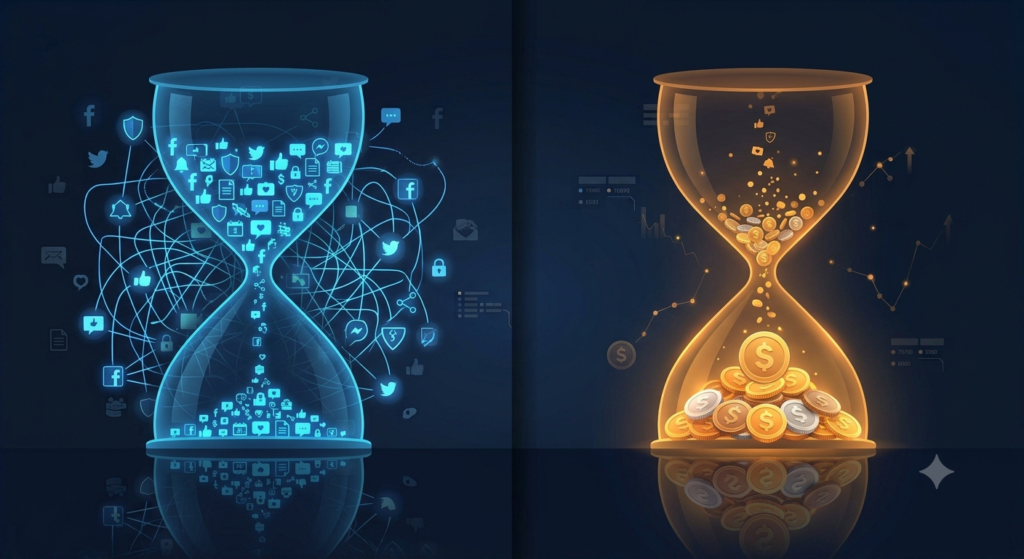
The invisible tax of distraction shows up in almost every part of a person’s financial life, usually without being named.
- Lower income. Distracted work takes longer and produces lower-quality output, which slows promotions, raises, and client growth.
- Missed opportunities. A distracted mind reacts late to good investments, good hires, and good decisions, arriving after the best window has closed.
- Poor investment choices. Fragmented attention leads to impulsive, headline-driven decisions instead of researched, long-term thinking.
- Skill stagnation. Learning a high-income skill requires sustained focus; without it, progress stalls indefinitely.
- Reduced creativity. Original ideas need uninterrupted mental space to form, which constant task-switching eliminates.
- Business failure. Founders who can’t protect their attention struggle to execute consistently enough to build something durable.
None of these costs appear instantly. They accumulate the same way compound interest does, except in reverse: small losses, repeated often enough, become a massive gap between where you are and where you could have been. This is the true anatomy of the invisible tax of distraction: not one dramatic loss, but thousands of small, unnoticed ones.
The Psychology Behind Distraction
Understanding why distraction feels so hard to resist starts with a look at how the brain processes reward.
Dopamine and instant gratification. Every notification, like, or new message triggers a small dopamine release. Your brain begins to crave that quick hit more than the slower, delayed reward of finishing meaningful work.
Habit loops. Behavioral psychology describes habits as a loop of cue, routine, and reward. A notification sound (cue) triggers checking your phone (routine), which delivers a small hit of novelty (reward). Repeat this enough times and it becomes nearly automatic.
Social media addiction. Platforms are explicitly designed using variable reward schedules, the same mechanism that makes slot machines compelling, to keep attention engaged as long as possible.
Decision fatigue. Every small choice, including whether to check your phone, draws from a limited daily reserve of mental energy. The more trivial decisions you make, the less energy remains for the important ones.
Context switching. Jumping between tasks forces your brain to reload context each time, which is measurably slower and more error-prone than sustained focus on one task.
Attention residue. As mentioned earlier, part of your attention stays attached to the previous task even after you’ve switched, reducing your effectiveness at the new one.
Understanding these mechanisms doesn’t eliminate their pull, but it does make it easier to recognize when they’re happening, which is the first real step toward reclaiming focus.
The Biggest Sources of Distraction in 2026
The tax of distraction is being collected from several directions simultaneously, often more than one at a time.
- Social media feeds designed to be endless
- Constant phone and app notifications
- Entertainment platforms optimized for binge-watching
- AI tool overwhelm from too many new apps to try
- Multitasking across browser tabs, chats, and tasks
- Information overload from news and newsletters
- Email inboxes treated as a to-do list
- Endless scrolling as a default idle behavior
- Busy work that feels productive but avoids the meaningful task
Most people are fighting several of these sources at once without realizing how much combined ground they’re losing.
Deep Work vs Shallow Work
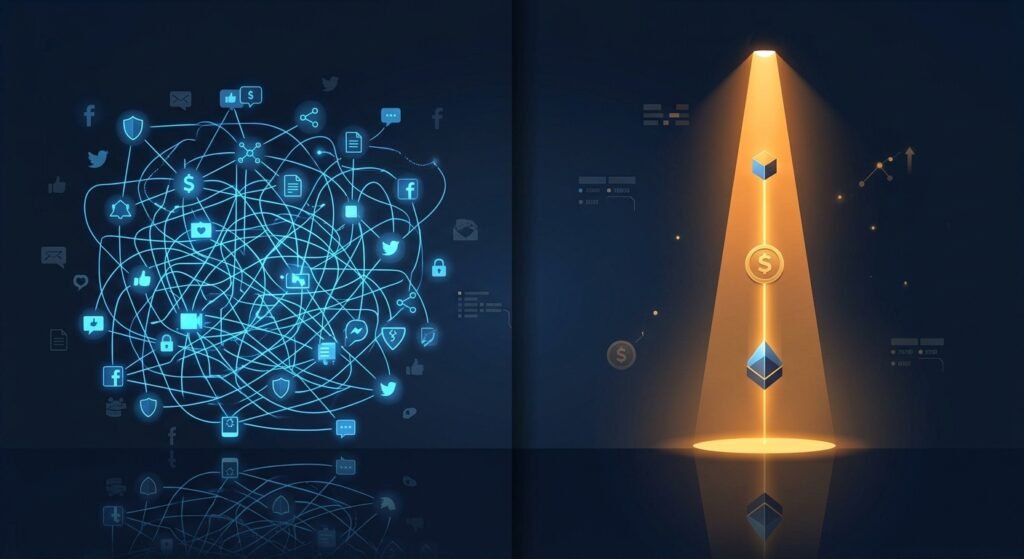
Cal Newport’s concept of deep work, cognitively demanding work performed without distraction, versus shallow work, low-value tasks performed while distracted, offers a useful lens for understanding where wealth is actually built.
| Factor | Deep Work | Shallow Work |
|---|---|---|
| Income potential | High — rare, valuable output | Low — easily replicated output |
| Learning speed | Fast, compounding skill growth | Slow, shallow retention |
| Productivity | High-quality output per hour | High activity, low output |
| Creativity | Original ideas and solutions | Repetitive, surface-level thinking |
| Wealth creation | Builds durable, valuable skills | Builds busywork, not value |
| Career growth | Promotions, recognition, leverage | Stagnation despite long hours |
| Business growth | Sustainable, differentiated offers | Reactive, inconsistent execution |
The pattern is consistent across careers, freelancing, and digital business: the people building real wealth are almost always the ones who protect blocks of deep, focused time, even if it means saying no to constant availability.
10 Practical Ways to Eliminate the Invisible Tax of Distraction
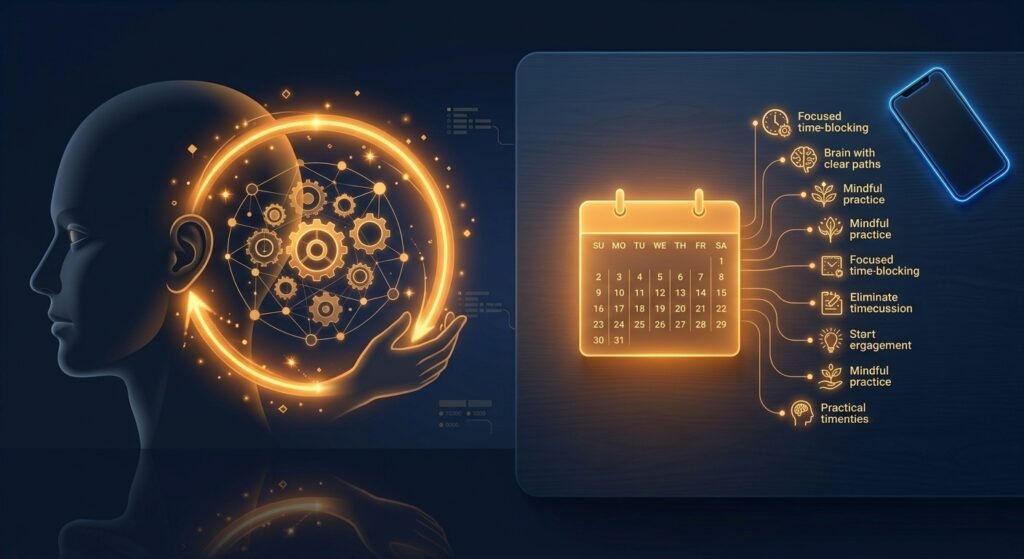
The invisible tax of distraction is reversible, and these ten habits are the most direct, practical way to reverse it starting today.
1. Schedule deep work blocks. Block 60–90 minutes on your calendar for a single task. Treat it like a client meeting you cannot reschedule. Action step: Block tomorrow’s first work hour right now.
2. Turn off non-essential notifications. Every notification is a request for your attention that you didn’t ask for. Action step: Go into your phone settings and disable notifications for every app except calls and messages.
3. Use the two-phone-rooms rule. Keep your phone in a different room during deep work sessions. Action step: Physically move your phone to another room before your next focus block.
4. Batch shallow tasks. Group emails, admin, and messages into two fixed windows per day instead of responding continuously. Action step: Pick a 10am and 4pm email window starting tomorrow.
5. Design your environment for focus. Remove visual and digital clutter from your workspace before starting. Action step: Close every browser tab that isn’t related to your current task.
6. Use a single-tasking rule. Commit to one task per work block, with no app-switching allowed. Action step: Write your one task at the top of a blank page before you begin.
7. Protect your mornings. Your willpower is highest earlier in the day; use it for your most valuable task, not email. Action step: Identify your single highest-value task and do it before checking any messages tomorrow.
8. Set a weekly focus goal. Track total deep work hours per week instead of tasks completed. Action step: Write down your target deep work hours for this week.
9. Build a shutdown ritual. End each workday with a two-minute review of what’s done and what’s next, so your mind can fully disengage. Action step: Write tomorrow’s top priority before closing your laptop tonight.
10. Audit your attention weekly. Once a week, review where your time actually went versus where you intended it to go. Action step: Spend five minutes this weekend comparing your calendar to your actual activity.
How Focus Creates Wealth Over Time
Focus compounds in the same way money does, and reversing the invisible tax of distraction works on that same compounding principle. A single focused hour produces a slightly better skill, a slightly better decision, or a slightly better piece of work. On its own, that hour looks unremarkable. Repeated consistently over months, it becomes a meaningfully higher income, a stronger business, and better investment judgment.
This is the same long-term thinking that underlies compound growth in investing: small, consistent inputs, protected from erosion, produce outsized results given enough time. Distraction is the erosion. Focus is the protection. Every hour you reclaim from the invisible tax of distraction is an hour reinvested into skills, decisions, and opportunities that build financial freedom.
Common Myths About Productivity and Focus
Myth: Multitasking makes you productive. In reality, switching between tasks reduces the quality and speed of both, and research on context switching consistently shows a measurable performance cost.
Myth: Being busy means being productive. Busyness measures activity, not value. A full calendar can still produce zero meaningful progress on what actually matters.
Myth: Motivation comes before action. Motivation typically follows action, not the other way around. Starting the task, even without motivation, is what generates the momentum to continue.
Myth: AI removes the need for focus. AI tools remove some execution friction, but they still require focused direction, review, and judgment to produce valuable output. Without focus, AI just accelerates distraction and low-quality work. In other words, AI doesn’t cancel the invisible tax of distraction; it simply raises the stakes for anyone who hasn’t dealt with it.
Frequently Asked Questions
What is the invisible tax of distraction?
The invisible tax of distraction is the hidden cost, measured in lost income, missed opportunities, and slower skill growth, caused by repeated interruptions to focused work. It’s called invisible because it never appears as a single expense; instead, it accumulates quietly through lower productivity, poorer decisions, and stalled progress over months and years. Most people underestimate this cost because each individual distraction feels harmless in isolation.
What is the invisible tax of distraction?
The invisible tax of distraction is the hidden cost, measured in lost income, missed opportunities, and slower skill growth, caused by repeated interruptions to focused work. It’s called invisible because it never appears as a single expense; instead, it accumulates quietly through lower productivity, poorer decisions, and stalled progress over months and years. Most people underestimate this cost because each individual distraction feels harmless in isolation.
How does distraction actually reduce income?
Distraction reduces income by slowing down the completion of valuable work, lowering its quality, and increasing the time needed to reach the same result. Over a career or business, this adds up to fewer completed projects, slower client turnover, and missed opportunities that better-focused competitors capture instead. This is the invisible tax of distraction operating in real time, one missed deadline and one lost client at a time.
Why is focus more valuable in the AI era?
AI has made execution faster for everyone, which means the differentiator between success and stagnation is no longer access to tools but the ability to direct sustained attention toward the right priorities. Focused people extract far more value from AI tools than distracted people using the same tools.
What is attention residue?
Attention residue is the portion of mental focus that remains attached to a previous task even after switching to a new one. It reduces performance on the new task and is one of the core reasons that frequent interruptions cost more time than the interruption itself appears to take.
How much time does context switching actually cost?
While the exact cost varies by task and individual, behavioral research consistently shows that switching between tasks reduces speed and increases errors compared to sustained, single-task focus. The cost is cumulative: frequent small switches throughout a day add up to a significant loss in total effective work time.
What’s the difference between deep work and shallow work?
Deep work is cognitively demanding work performed without distraction that produces high-value, hard-to-replicate output. Shallow work is low-value, easily replicated activity often performed while distracted, such as answering routine emails. Wealth-building skills and businesses are built primarily through deep work.
Is the invisible tax of distraction the same for everyone?
The invisible tax of distraction affects everyone who does knowledge work, but the size of the tax varies with job type, environment, and existing habits. A remote digital entrepreneur juggling multiple tools and platforms typically pays a higher invisible tax of distraction than someone in a highly structured role with fewer competing inputs, which is exactly why environment design matters so much.
Can digital entrepreneurs realistically avoid distraction?
Complete avoidance isn’t realistic, but meaningful reduction is achievable through structural changes such as scheduled deep work blocks, notification limits, and environment design. Entrepreneurs who build these systems consistently outperform those relying on willpower alone.
Conclusion
The invisible tax of distraction is one of the most expensive costs in modern financial life precisely because it never sends a bill. It arrives instead as a slower career, a stalled business, and opportunities that quietly passed by while attention was elsewhere. The good news is that this tax is entirely reversible. Every distraction you eliminate and every deep work block you protect is a direct reinvestment into your income, your skills, and your long-term financial freedom. Start with one focus block today, and let it compound from there — because treating the invisible tax of distraction as seriously as any other expense may be the smartest financial decision you make this year.